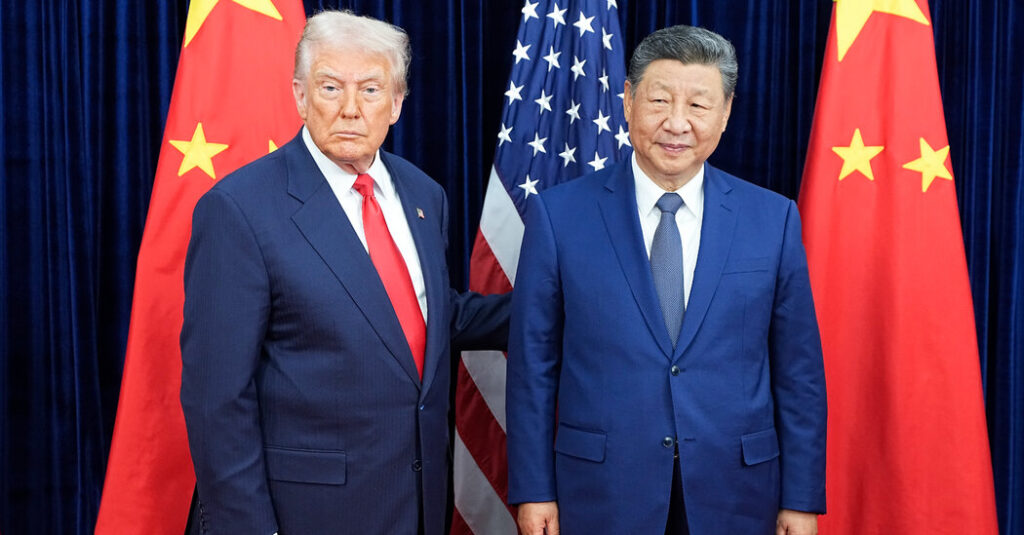
U.S. and Chinese officials are setting up a dialogue about artificial intelligence and a hotline to report national security risks from the technology. The United States is lodging criticisms with China over its companies’ copying American A.I. models. And a state dinner hosting China’s leader on Thursday is expected to be attended by some of America’s biggest A.I. and tech titans, including executives from OpenAI, Google and Nvidia.
A.I. is front and center as officials from the United States and China meet this week in New York and Washington. But with technological competition between the countries so intense, and little consensus within the United States about the path forward on A.I. regulation, experts do not expect much headway.
Concerns are mounting in the United States about potential threats from A.I., after warnings from A.I. researchers and incidents of A.I. agents escaping their training environments and hacking websites. Many U.S. officials worry that A.I. could enhance China’s ability to launch cyberattacks on the United States or crack military codes. Some believe the Trump administration should be doing more to limit China’s access to American chips and other A.I. technology.
But President Trump has taken a laissez faire approach. The only guardrails A.I. needs are a “strong and smart president,” he has said.
“Whoever wins AI, WINS! We are leading now over China, and everyone else, and I’m going to keep it that way!” Mr. Trump wrote on social media on Monday. “I’m not going to stifle Growth, of something that will be bigger than the Industrial Revolution, or the Internet, itself.”
Mr. Trump has opposed state regulation of A.I. And he has largely supported Nvidia’s selling the computer chips that fuel A.I. models abroad, relaxing restrictions the Biden administration set on providing the technology to China and other nations.
The administration has granted a limited number of licenses this year to Nvidia to sell its H200 chip to China. Nvidia and its supporters argue that not selling the chips creates an opportunity for Chinese companies like Huawei to master their own A.I. chip technology.
The Trump administration is also widely expected to extend a trade truce with China that includes an agreement to pause sanctions on thousands of Chinese companies.
Lawmakers are considering legislation that could impose tougher limits on the sale of chips and chip-making equipment to China, but it is unclear if the bills have enough votes to pass.
In a letter to Mr. Trump on Tuesday, Senator Elizabeth Warren, Democrat of Massachusetts, accused the president of accommodating the A.I. industry’s demands and said she was concerned he would double down on a “dangerous approach to artificial intelligence” in talks with Xi Jinping, the leader of China.
Ms. Warren said that Mr. Trump had used a previous meeting with Mr. Xi to advance the interests of tech leaders including Jensen Huang, Nvidia’s chief executive, who accompanied Mr. Trump on his trip to Beijing this year. She added that Mr. Huang would be called before Congress next year.
“The American people expect you to press President Xi about the risks of AI and work with China and countries around the world to set rules and regulations for this technology,” Ms. Warren wrote to Mr. Trump.
Scott Bessent, the Treasury secretary who plays a leading role in negotiating with China, has acknowledged the threat that A.I.-driven attacks might pose to U.S. stability and the financial system.
Speaking after a meeting with his Chinese counterparts on Sunday, Mr. Bessent said that the United States and China had discussed creating a notification system for national security issues related to A.I.
On CNBC on Monday, Mr. Bessent said that “the important thing was to start talking.” The sides agreed to meet on A.I. again, probably in two months in Shenzhen, and would consider “what the leading A.I. dangers are, whether it’s uncontrollable agents, whether it’s nonstate actors, and cyber nonstate actors in bioweapons,” he said.
Some experts praised the idea of more dialogue on A.I. between the countries.
“I think industry from both countries feels there’s a need to at least have some sort of A.I. governance conversation,” said Eric Zheng, the president of the American Chamber of Commerce in Shanghai.
But many analysts have said that talks are more likely to result in an exchange of definitions and principles than concrete actions. The U.S. government asks American companies to submit their most sophisticated A.I. models for government review, but it has not made a similar request about the type of open-source A.I. models developed by Chinese companies.
Aalok Mehta, an analyst at the Center for Strategic and International Studies, said that the United States and China had some common ground. Chinese policymakers had also been thinking about A.I. safety and considering more intervention to gain insight into A.I. labs.
But any A.I. talks will be complicated by the fact that neither country is likely to agree to anything that restrains their own competitive ability, Mr. Mehta said in a panel discussion in Washington last week. American officials have also accused Chinese companies of stealing A.I. technology through distillation, and considered ratcheting up export controls on semiconductors.
China feels the United States bears more responsibility in A.I., because it has the world’s most advanced models, Mr. Mehta said. That leaves “a very narrow set of issues that they can have productive conversations on,” he said.
Edgard D. Kagan, a senior adviser for the Center for Strategic and International Studies, said at the same event that fundamental distrust between the countries was likely to limit the information sharing that would be needed to have confidence that both sides were keeping their promises.
“China is deeply suspicious of anything that looks like it’s designed to lock in U.S. advantages,” he said, adding, “It will be very, very hard to come up with a mechanism that is anything more than symbolic right now.”
The post U.S. and China Balance A.I. Risks and Rivalry appeared first on New York Times.