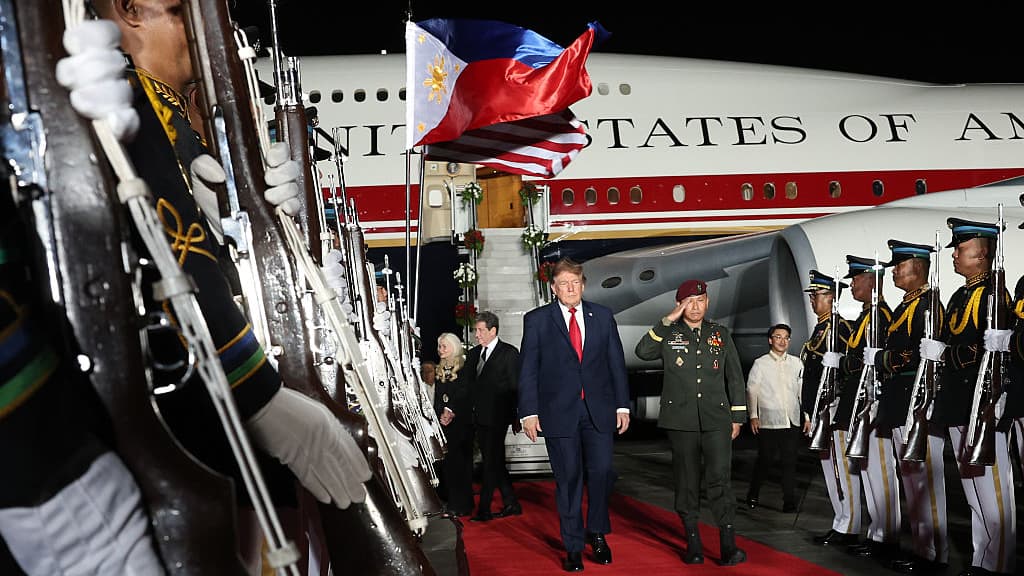
When Donald Trump landed in Manila on Tuesday for the first stop of his trip to Asia this week, the Philippine government rolled out the red carpet for the ally leader. But elsewhere in the Southeast Asian nation, the U.S. President’s welcome wasn’t so warm.
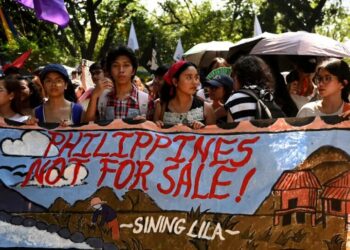
In the lead-up to Trump’s visit, activists, students, and members of the local indigenous community clashed with Philippine law enforcement in the capital, where the 2026 Association of Southeast Asian Nations (ASEAN) Summit is being hosted, and in Cebu. The demonstrations have repeated the demand: “Trump Out.”
Violence and commotion can be seen in videos and photos shared online by local journalists. On Sunday, more than 200 people were arrested.
The protests erupted as the Philippines opened the ASEAN Summit on Sunday and invited several world leaders to Manila. Civic groups have condemned the response from the Philippine police, which has insisted it exercised “maximum tolerance” and has done nothing wrong.
A spokesperson for Philippine President Ferdinand “Bongbong” Marcos Jr. urged protesters on Sunday not to tarnish the country’s image amid the regional summit. “We should be uniting right at this time,” the spokesperson said. “Let’s not mar the Philippines’ image with other nations.”
But the brutal crackdown on protesters has only urged more Filipinos to take to the streets, according to leaders of the protest movement, who estimated more than 10,000 would show up as the U.S. President landed in Manila. In response, police beefed up their security presence at one of the protest sites.
“We want the whole world to see the protests Filipinos have prepared,” civic group leader Raymond Palatino told a local radio station earlier Tuesday. “If Marcos has a red-carpet welcome for Trump, for us, it’s protests.”
The protests, however, are not necessarily representative of the Philippine population’s view of Trump. A Pew Research Survey conducted in February and March found that 68% of respondents in the country had confidence in Trump to do the right thing regarding world affairs—a greater share than those who had confidence in other world leaders, including France’s Emmanuel Macron, China’s Xi Jinping, and Russia’s Vladimir Putin.
How the AI revolution sparked protests
Protesters have decried Trump’s role in exacerbating conflict in the Middle East, which has pushed energy and general goods prices upward globally.
But at the heart of the Philippines protests is a U.S.-led initiative called Pax Silica, which draws from the Latin word pax for peace and aims to boost semiconductor and other supply chains to rival China’s growing AI and tech industry. Harkening to the “Pax Americana” period of relative peace post-World War II, the initiative, which was established in December 2025, has more than two dozen signatories, including the Philippines.
Each of the signatories is expected to bring something to the table. The U.S. recognizes that the Philippines has “significant” reserves of minerals necessary for these chains. A note published by the ASEAN Business Advisory Council said the Philippines is a “critical production hub” that specializes in chip assembly, testing, and packaging, with the semiconductor and electronics sector remaining “the most significant contributor to the Philippines’ export performance.” Government figures show these accounted for 59.3% of Philippine merchandise exports in 2025.
The Philippines’ participation would draw it into Washington’s AI arms race with Beijing, which Manila already has tensions with over disputes in the hotly contested South China Sea.
The Marcos Administration wants to transform the Philippines into a regional AI powerhouse, and Finance Secretary Frederick Go said in April that, by joining Pax Silica, the country ensures that its “mineral resources and strategic location are not simply supporting global industries from the margins, but are actively harnessed to build the industries of the future.” In a July national address, Marcos touted that the initiative will “bring quality jobs to our people, accelerate our industrial competitiveness, and revitalize our economy.”
Part of that initiative, however, is a plan to build an industrial hub covering an area greater than 3,000 football fields in New Clark City, north of Manila, which is close to the former U.S. Clark airbase. That land would also cover areas that generations of an Indigenous Aeta community have long inhabited as well as arable land that local farmers have long tilled. Human Rights Watch said Monday that the move threatens to displace these communities.
“What will happen to our ancestral land?” a member of the Aeta community told local news outlet ABS-CBN on Monday. “They will just send us away? Kick us out? What will happen to our community?”
Critics have also warned that building the hub threatens to consume the Philippines’ water, energy, and mineral resources—up to 90 million liters of water a day, based on officials’ estimates—and would stress the environment. This has fueled speculation that a data center is being built. The Philippines denied this, but a U.S. State Department spokesperson told the New York Times that it “will depend on a number of factors, including environmental and infrastructure studies still to come.”
A farmers’ activist group criticized the plan in April, saying that the Philippines “is opening up our mountains and ancestral lands for destructive mining and foreign industries, not for Filipinos.”
Philippine government happier to receive
Despite reinvigorated U.S.-Philippines ties since Marcos’ presidency, Trump has made his dislike of multilateral forums well known, and the ASEAN Summit has historically been criticized for its lack of effectiveness and purpose.
But the Philippine government appeared to make multiple accommodations for the U.S. President to visit, while on his way to the more significant Asia-Pacific Economic Cooperation (APEC) Economic Leaders Meeting in Shenzhen—where he is set to meet with Putin and Xi later in the week. Even though Trump would miss most of the ASEAN leaders’ summit by the time he arrived on Tuesday, he would have missed even more had the Philippines’ foreign affairs department not intervened. The department told local paper BusinessMirror that it revised the original schedule, which was supposed to open two days earlier, to make it more amenable to leaders expected to attend other major international gatherings.
Marcos is scheduled to receive Trump at the Philippine presidential palace on Wednesday, complete with a state banquet. Officials are also trying to wrangle a reunion between Trump and former Philippine First Lady Imelda Marcos, the current President’s 97-year-old mother. But that depends on whether doctors clear her to be fit.
Authorities in Manila conducted road clearing and clean-up operations ahead of the summit, though critics argue that this was “all for show” and is an attempt to conceal the urban poor living in the capital’s streets.
Marcos needs to woo Trump, Manila-based political analyst Cleve Arguelles, founder and CEO of public opinion research firm Momentum Research, tells TIME. Arguelles says that Marcos wants “to convince Trump personally that the Philippines is a valuable ally worth defending and investing in,” especially as the world becomes increasingly split between the U.S. and its adversaries.
Arguelles adds that pleasing Trump could also give Marcos a chance to improve his domestic political authority, which has flagged amid an ongoing feud with his Vice President Sara Duterte, as well as reframe his family’s controversial legacy.
“The Marcos family’s political rehabilitation has always had an international dimension, particularly given the role of the United States in facilitating the family’s departure from power in 1986,” Arguelles said. Marcos’ despotic father, who was the country’s former President from 1965 to 1986, was ousted by Filipinos in a popular revolt, and the U.S. helped their family leave the Philippines for Hawaii, where they lived in exile for a few years.
Trump’s visit to the Philippines would be the first during his second-term administration, and Arguelles says that alone is already significant: “We should not underestimate the symbolic importance of an American President being warmly received by a Marcos.”
The post Philippine Protests Grow as Government Welcomes Trump appeared first on TIME.