President Trump told reporters on Tuesday that his administration is reviewing a possible ban on U.S. exports of diesel to help lower fuel costs for farmers, truckers and businesses.
Some Republicans in Congress have been calling for a ban on exports as the cost of diesel has hit records because of global supply shortages that have resulted from the U.S.-Israeli war against Iran and the yearslong Russia-Ukraine conflict. The Iran war in particular, experts say, has driven much of the recent increase in diesel prices by reducing refining capacity.
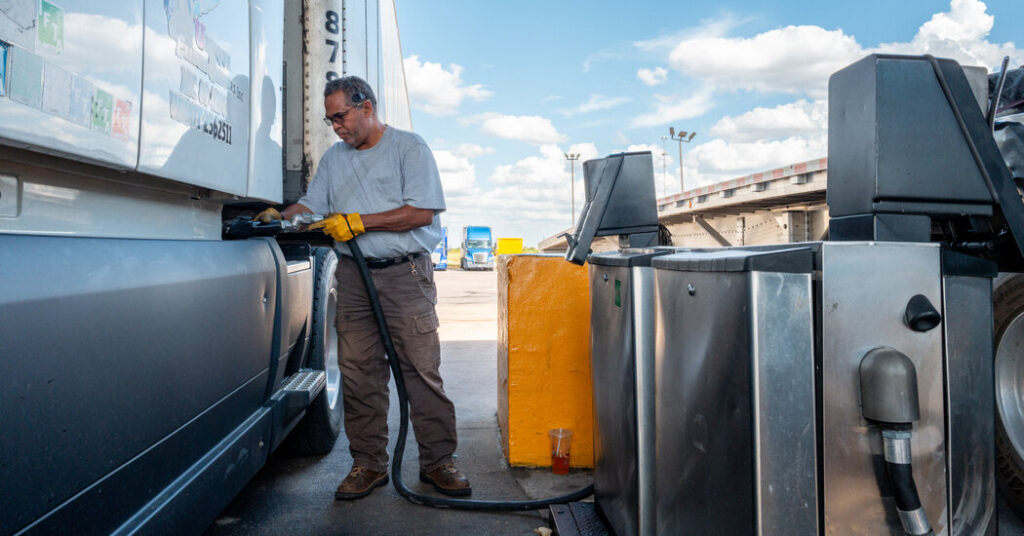
Diesel fuel powers trains and trucks as well as large machinery and farm equipment. The record high prices for diesel means consumers ultimately pay more for food and other products. According to AAA motor club, the nationwide average diesel price was $6.53 a gallon on Tuesday, up from $3.69 a gallon a year ago.
“I’ve called for it,” Mr. Trump said about a ban on diesel exports. “I’ve called for it within my people. I’ve been talking about it.”
Rising energy costs have become an enormous political headache for the president as he tries to convince voters to elect Republicans in the November elections. Recent polls have shown many of the party’s candidates, including those running in what have long been regarded as safe Republican seats, in tight races with Democrats or independents.
Global demand for diesel fuel led to record-high exports from the United States this year, topping 1.6 million barrels a day in recent weeks, according to the U.S. Energy Information Administration. Before the war started on Feb. 28, the country was exporting about 1.1 million barrels a day.
The E.I.A. this month said that it expected U.S. inventories of diesel to drop below 100 million barrels. Inventories reached a five-year low in 2025.
The American Petroleum Institute, which represents the country’s oil and natural gas industry, contends that a ban on U.S. exports of diesel would not bring relief to businesses and consumers. Instead, a ban would add to shortages by prompting U.S. refineries to reduce production, exacerbating the global shortage of the fuel.
The United States is currently the world’s largest supplier of diesel, providing about 20 percent of the eight million barrels of diesel traded by sea daily, the industry group said in a statement.
“Americans are hurting from rising diesel costs driven by an unprecedented disruption to global refining capacity,” Mike Sommers, president and chief executive at the petroleum institute, said in a statement. “We understand the administration is looking at every option to deliver relief, but restricting U.S. energy exports would only compound the problem.”
Jim Mitchell, director of oil trading analytics at the research firm Wood Mackenzie, said Mr. Trump could use emergency powers to at least temporarily ban diesel exports. But doing so might not result a big immediate reduction in the price of the fuel.
“There is no switch that can make diesel prices go down in a week,” Mr. Mitchell said.
The post Trump Says He Supports Banning Diesel Exports to Bring Down Prices appeared first on New York Times.