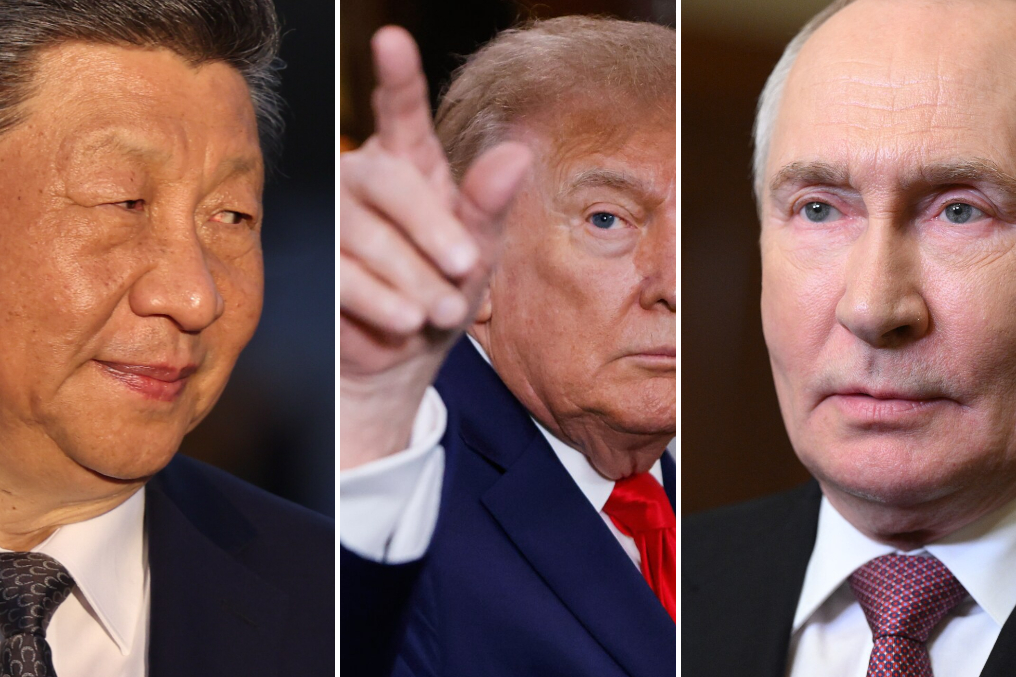
We seem to be living in the age of the autocrats, where Presidents Donald Trump, Xi Jinping and Vladimir Putin bestride the globe. The gathering this week of the U.N. General Assembly in New York seems a mere sideshow to the real power game at the Trump-Xi summit.
But appearances can be deceptive: This may be the twilight of the dictators’ era, not the dawn. The three global strongmen are aging — Trump is 80, and Xi and Putin are 73 — and all three are beset by speculation about their health. They rule decisively, but over fragmented countries. None has created a plan to sustain his legacy.
All three suffer from what might be called autocrats’ disease. In their arrogance, they make mistakes. Putin made a catastrophic blunder invading Ukraine in 2022, expecting a quick victory. Trump made a similar error attacking what he thought was a feeble Iran in February. They both sink deeper into the morass. Putin’s army has suffered 1.4 million dead and wounded. Trump’s war has cost some $43 billion and shattered his political base.
Truly powerful leaders don’t bluff. But there was Trump, once again, on Tuesday at the United Nations threatening to “annihilate” Iran if it doesn’t capitulate. There’s a phrase poker players use for someone who mistakenly believes he has an unbeatable strategy. They say he’s “on tilt.” That’s Trump.
Xi takes fewer military risks, so his errors aren’t so obvious — but they’re very real. Xi rules a system he doesn’t trust, which in turn doesn’t trust him. He has carried out a near-continuous military purge that has removed more than 100 senior officers since 2023. He has ousted five of the seven members of the Central Military Commission. Xi also seems wary of China’s technology elite, the jewel in his crown, levying a huge fine on Alibaba and sidelining its founder, Jack Ma, before rehabilitating him last year.
The autocratic moment was captured in February 2025, a month after Trump’s inauguration, by the late Alex Younger, former head of Britain’s MI6. His words seemed prescient.
“We are in a new era where, by and large, international relations aren’t going to be determined by rules and multilateral institutions. They’re going to be determined by strong men and deals,” Younger told a BBC interviewer. He likened the situation to the Yalta Conference in 1945, “where three strong men … decided the fate of small countries. I think that’s Donald Trump’s mindset, certainly Putin’s mindset, it’s Xi Jinping’s mindset. … That’s the world we’re going into.”
But that’s not quite the way it has turned out. The big countries’ attempts to impose their will have generally gone badly. The most obvious examples are the wars in Ukraine and Iran. The use of drones tipped the strategic balance in both of those conflicts. We learned that cheap drones, the weapons of the weak, can confound the mighty arsenals of the superpowers.
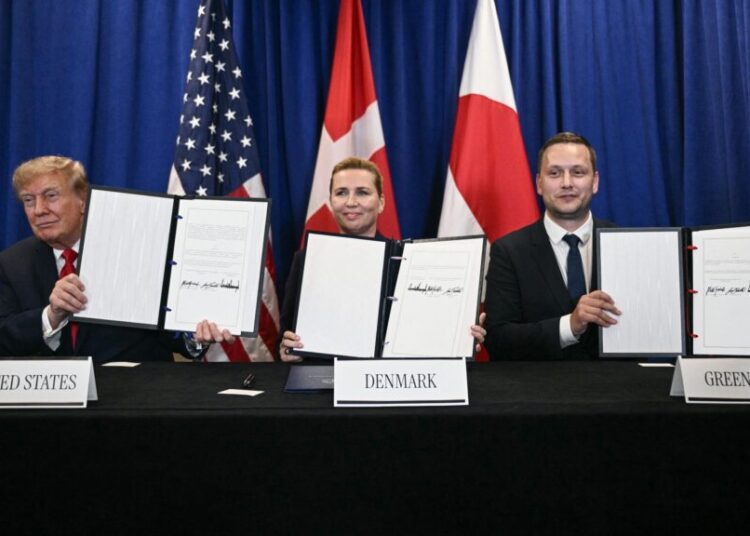
The autocrats’ paradigm that “might makes right” seemed unstoppable, until it wasn’t. The most instructive example was Trump’s egregious threat last year to invade Greenland unless Denmark ceded sovereignty. But that power grab helped galvanize European resistance to Trump in January in Davos. Trump had to retreat, and his final capitulation came this week with a plan to build an Arctic base to enhance the U.S. military presence in Greenland under an updated 1951 treaty. That’s essentially the compromise that Denmark was floating a year ago.
Xi has also had problems trying to intimidate his neighbors. China battered Japanese Prime Minister Sanae Takaichi after she indicated Japan might respond militarily to a Chinese assault on Taiwan — but she held her ground. So did Philippine President Ferdinand Marcos Jr. when he defied Chinese threats in the South China Sea.
The aging autocrats have a final problem. “Father Time always wins,” as 96-year-old super-tycoon Warren Buffett put it last week in announcing his retirement as chairman of Berkshire Hathaway.
Trump, at 80, shows his age. Putin, once the bare-chested hyper-athlete, has slowed, too, and an analyst wrote last year that he was “in denial of his advanced age.” And after Xi missed a banquet in New Delhi this month because of illness, the Wall Street Journal cited (without supporting evidence) a former CIA analyst’s assessment that Xi was “a lifelong smoker, overweight, no fan of exercise — and a man long fond of a drink.”
If I’m right that it’s twilight for the autocrats, then whose time is dawning? There’s no easy answer. To be sure, Trump, Xi and Putin could remain dominant for years, and the aftershocks of their time in power will rumble long after they’re gone. But it’s striking that all three seem allergic to succession plans. Trump preens atop a splintering MAGA coalition. Putin’s potential successors, as described by The Post’s Mary Ilyushina, seem a collection of nonentities. Xi, meanwhile, actively resists a return of the collective leadership that preceded him.
The rising stars today are the “middle powers” who are filling the space the autocrats seem unable to control. Most notable is Canada’s Prime Minister Mark Carney, who led the rebellion against Trump’s tariff war. His speech at Davos is a defining document of what I hope will be the post-autocrat era. “We are in the midst of a rupture, not a transition,” he said. “When the rules no longer protect you, you must protect yourself.” He has stuck by that vow ever since.
Thinking about the future, we should recognize that although Xi may be a wasting asset, China isn’t. Xi was right when he welcomed Trump to Beijing in May with a vision of a rising China: “Transformation not seen in a century is accelerating across the globe, and the international situation is fluid and turbulent. The world has come to a new crossroads.”
We can see the hubris in all three leaders as they struggle to dominate a world in transition. They’re superpowers that can’t win wars; dominant economies burdened by debt and corruption. Most of all, they face the unknowable challenges of transformational AI technology.
Wise leaders view the future with humility — and a recognition that even with vast power, they can’t steer events. We’re stuck with the autocratic leaders we’ve got. But not forever.
The post The autocrats may seem immovable. But their time is passing. appeared first on Washington Post.