As the United Nations searches for its next leader, diplomats say there are key qualities they would like to see in the next secretary general. They seek someone who proactively puts the U.N. at the center of resolving global conflicts and enforces cost-cutting and reform.
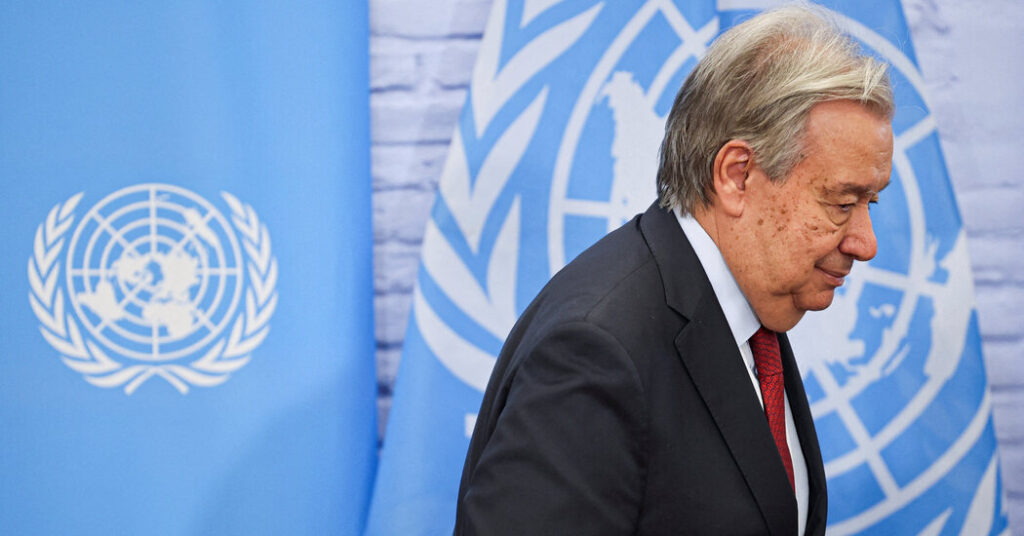
The topic of who will succeed António Guterres when he steps down in December is expected to be hotly debated this week behind closed doors in diplomatic meetings during the annual U.N. General Assembly in New York. The conversations “will drive a lot of the candidates’ fortunes and separate contenders from pretenders,” said Daniel Forti, the head of U.N. affairs at the International Crisis Group.
Here’s what else you need to know:
A monthslong selection
The U.N. Security Council selects the secretary general in a monthslong process that begins with an informal, nonbinding and closed “straw poll,” or informal ballots. The 15 members of the Council vote for the candidates.
They say whether candidates are “encouraged” or “discouraged,” or “no opinion is expressed.”
The last straw poll was conducted on Sept. 18, and although the results are meant to be confidential, they have leaked to the news media.
Once the Council agrees on a single nominee, it will pass a resolution and recommend the person to the General Assembly, which will take up a procedural vote. The nominee has to have nine votes in favor and no vetoes by the Security Council’s five permanent members — the United States, France, Britain, Russia and China — to get the job.
Secret straw polls
Eight candidates were whittled to seven after Michelle Bachelet dropped out of the race on Friday because of low polling numbers.
Ms. Bachelet, 75, the former two-time president of Chile, had also served as the U.N. high commissioner for human rights and as the executive director of U.N. Women, an organization focused on women’s rights. She had one encouraged vote, 11 discouraged votes and three votes of no opinion.
So far, no clear front-runner has emerged, according to diplomats and leaked results of three secret straw polls held by the Security Council. Mr. Forti said more contenders were likely to join the race or drop out ahead of the Council’s final recommendation.
In previous selections of the secretary general, by this time at least one or two front-runners had emerged, diplomats say. The results of the straw polls have been so inconclusive that, for the first time, Mr. Forti said, diplomats and U.N. officials are openly wondering what will happen if the Council does not settle on a candidate.
Mr. Guterres, 77, a former prime minister of Portugal who also led the U.N.’s refugee agency, has held the post of secretary general since 2017 and served two terms. He has indicated that he is not interested in remaining in an interim role and plans to be in his native Portugal come the beginning of next year, said his spokesman, Stéphane Dujarric.
A successor to Mr. Guterres has to be chosen before Dec. 31, after which the person would take the helm of the U.N. on Jan. 1, 2027.
U.S. and Russia signal displeasure
Diplomats and a senior U.N. official said that Russia had indicated it would veto one candidate, Rafael Grossi, the leader of the U.N.’s atomic watchdog, because it was not pleased with how he had handled the standoff between Russia and Ukraine over the Zaporizhzhia nuclear plant.
The United States had also indicated it would block Ms. Bachelet over her positions on abortion. It also opposes Carolyn Rodrigues-Birkett, Guyana’s ambassador to the U.N., for calling Israel’s conduct in Gaza a genocide.
The U.N. typically rotates the office of the secretary general from one of its five recognized regions. And because the past three leaders have been from Africa, Asia and Western Europe, it is expected that the new secretary general will originate from Latin America or the Caribbean.
A female secretary general would also be a first in the organization’s 81-year history.
The candidates and their polling ranks
-
Rebeca Grynspan, 70. The economist and former vice president of Costa Rica currently leads the U.N. Conference on Trade and Development. She stepped away from her duties to avoid a conflict of interest while she campaigns for the top U.N. job. Ms. Grynspan gained a narrow edge in the most recent straw poll, with nine encouraged votes, five discouraged votes and one no-opinion ballot.
-
Ms. Rodrigues-Birkett, 53. Guyana’s former foreign minister has served as the South American country’s ambassador to the United Nations since 2020. As a former member of the Security Council, She has U.N. leadership experience. She received eight encouraged votes and six discouraged votes, and one person voted no opinion.
-
Olara Otunnu, 75. The Ugandan politician and diplomat served as an under secretary general at the U.N. in the administration of Secretary General Kofi Annan. Mr. Otunnu is the oldest candidate in the race. He served as Uganda’s ambassador to the U.N. in the 1980s and was his country’s foreign minister from 1985 to 1986. He received five encouraged votes, seven discouraged votes and three ballots with no opinion.
-
Mr. Grossi, 65. An Argentine career diplomat, he leads the International Atomic Energy Agency, the U.N.’s atomic watchdog. For the past six years, Mr. Grossi has played a prominent role in two notable nuclear crises: the standoff with Iran over its nuclear program and the threats to the Zaporizhzhia nuclear plant in Ukraine after the Russian full-scale invasion. He had five encouraged votes, eight votes of discouraged and two votes signaling no opinion.
-
Macky Sall, 64. A prominent politician from Senegal, he served as the country’s president from 2012 to 2024. He was also its prime minister and president of the National Assembly. He had five encouraged votes, nine discouraged and one no-opinion vote.
-
María Fernanda Espinosa, 62. She was the foreign minister and defense minister of Ecuador. She also has a range of experience with the U.N., serving as Ecuador’s ambassador to the body and president of the General Assembly. She is the executive director of GWL Voices, a nonprofit organization that works on gender equality, and has been an adviser to the U.N. on climate change, biodiversity and the rights of Indigenous people. She had three encouraged votes, six discouraged votes and six votes of no opinion.
-
Ivonne Baki, 75. An Ecuadorean politician and diplomat, she was the minister of industries and productivity and the president of Parliament. She was her country’s first female ambassador to the United States and was ambassador to France and Qatar. She had zero encouraged votes, 10 discouraged ones and five votes of no opinion.
The post The U.N. Is Searching for Its Next Leader appeared first on New York Times.