This essay is part of “The New World Disorder,” a series exploring the disintegration of the postwar international system and how countries are adjusting as America steps aside.
Each month, tens of thousands of tourists arriving from the United States descend over the green mountains of Costa Rica to touch down at Juan Santamaría International Airport outside San José. They shuffle through immigration and then past images of sloths hawking 5G SIM cards, toucans selling rum distilled with renewable energy and someone doing yoga at sunset. Costa Rica is the happiest country in Latin America, a sign at baggage claim tells them. “Pure life,” the unofficial national motto goes: “Pura vida!”
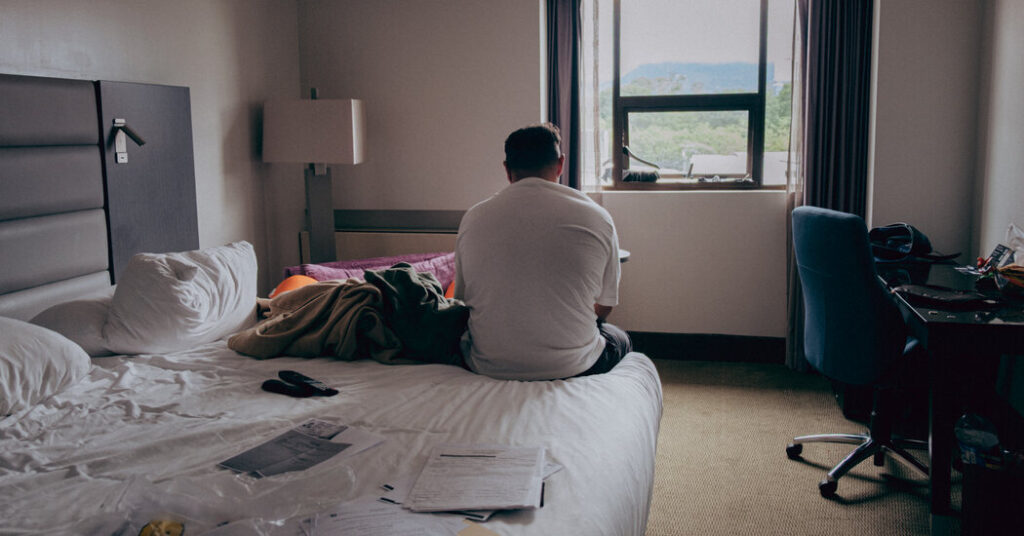
Then, every week or so, another kind of flight lands, carrying men, women and sometimes children deported from the United States. Some arrive with their wrists and ankles in restraints. Many didn’t know where they were going until they boarded the plane. They aren’t here for the toucans or the yoga. They are shuttled to hotels, where they face a few options, none of them necessarily good: Go back to the place you left, find another way to leave, or stay — which, for many, means no family, no job and no idea what to do next.
Since the beginning of last year, the U.S. government has sent more than 600 men, women and children from dozens of countries to this tiny Central American nation where they have few or no ties. It is one data point in a much bigger effort: So far, the second Trump administration has deported over 25,000 migrants to 29 so-called “third countries” under different legal mechanisms, according to Refugees International and Human Rights First, two groups tracking the policy. Many came to the United States seeking safety, or had already been granted protection in U.S. courts.
The Trump administration is not the first government to send migrants to other nations, but it has supercharged the practice like no other before it. Deals with countries willing to take noncitizens have been inked in Europe, Asia, Africa, Latin America and the Caribbean, despite some having records of human rights abuses. The European Union is also dabbling in the strategy, as is Australia. The receiving nations agree to take deportees for a variety of reasons: direct payments, trade pressure or sometimes, it seems, simply because a more powerful partner asked.
The proliferation of these arrangements is undermining an idea that has been a bedrock of international law for the past 75 years. After World War II displaced millions of people, the international community came up with a new legal status — refugee — and a set of rights for this growing population. Under the 1951 Refugee Convention and its 1967 protocol, most nations pledged not to send people fleeing danger back to jeopardy. They called not just for the right of refugees to live in physical safety, but the right to build a full, new life. The system was at the core of the 20th century’s humanitarian agenda. It created stability in a fragile political moment and was an economic boon for wealthy countries that took people in.
The United States helped lead this charge and has granted protection to some four million asylum seekers and refugees since 1980. Now, as the Trump administration seeks to stop the “invasion” it declared at America’s borders and end “the era of mass migration,” the number of refugees admitted and people granted asylum has plummeted. A raft of new policies — including sending people to third countries, a practice facing serious legal challenges in the United States and in receiving countries — is not only shrinking the space for those seeking safety in the United States. It’s threatening the entire notion of global protection.
It is part of the broader disintegration of the international order that has glued the world together since 1945. In its place, something new is taking shape — a system that is more transactional, more arbitrary and crueler, and one in which, more and more, everyone is on their own.
On Sept. 14 at 6 p.m., Costa Ricans gather to sing their national anthem and mark the country’s independence from Spain. Inside one hotel lobby in San José, a small crowd managed a subdued rendition. Toward the back, a few hotel guests recently deported from America looked on, holding up their phones.
The next morning, on the patio over breakfast, I met Mónica Yadira Sánchez de la Rosa, a 35-year-old from Reynosa, Mexico, who arrived in August. Ms. Sánchez had been living in McAllen, Texas, since 2024, when she and her three young children fled her abusive husband, and crossed the U.S. border to claim asylum.
In Mexico, some 10 women are killed every day by their partners or family. But claiming asylum for domestic violence isn’t easy, and Ms. Sánchez couldn’t afford an attorney. As her case wound through the immigration system, her children started school, and she found some under-the-table work. By the time of her latest court hearing in June, she was too scared of ICE agents to attend, and she was ordered to leave the country. Not long after, during a traffic stop, she was arrested, detained and deported within days to Costa Rica while her children were at home, waiting.
For Ms. Sánchez, there wasn’t a question of what she would do next. Her kids, who were about to start the school year in Texas, returned to Reynosa after she was deported, and when we met, she was preparing to take a flight home. She said if her husband threatened her again, she was ready to go to the police — even though, she added, “I talked to them before and they wouldn’t listen to me.”
Costa Rica has become one of the biggest recipients of third-country nationals from the United States. People are sent here under different circumstances: Some are economic migrants who crossed into America without authorization and were quickly deported. Others are asylum seekers who were denied the chance to seek asylum at the border, or, like Ms. Sánchez, deported after they’d been living in the United States for years. Once in Costa Rica, they are interviewed by the International Organization for Migration, a U.N. agency. If they want to go home, and I.O.M. deems it safe for them to do so, they can enter the agency’s Assisted Voluntary Return program. The services the agency is providing in Costa Rica — return flights, hotels, food, clothing, medical care — are paid for by the United States.
Then there are those who can’t go home. They can try to leave Costa Rica on their own, apply for refugee status there or stay and work for up to a year on a temporary humanitarian permit, receiving I.O.M. support. The U.S. government is helping pay for that, too.
Over two hundred people sent to Costa Rica this year have not returned to their home countries, according to official statistics. As of July, the government said only a handful had formally applied for asylum. Those who do face a long wait: There are nearly 200,000 pending applications in Costa Rica’s overstretched system, which its Office of the Comptroller General warned in 2024 was at risk of collapse.
The Costa Rican government is clear that integrating U.S. deportees into the country, while an option, is not its primary objective. Costa Rica has created a model to ensure “people have enough time to decide to return to their countries of origin voluntarily,” said Omer Badilla, the head of its migration authority. “We adopted it to avoid any negative criticism suggesting we were rushing people.”
The people I talked to in Costa Rica who said they were scared to go home — men and women from Nigeria, Azerbaijan, China, Colombia, Brazil, the Democratic Republic of Congo, Cameroon — were confused, frustrated or openly angry. They said they weren’t getting enough information from I.O.M. or the government about what to do next, such as how to apply for asylum, find work or do practical things like set up a bank account. In August, the government temporarily suspended approved visits to the hotels from lawyers and migrants’ rights advocates, saying some of the migrants were uncomfortable with the process.
Of the places where third-country nationals are being sent, Costa Rica is one of the “least bad options,” said Yael Schacher, director for the Americas and Europe at Refugees International. Some people who have been sent to third countries have been beaten, indefinitely detained or forced back to the places they had fled. But even states that don’t send people into danger can create conditions that coerce them into returning home.
“You’re basically put in a situation where you have no good choices,” Ms. Schacher said. “They’re not forcing anybody to go home, but they’re making it very, very difficult for people to do anything else.”
The government said under no circumstances will people be forced back home in breach of international law, and that migrants are informed about all their immigration options. When I asked Mr. Badilla, the migration chief, about migrants’ concerns, he said he was “shocked,” and that the government was safeguarding their rights and getting them all the information they needed from the time they arrived.
Of course, Mr. Badilla said, it’s not the government’s responsibility to do everything. “Let me put it this way,” he added, jokingly: “If they want information about going to a beach in Costa Rica — well, our institutional protocols probably aren’t designed to tell them to go to a beach in Costa Rica.”
During my visits to different hotels around San José, no one I met looked like they were planning a beach trip. People walked the halls to pass time, napped on couches in the lobby or sat and talked to people back home, trying to figure out what to do. A hotel band played Harry Styles and R.E.M. covers, chattering delegates from conferences passed through, and all the time the migrants’ desperation was building.
I talked to a man from Colombia who said he fled with his wife after he reported the illegal activities of a local paramilitary group to authorities, and was told by militants he had 72 hours to leave the country. (He asked that his name not be used in the story, out of fear.) After a terrifying journey through Mexico, where the couple were held in an abandoned house by armed men for two weeks, they crossed the border. They were detained, and, despite asking to speak to a judge, were eventually put on a plane and told they were being sent back to Colombia.
“We were shackled on our hands, feet and waist,” the man recalled. “I kept telling officials I needed to meet with a judge, because if I’m sent back to my country, I wouldn’t last for more than two hours.” He didn’t know he was going to Costa Rica until they landed, he said. At first, he was relieved; Costa Rican officials were welcoming. The feeling didn’t last. He can’t find enough work to support his family back home, and he has nowhere else to go.
I asked him how the experience had changed the way he felt about the United States. He thought it was still a good country. Then he brought up a news story he’d read earlier in the day, about another Colombian migrant in Maine who was shot and killed by a U.S. immigration agent.
It reminded him of something one of his captors in Mexico said to him: Sometimes the Devil isn’t so bad, and sometimes God isn’t so good.
This summer, the 1951 Refugee Convention turned 75. When the United States and other countries signed on to either the convention or its 1967 protocol, they pledged not to send asylum seekers back to the place where their life or freedom was in danger.
As the 20th century wore on, wealthy nations started looking for legal avenues to keep migrants, including asylum seekers, out. In the early 1990s, as thousands of Haitians fled a violent military coup, the U.S. Coast Guard began intercepting boats and sending people to the U.S. naval base in Guantánamo Bay to screen their asylum claims. In 2001, Australia introduced its Pacific Solution, in which migrants were sent to the island nations of Nauru and Papua New Guinea to have their claims heard. In the late 2000s, Italian Coast Guard ships began turning around boats arriving from Africa. When a European court found this to be in violation of international law, Europe tried working with African governments to prevent people from making the journey in the first place.
Until recently, sending people to countries they had no connection to was relatively rare in the United States. Now it has become a key plank of the Trump administration’s deportation agenda. The second administration has signed agreements with at least 35 countries, according to Refugees International.
In Europe, Austria, Denmark, Germany, Greece and the Netherlands have been working together to create the euphemistically named “return hubs” for rejected asylum seekers. Among the destinations reportedly under consideration are Rwanda and Uganda, as well as Uzbekistan, Tunisia, Libya, Egypt, Ethiopia, Mauritania and Kazakhstan, according to Human Rights Watch. Last year, Australia once again started sending some migrants to Nauru.
All of these countries are “signaling to each other a willingness to abandon some of the most significant norms of international law to have crystallized in the wake of the Second World War,” said Ian M. Kysel, a clinical professor of law at Cornell Law School and a visiting scholar at Stanford Law School.
A State Department official, Andrew Veprek, said earlier this year in an interview with Mark Krikorian of the Center for Immigration Studies that dealing with asylum seekers is a “global burden.”
“If there are countries that are willing to help share in that burden — want to cooperate with us — then we’re quite happy to talk with them about it,” Mr. Veprek said.
The Trump administration has told its partners that migrants should not be forced home or sent to further danger. It happens anyway.
This summer, I spoke on the phone to a Ghanaian man who was in hiding in Togo. After being assaulted multiple times both by police and by local gangs because he is gay, the man left Ghana, where homosexuality is illegal. He traveled through the Darién Gap and crossed into the United States, where, eventually, an immigration judge granted him a legal protection called “withholding of removal,” which has historically allowed a noncitizen who is not granted asylum but meets the definition of a refugee to remain in the United States if he or she faces danger back home. He was never released from detention, and a little less than a year later, he was restrained and put on what appeared to him to be a small private jet with other migrants. Without being told where it was going until shortly before landing, he was flown to Equatorial Guinea.
He is one of dozens of third-country nationals deported in an agreement with Equatorial Guinea, which received $7.5 million from the Trump administration. Once there, the man was not given the option to seek asylum, he said. Instead, after he’d spent a month or so in a hotel, officials escorted him to an airport and put him on another plane, this time back to Ghana. He hid for a few days with help from a family friend, then fled to Togo, where he has been living for more than eight months.
The legal circumstances of the people the United States is sending to third countries — like the conditions they encounter — vary widely. Many, like the man in Togo, have been granted legal protection in U.S. courts that prevents them from being sent to their countries of origin. Though the law permits them to be deported to a third country, deportations have been taking place without giving migrants sufficient notice or the chance to say if they are fearful of the destination. A federal appeals court ruled on Sept. 18 that the way the government was conducting the deportations was unlawful; the administration is expected to appeal.
Other migrants are being sent to third countries in different ways, including after trying to claim asylum at the U.S. border, like many of the people I met in Costa Rica. The Trump administration shut down asylum access at the border last year, an order also found to be unlawful by a federal appeals court. The Trump administration has asked the Supreme Court to hear the case.
“It’s one thing to say the asylum system should be revised,” said Lee Gelernt, an A.C.L.U. attorney who has argued the case challenging the Trump administration asylum ban. “It’s a whole other thing to eliminate it entirely.”
The administration says its policies are legal and remain in effect. “The Trump administration is utilizing all lawful options to carry out the largest deportation operation in history, just as President Trump promised,” a Department of Homeland Security spokesperson said in an email. “Every illegal alien with a final order of removal has received full due process.” The State Department did not respond to requests for comment.
Ms. Schacher says the focus on third-country removals reflects “the Trump administration’s desire to completely decimate the United States as a country for refugees, decimate adherence to the Refugee Convention and decimate the humanitarian architecture that was created after World War II.”
“It’s not just they’ve abdicated responsibility,” she said. “They’re actively subverting the old system and trying to bring the entire world with them.”
The Trump administration has been open about the fact that it wants to change how the world thinks about these protections. Mr. Veprek of the State Department said in the Center for Immigration Studies interview that the administration was in discussions with other nations about altering the international asylum and refugee system, including making refugee status temporary. (Mr. Veprek declined to be interviewed for this essay.)
“What is refuge, really?” said Mr. Veprek. When asked if the Trump administration would consider pulling out of the 1967 protocol, he didn’t dismiss the idea outright.
It takes hours to drive from the clogged streets of downtown San José to the mountain town of Monteverde. A narrow road of hairpin bends empties into a picturesque enclave where mist from the nearby cloud forest drifts over the streets. There is a preponderance of butterflies and coffee shops catering to foreign tourists. A “pura vida” sign hangs in a shop window, softly emitting the national ethos of easygoing optimism in pink neon.
In recent years, Costa Rica’s pura vida vibes have been overlaid with something new. Regional drug cartels settled in, crime rose, unemployment spiked, and Costa Ricans increasingly blamed migrants, especially the hundreds of thousands of Nicaraguans who fled south as their own country’s rule of law collapsed.
In 2022, Costa Ricans elected President Rodrigo Chaves, a populist who channeled the draconian but statistically effective model of President Nayib Bukele of El Salvador to reduce crime. When President Trump returned to office in 2025, he found a like-minded partner in Costa Rica, which was spurred to cooperate because U.S. trade props up its economy.
Weeks after Mr. Trump’s inauguration, two planes carrying 200 third-country nationals, including 81 children, landed at the airport near San José from the United States. They were loaded onto buses and driven to a former pencil factory turned migrant shelter near the Panama border, known as the Temporary Attention Center for Migrants, or CATEM.
German Smirnov was one of the people on those planes. A former election worker in St. Petersburg, Russia, Mr. Smirnov fled his home country after authorities discovered video on his phone that he had taken allegedly showing electoral fraud at a polling station. After police started looking for him, he decided to go with his wife and son to America, arriving in Mexico in the Biden administration’s last year.
On Mr. Trump’s first day in office, their asylum appointment was canceled. The family decided to cross the border by car anyway. They were immediately detained. Mr. Smirnov said he tried repeatedly to ask for his asylum claims to be heard, but says they never were. After being in detention for a little over a month, Mr. Smirnov, his wife and his son were put on a plane to Costa Rica and taken to CATEM. He recalls seeing the lights alongside the road and thinking maybe things wouldn’t be so bad.
But the conditions were “so bad,” Mr. Smirnov recalled. As we talked, he pulled up photo after photo: of his son, kneeling on the floor, drawing, next to a bunk bed of plastic-covered mattresses; of kids trying to cool off in a makeshift tub in the extreme heat; of somebody asleep by a bird’s nest fallen from the rafters. Over the months he was there, Mr. Smirnov became a kind of spokesman for the detainees and started to sneak out through a hole in the fence surrounding the facility to give interviews. The reports that emerged alerted civil society groups and local opposition politicians to the conditions at CATEM, including the number of children there and that people were not initially free to leave.
Costa Rica’s highest court later ruled that the government was violating a long list of migrants’ rights. The government began to issue “humanitarian permits” that would allow deportees to stay in the country temporarily. (Mr. Badilla said he respected but did not agree with the ruling and denied that people were being forcibly detained.)
The bad press and court cases didn’t dissuade the Costa Rican government from making a second deal with Washington in March 2026, in which it agreed to take up to 25 deportees per week. Under this agreement, 22 flights have arrived so far, carrying 460 men, women and children of over 30 nationalities. Mr. Badilla, the immigration chief, said in both agreements the United States has paid for most of the process. Washington has also separately helped fund Costa Rica’s own deportation flights to other countries in Latin America.
Natasha Pérez Tümmler, a lawyer who handles the Americas at the Global Strategic Litigation Council, an international coalition of lawyers and advocates, is helping Mr. Smirnov and others seek compensation for their treatment at CATEM, which the court ruled the state should pay. Overall, the government’s handling of the deportees from the United States has been disorganized, Ms. Pérez said: “There doesn’t seem to be a plan. There doesn’t seem to be a strategy.”
Mr. Badilla acknowledged it has been a learning process, but said the government has protected the migrants’ rights and offered them appropriate care. “I’m not justifying the U.S. government’s actions,” he said. “But it’s no secret to anyone that the United States is Costa Rica’s main strategic partner and ally — not only in terms of migration, but also in social, political and security matters.”
The I.O.M. has also come under scrutiny for agreeing to assist deportees in third countries like Costa Rica, thus enabling the Trump administration’s agenda, critics say. Would governments like Costa Rica sign on for this if I.O.M. were not available to help?
The agency challenges this idea. “I.O.M. stepping back would not stop these removals,” the agency said in a statement released last week defending its work in third countries. “Those who argue we should withhold basic assistance to make a policy point are asking I.O.M. to ignore the ordeal faced by extremely vulnerable individuals. We will not do that.”
All of the calculations and adjustments being made as the United States charts a new course through history are laying the foundation for a new normal. Some will try to hold on to the humanitarian impulse that most of the world coalesced around last century; others will choose to go with the flow.
I asked a young man from Azerbaijan, who said he was deported after trying to claim asylum at the U.S. border, if he would try to stay. He stared out a window for a few moments, as if trying to wrap his head around the idea of living his whole life in the country he saw out there, before typing his answer into a translation app: “I don’t know anyone here. I don’t have any family here. I don’t think I can live alone here.”
It didn’t feel like a good beginning.
Most people sent to CATEM have now left Costa Rica. The Trump administration paid for many to return to their home countries or other third countries; others have tried to make the journey back across the U.S. border.
I met Mr. Smirnov and his family exactly a year after a bus dropped them off in Monteverde. For a long time, Mr. Smirnov said, he wanted to go back to the United States. He speaks English well, has friends in America and feels he could have built a life there. Now he and his family, seeing no other choice, are planning to apply for asylum in Costa Rica: “My destiny right now is connected to this place.”
Sitting in a small apartment above a dentist’s office, Mr. Smirnov seemed focused on trying to let go of what he’s lost — not just the physical reality and comforts of his life in Russia, but his sense of justice, his belief in America and the expectation that he can have control over his own life.
“I go to my job. I’m tired. I go home. I sleep. I go to my job. I get some free time. I play my video games,” he said. “I don’t plan a lot.”
His family has a safe place to live, and his son is in school. But he has panic attacks. He worries about what will happen next — if financial support from a Quaker community in Monteverde will end, if his work will run out, if his family will lose this apartment, if they won’t have money to buy food.
If his fear of the past is gone, a fear for the future has taken its place. For Mr. Smirnov, and hundreds of people who have arrived since him, the happiest country in Latin America was never the destination. It’s the waiting room. What comes next is unknown.
Krista Mahr is a senior international editor for Opinion. Hope Mora is a Mexican-American photographer based in Texas. Rubén Fernández Jiménez contributed reporting in Costa Rica.
The Times is committed to publishing a diversity of letters to the editor. We’d like to hear what you think about this or any of our articles. Here are some tips. And here’s our email: [email protected].
Follow the New York Times Opinion section on Facebook, Instagram, TikTok, Bluesky, WhatsApp and Threads.
The post In the New World Taking Shape, We’re All on Our Own appeared first on New York Times.