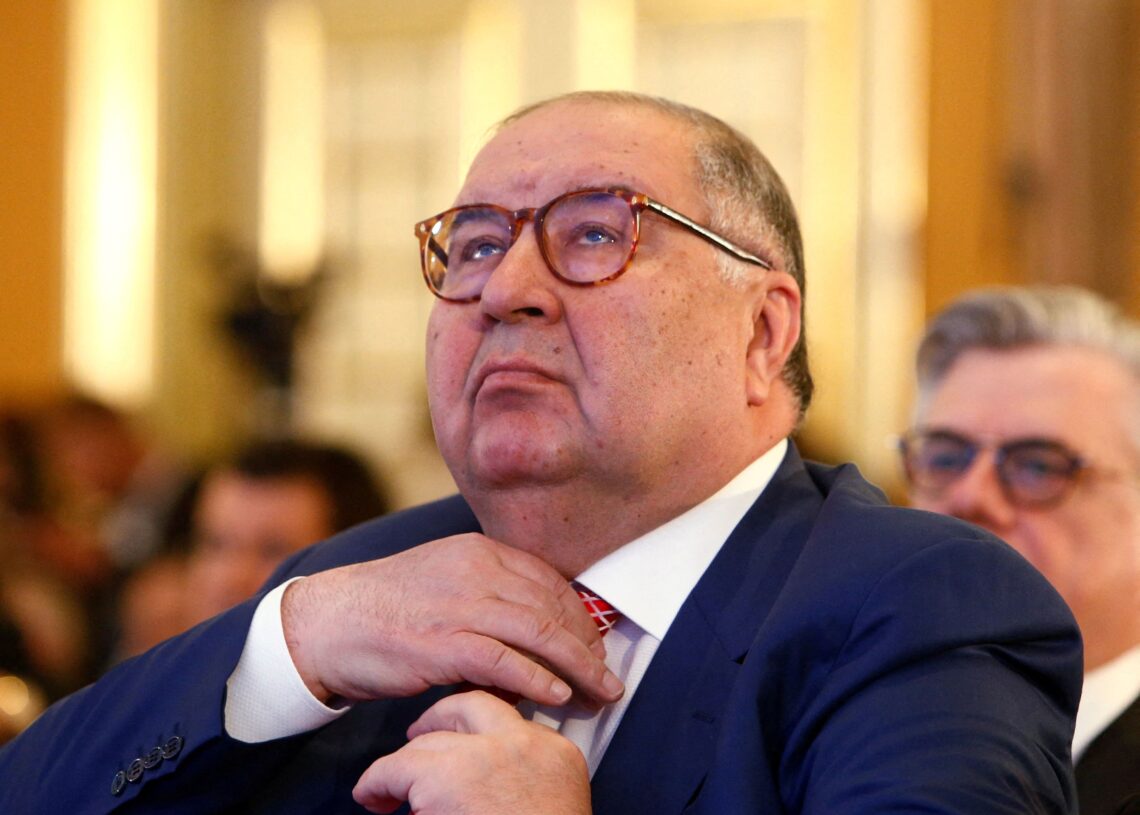
BRUSSELS — The European Union on Tuesday lifted sanctions on two of Russia’s wealthiest men, including billionaire Alisher Usmanov, who was referred to as “one of Vladimir Putin’s favorite oligarchs” when the bloc imposed restrictions on him after Russia’s 2022 invasion of Ukraine.
The decision followed France’s push to drop sanctions on Usmanov as part of efforts to secure the release of French nationals held in Azerbaijan, said two diplomats who, like others, spoke on the condition of anonymity to discuss sensitive diplomacy.
As some E.U. nations resisted the French request, the deadlock for days delayed renewal of a sanctions package against more than 2,600 individuals and entities. The measures include travel restrictions and asset freezes intended to punish people close to Russian President Vladimir Putin or to hit Moscow’s war chest.
E.U. nations agreed Tuesday to delist Usmanov and a second Russian billionaire, Mikhail Fridman, in return for prolonging the sanctions against hundreds of others for three years.
The proposal to spare the pair triggered an outcry from Kyiv and pushback from some European officials who warned that it risks setting off a domino effect and undermining the E.U. sanctions regime as Russia’s war in Ukraine intensifies.
A diplomat from Ireland, which currently holds the E.U.’s rotating presidency, said it was a “difficult compromise” to keep the broader sanctions in place for a longer period of time, ensuring “predictability.” The decision avoids repeatedly throwing the list back into question as the bloc has typically renewed measures against Russia every six months.
But Ukrainian Foreign Minister Andrii Sybiha described the plan as “shameful” on Tuesday and said it gives Moscow “what it wanted: a sense of impunity.”
Ukrainian President Volodymyr Zelensky, who is expected to meet President Donald Trump this week at the United Nations in New York, warned against the move, saying it was “not time for Europe to give Russia gifts.”
The debate has laid bare cracks among the E.U.’s 27 member states. The prospect of countries putting their national priorities first could also stymie the bloc’s strategy to pressure Russia.
France surprised its E.U. neighbors with the push to delist Usmanov, the sort of attempt that previously came from the bloc’s Kremlin-friendly leaders in Hungary and Slovakia.
Luxembourg, where Fridman has engaged in a legal battle, had sought to remove him from the blacklist too if Usmanov was spared, one of the diplomats said.
Usmanov, an Uzbek-born Russian citizen, is one of Russia’s most powerful oligarchs, who at times has ranked as the country’s richest man and for more than a decade was a shareholder in the storied British soccer team Arsenal.
He has been fighting economic penalties against him in European courts since he was hit with E.U. and U.S. sanctions in 2022.
The United States targeted him for being “known to be close to Putin.” Usmanov denies any such ties and has deployed lawyers to challenge that description of him in Europe, as well as to fight E.U. sanctions against him.
Fridman, who made his fortune in oil and banking, has also challenged European measures against him. In targeting Fridman in 2022, the E.U. wrote that he was “referred to as a top Russian financier and enabler of Putin’s inner circle.”
But in a sign of shifting tides in Europe and beyond, E.U. ambassadors agreed to drop the sanctions against both men Tuesday after days of closed-door negotiations including strong objections from at least one member state, Latvia.
The White House and the U.S. Treasury did not immediately respond to requests for comment.
Kremlin spokesman Dmitry Peskov on Tuesday noted Russia’s long-standing opposition to all the sanctions, which he said should be ended.
“As you know, we consider these sanctions illegal,” he told reporters. “We believe these sanctions should be lifted from Usmanov, from Fridman, and from all Russian businessmen, as well as from all Russian citizens.”
France joined Slovakia in blocking the sanctions rollover last week over Usmanov, the diplomats said. Paris has not confirmed its reasons.
A French diplomatic official said the country has “a specific national security issue and wishes to respond positively to our international partners who are approaching us regarding Mr. Usmanov.”
France remains “one of the countries most committed to increasing pressure, by all means, on the Russian military apparatus and to supporting Ukraine,” the official said.
The motivation to secure the release of French citizens from Azerbaijan was first reported by the Financial Times. French President Emmanuel Macron’s government has played a key role in European efforts to arm Ukraine and to deplete Russia’s coffers, including seizing vessels accused of carrying embargoed oil.
“Nobody saw that coming,” one E.U. diplomat said. “Even if you can justify the reason, it sets a dangerous precedent.”
The effort from Paris comes just months ahead of a presidential election in which far-right candidate Marine Le Pen is leading in the polls. Le Pen and her party, National Rally, have previously faced allegations of accepting financial help from Russia.
Macron met Zelensky on Monday at U.N. headquarters in New York and pledged to reinforce Ukraine’s air defenses. Macron has not publicly addressed the French bid to delist Usmanov.
Renewing the E.U. measures or taking people off the blacklist requires the approval of all 27 member states.
E.U. ambassadors, failing to reach an agreement, had approved a one-week extension of the sanctions regime and met again Tuesday in a rush to break the impasse.
Latvia held out in opposition to spare the two Russian magnates but eventually relented on Tuesday and abstained from the vote, allowing the deal to proceed.
Latvian Prime Minister Andris Kulbergs noted in a statement that this locks in sanctions against all other people and companies on the list for three years.
“Latvia opposed the removal of politically motivated individuals from the list of individual sanctions and was the only E.U. member state to do so until the last,” Kulbergs said.
The E.U. standoff has factored into the political debate in Latvia ahead of national elections there next month.
The Baltic nations — Estonia, Latvia and Lithuania — which border Russia, have long pushed for the most hawkish measures against the Kremlin as E.U. nations periodically debate sanctions renewal and impose new restrictions.
During the war, Western nations have agreed to prisoner-exchange deals with Moscow and separately lifted measures against some Russian citizens.
Some Russian businesspeople previously had sanctions overturned after winning lawsuits or breaking from the Kremlin. The E.U. also has quietly delisted Russian nationals to avoid having Slovakian Prime Minister Robert Fico or Hungary’s then-Prime Minister Viktor Orban veto renewal of the whole sanctions package.
Other E.U. states previously made requests to water down measures targeting Russia, such as on oil or shipping, over national economic concerns.
The people previously delisted were much less powerful and prominent than Usmanov, who has been photographed with Putin and received an award from him for “services to the Russian state.”
Usmanov became one of Russia’s richest men through stakes he built in the 1990s in Russia’s metals industry and then in the country’s gas monopoly, Gazprom.
He used a top-level position that he held at the state gas giant at the beginning of Putin’s presidency to take over a further swath of the metals industry at a reduced price.
Fridman, a Russian-Israeli citizen, has sought billions in compensation from Luxembourg for his frozen assets in the country.
The U.S. Treasury Department put Fridman under sanctions in 2023. He has sought to distance himself from his Russian business empire that includes one of Russia’s biggest private banks, Alfa-Bank, and an insurance giant, AlfaStrakhovanie, since the 2022 invasion of Ukraine.
Although he resigned from the board of ABH Holdings, the Luxembourg-based parent company of Alfa-Bank, in March 2022, he retains a 33 percent stake in the holding company.
Fridman moved back to Moscow from London in 2023 after facing criminal charges in Britain that were later dropped.
Belton reported from London. Riley Beggin and Katherine Doyle in Washington contributed to this report.
The post E.U. drops sanctions on two of Russia’s richest oligarchs despite Kyiv’s outcry appeared first on Washington Post.