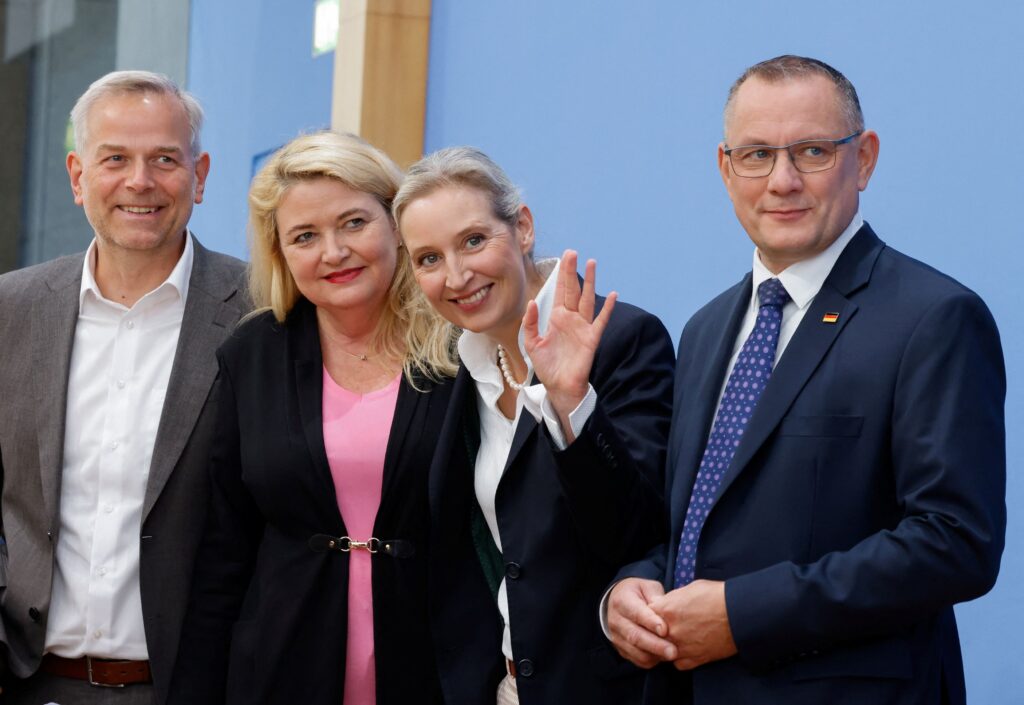
BERLIN — An audible gasp swept through the watch party of the Christian Democratic Union — the party of Chancellor Friedrich Merz and mainstay force in German politics — as election results on Sunday evening showed it failing to win seats in a state legislature for the first time since the party’s founding in 1945.
Two state elections in Germany this past weekend yielded two very different first-place finishers — on polar opposite fringes of the political spectrum.
In the state of Mecklenburg-West Pomerania, where the CDU fell embarrassingly short of the 5 percent threshold to enter the regional parliament, the far-right Alternative for Germany (AfD) party, labeled “extremist” by German intelligence, claimed its second major state-level win in a month.
A few dozen miles away in Berlin’s young, liberal-minded capital, the left-wing party, Die Linke, which means the Left, scored a historic victory, positioning its local leader, Elif Eralp, an anti-capitalist inspired by New York City’s Zohran Mamdani, to become mayor.
On one level, the results seemed to reflect a deepening political polarization, the kind of rift that has fractured other wealthy democracies, including the United States. But it also showed more and more Germans rejecting politics-as-usual, and especially the big tent centrist parties such as the CDU, which has governed Germany for 17 of the past 24 years.
For most of that time, the CDU was led by Angela Merkel, who was often beloved for her Zen-like pragmatism. When the CDU wasn’t in charge, the center-left Social Democratic Party took over, but the parties are compatible enough that they have frequently formed governing coalitions together, while pledging not to work with more overtly partisan parties like the AfD.
“It’s an anti-elite election, and it’s an anti-Merz election,” said Michael Broker, editor in chief of Table Briefings, a specialized media platform focused on policy analysis.
Traditional politicians decried Sunday’s results.
“The extremes finished in front,” Markus Söder, Bavaria’s state premier and leader of the Christian Social Union, the CDU’s Bavarian sister party, said Monday. “AfD and Left Party. Blue wave and red front.”
The elections results dealt another blow to Merz, whose approval ratings are teetering between 10 and 15 percent — record lows for a sitting chancellor.
Much of that decline traces to doubts that Merz, 70, can revive the stagnant economy or bring down the cost of living, adding to public dismay over an unpopular reform agenda.
“This one promise we had in the country, that our kids will have it better than us, and it will be driven by welfare, technology and industry, is broken, which people think is partly the blame of Merkel-CDU,” Broker said, adding that this led to a fragmentation of voters with vastly different views on the economy, migration and social issues, which neither centrist party managed to reconcile.
The Sunday elections were very specific in nature, taking place in East Germany, the former Communist part of the country, where the protest vote has become normalized in recent years. That sentiment is driven by a mix of historic grievances following reunification — mainly lasting economic gaps and a deep-rooted feeling of being second-class citizens compared with the economically stronger West.
The AfD’s triumph in Mecklenburg-West Pomerania followed its similar first-place finish earlier this month in Saxony-Anhalt. In each region, however, the AfD failed to secure enough votes to form a government, and other parties have ruled out cooperating with it under a fire wall policy meant to keep extreme parties out of power in Germany.
In Berlin, Die Linke will have to form a coalition with the Greens and Social Democrats, but Eralp, its leader, seems likely to accomplish that and claim the city’s top post.
In nationwide polls, the CDU is still holding around 20 percent, with its coalition partner, the Social Democrats, adding another 13 percent, and the reluctance toward dealing with fringe parties remains stronger in the more prosperous, populous West.
But the AfD has been rising nationwide, overtaking the CDU this spring and is now polling ahead of all other parties at about 28 percent. Germany’s next federal election isn’t expected until 2029, but the centrist coalition that has governed Germany for years is under pressure.
Alice Weidel, co-chair of the AfD, on Monday proclaimed her party to be the country’s new Volkspartei, or “people’s party,” and urged the CDU to accept AfD’s rising resonance and break the fire wall.
That statement prompted pushback from critics of the AfD.
“We don’t have Volkspartei, or catchall parties, anymore on the national level,” said Wolfgang Muno, a political science professor at Rostock University. “And by definition the catchall party is a center party, ideologically moderated, while the AfD has constantly radicalized itself.”
Muno added, “Here we had two very specialized elections in East Germany — and a completely different one in Berlin — but the elections next years will be in Western German states, where the AfD may rise again but far away from majority success.”
German voters, however, are deeply unsettled by the stagnating economy and uneasy about Merz’s proposed changes to the pension system and to labor rules.
So, they’re turning to parties offering simpler solutions. For the AfD, that centers on turning away immigrants and returning to cheaper Russian energy. For Die Linke, it means redistributing wealth through new taxes on the rich and on corporations.
“They offer very easy answers to very complicated questions. They promise economic growth, but they don’t give a plan or arguments how they’re going to do it or how they finance their campaign ideas,” Broker said. “But the questions [they pose] are the right questions. Do we have too many taxes? Do we have too much bureaucracy? Do we have too much immigration?”
In Mecklenburg-West Pomerania, the AfD’s pledge to reopen the Russian-built Nord Stream gas pipeline and cut energy costs gave frustrated voters in the region another reason to break from Berlin’s mainstream governing coalition.
In Berlin, AfD prioritized migration and internal security, proposing more deportations and a district-level police force as well as giving priority to native Berliners over asylum seekers for public housing.
That strategy helped the party roughly double its previous election result to 16.3 percent, compared with 25.7 percent for Die Linke.
Die Linke and Eralp, meanwhile, ran on an anti-capitalist promise of expropriating more than 200,000 housing units from corporate landlords and cleaning up the trash on the capital’s streets.
Her campaign was heavily modeled on that of Mamdani, New York’s democratic socialist mayor, and was marked by personal appeals and wide social media outreach that worked well among young voters and generated support from thousands of Berliners who previously did not vote.
On Monday, a jubilant Eralp posted a video of herself with a shout-out to Mamdani and the caption: “Someone’s gotta hold it down in Berlin.”
But her expropriation plan has drawn pushback from virtually every other party. The center-left Social Democrats put its cost at roughly 20 billion euros (about $23 billion), and it remains unclear how Die Linke intends to finance it.
Merz warned that the policy would have “devastating effects” on foreign investment if it were implemented and said he expects swift legislation to block expropriations.
Merz on Monday lamented that “the trust in institutions is declining and being exploited by radical parties on the left and right.”
Weidel, in turn, called him a “weak chancellor” and urged him to resign, which Merz countered by saying he would stay in power.
“I know my own position has played a role, too,” Merz said, “But I believe that the causes go far beyond that. We are experiencing sweeping changes of the political party system both in Germany and in many other countries around the world.”
The post Victories by far left and far right show Germans sick of politics as usual appeared first on Washington Post.