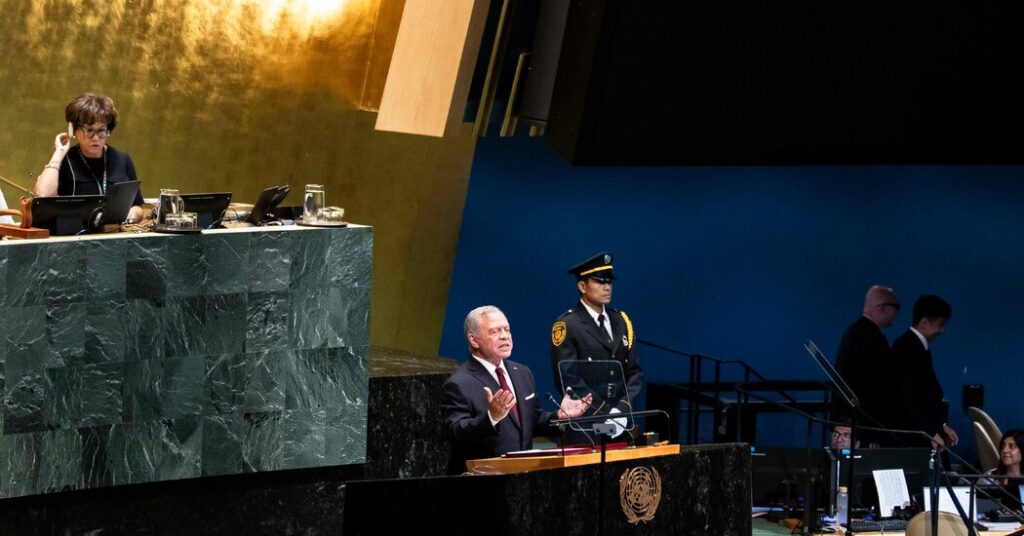
Standing on a podium often reserved for messages of peace, President Trump on Tuesday brought his escalating threats against Iran directly before world leaders. They largely did not respond.
Mr. Trump told the United Nations General Assembly that he was deciding whether to “annihilate” Iran if the war — launched by the United States and Israel — drags on without a peace deal. But other world leaders said little about a conflict that has widely disrupted trade, driven up fuel prices and prompted Iranian attacks on other countries in the Middle East.
Those who did urged peace, not escalation.
Among them was Sheikh Tamim bin Hamad Al Thani, the emir of Qatar, which helped broker a June cease-fire between the United States and Iran that has fallen apart. He urged a return to negotiations to find a “lasting solution that ensures security and stability for the entire region, including Iran.”
“The opportunity for a peaceful diplomatic solution, which we believe is both possible and realistic, must not be missed,” he said.
The war has expanded to new fronts since Iran came under attack in February, with Iranian proxy forces repeatedly attacking military bases and ships across the region. Since the cease-fire between the United States and Iran broke down, there has been no clear off-ramp from the conflict.
The sides are locked in a showdown over the Strait of Hormuz that has suffocated global trade and led to sudden bursts of military activity.
As Mr. Trump’s ultimatum against Iran loomed over the gathering, the leaders of three countries affected by the conflict — Jordan, Qatar and Turkey, all U.S. allies — focused more on criticizing Israel over its conduct of the war in Gaza.
King Abdullah II of Jordan, caught in the middle as Iran strikes bases in his country used by the American military, did not criticize the United States for launching the war. But he did address its far-reaching consequences.
“If anyone had any doubt that conflict from our region stays there,” he said, “just look at the energy and grocery bills of ordinary families, from Mumbai to Minnesota.”
Sheikh Tamim, the Qatari emir, said the crisis was the result of “years of procrastination, managing crises with temporary fixes and unrealistic policies.” He said the region lacked safeguards for collective security.
Turkey’s president, Recep Tayyip Erdogan, said that he wanted an end to “the climate of war.”
“I strongly underline that any dangerous attempt to spread these conflicts, these clashes, to neighboring regions serves no one’s interests,” he said.
President João Lourenço of Angola, a country in southern Africa that is removed from the conflict geographically, said wars in other parts of the world had caused “instability on our continent,” with “devastating effects on the most vulnerable countries.”
“Today we live in an environment of global anarchy in which the use of force prevails over the force of reason and law,” he said.
President Gitanas Nauseda of Lithuania called attacks by Iranian-backed militant groups on neighboring countries a threat to international peace.
In his remarks to the General Assembly, the president of France’s, Emmanuel Macron urged the body to stand against those who want a world ruled by the “law of the jungle.” But he did not name those he believed responsible for fueling conflicts.
“The question before us, in very simple terms, is whether we want to live in this state of nature, with a kind of return to the law of the jungle, or in a civilized international society,” Mr. Macron said.
Iran was quick to reject Mr. Trump’s ultimatum as an empty threat. Iran’s armed forces, in a statement carried by state media on Tuesday, called his address an “exploitation of the U.N.’s podium to legitimize aggression, insecurity and global banditry.”
The Iranian president, Masoud Pezeshkian, is slated to speak to the assembly on Wednesday.
The post As Trump Lobs Threats, Other World Leaders Mostly Avoid Talk of Iran appeared first on New York Times.