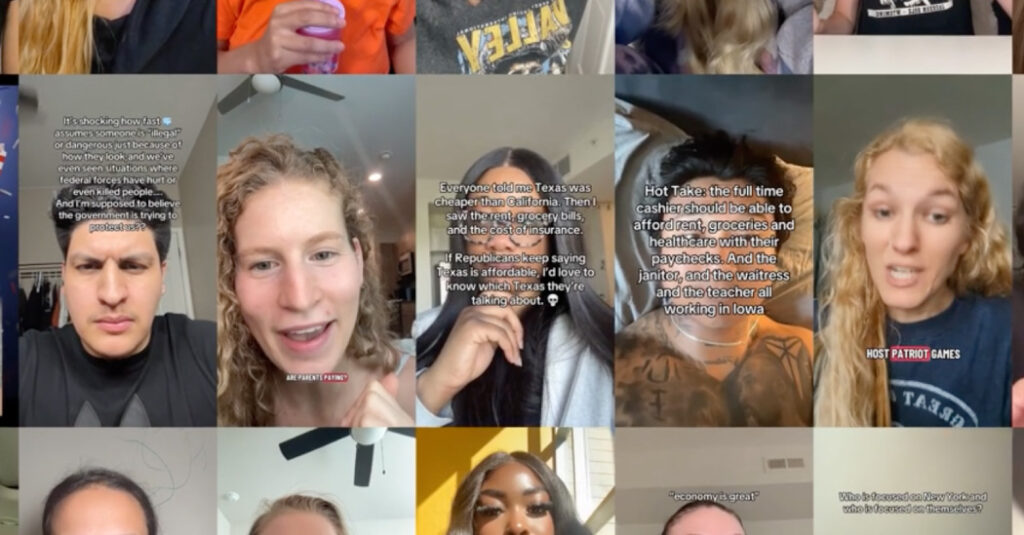
Judging from his TikTok feed, Drew was struggling to get by as a young man living near Dallas. Grocery bills were skyrocketing, he said, and he was looking for thrift stores to help keep costs down.
In reality, according to his LinkedIn profile, Drew was a man from Utah named Alex Forrester, who said he was now in Florida. “All of it was paid for,” he said in a video posted in late June, which was later deleted. “I don’t even live in Texas,” adding an expletive.
Mr. Forrester, who did not respond to requests for comment, is one of more than 100 content creators identified by The New York Times who in recent months have been paid as much as $30 per post by a progressive group to create videos about affordability for social media.
Similar campaigns this year have paid ordinary people to promote a Republican candidate for Los Angeles mayor, to oppose a regulatory bill pushed by the crypto industry and to call for tighter regulation of artificial intelligence. Early this month, an unidentified nonprofit group offered up to $1,500 for videos on TikTok, YouTube and Instagram that support “mail voting working correctly.”
The accounts posting these messages aren’t run by celebrity influencers with massive engagement, legions of fans and lucrative product endorsement deals. Most have only a smattering of followers and, often, the people behind them aren’t even based in the United States.
Functioning more like birdshot than a single bullet, these high-volume social media campaigns represent the new vanguard of modern political influence, saturating the internet with a topic until it is all but unavoidable. That can help game social media network algorithms so that they treat coordinated content as organic, spreading the message even wider. Built from dozens or hundreds of posts from accounts you’ve never heard of, they amount to an echo chamber on a budget.
“This is digital astroturfing, plain and simple,” said Samuel Woolley, a professor at the University of Pittsburgh who studies how new technologies can be used to manipulate public opinion on the web. “The more people see an idea online, the more inured to it they become and the more commonplace and acceptable it becomes.”
In the political sphere, social media strategies centered around big payments to marquee influencers are still prevalent, with some large accounts taking in $25,000 or more for a single video.
But increasingly, efforts are shifting to content made by smaller freelancers who churn out on-camera videos, slide shows and other material targeting specific audiences.
Some posts, known as user generated content, or U.G.C., feature an individual content creator speaking directly to the camera. Others, referred to in the industry as clipping, consist of short clips taken from longer videos overlaid with text or commentary driving a particular point home.
Such content is rarely marked as paid advertising and, in most cases, laws don’t require any such disclosures for political topics.
Specialized marketplaces
One recent campaign, called “Protect What’s Human,” offered $300 or more for posts on Instagram and TikTok that called for “real rules on A.I.” But the job listing made no mention of who funded the effort or any requirement to disclose that it was not organic content. The only obligation was that creators verify that they “have a personal perspective or experience related to how A.I. may affect my work, profession, family, or community.”
“Protect What’s Human” was advertised on a site called People First, one of a growing number of specialized online marketplaces where content creators can look for paid opportunities. Some focus mostly on political advocacy, while others largely feature commercial gigs with a smaller number of political jobs mixed in.
A recent clipping campaign listed on the social commerce platform Whop offered $3 per 1,000 views for short-form videos praising Pierre Poilievre, the conservative leader of Canada’s opposition party. For inspiration, it provided a video of Mr. Poilievre blaming the country’s prime minister for high food prices. Another campaign offered $2 per 1,000 views to promote Maria Syrengela, a member of Greece’s parliament.
A different opportunity on the same marketplace offered even less — $1.50 per 1,000 views — to “join a community of volunteers” working to elect Mike Minogue, the Republican nominee for Massachusetts governor, by cutting videos of the candidate “into compelling 15-60 second clips” posted on social media. The maximum payout for any pro-Minogue post was $150, according to the listing, a tiny fraction of what a big-name social media star would typically charge and an even tinier fraction of the $12.7 million Mr. Minogue has spent so far on television advertising, according to data from tracking firm AdImpact.
“People are sick of paying the insane pricing that typically comes with influencer marketing,” said Drew Levin, a co-founder of SideShift, a popular U.G.C. marketplace, on a podcast last year. “Why spend $1,000 on one video, when you can spend $1,000 on 30 videos?”
Early this year, Project Bullhorn, a Democratic-aligned venture that has said it wants to combat right-wing dominance on social media, turned to SideShift to seek out “U.G.C. creators to speak on the rising crisis of affordability around the United States ahead of the 2026 midterms,” according to a job posting on the site. Initially, it offered $30 per video, but the affordability crisis apparently hit Project Bullhorn as well: That rate recently dropped to $25, the job listing showed.
The Times identified more than 100 social media accounts that took part in Project Bullhorn’s campaign by analyzing the activity of thousands of content creators who signed up with SideShift.
The videos they produced featured creators talking about the high cost of food, fuel and housing around the country; few disclosed they were paid for their posts.
Only a third of the affordability campaign creators appeared to live in the states about which they had posted, according to a Times analysis of participants who had shared their locations.
One man who claimed to be “born and raised” in Texas was actually from Leicestershire, England, according to his profile on SideShift. A woman hired by the campaign to post about affordability in the United States actually lived in Ontario, Canada.
Project Bullhorn declined a request for comment. But a person familiar with the campaign who requested anonymity because they were not authorized to speak publicly about the group’s activities said that participating creators are supposed to live in the states that they talk about, or have a close connection to those places, and should be speaking about their own experiences.
‘Can’t make Ron look bad’
Starting in May, creators were offered $1.50 per 1,000 views of videos that combine flattering clips of Ron DeSantis, the Republican governor of Florida, with scripted captions like “DeSantis not holding back  ” and “This DeSantis clip has me
  ” on TikTok, YouTube and Instagram.
A detailed set of instructions laid out guidelines for what to do — and what not to do. The golden rule? “Can’t make Ron look bad.”
Mr. DeSantis is term-limited as governor and not currently running for any other office. The job listing does not say who paid for the campaign, but the digital marketing agency Clipping Culture, which posted the ad, stated on its website that the campaign generated more than 6 million views from 1,441 videos.
A review found that a number of those videos appeared to have been made by accounts based overseas. A video featuring Joe Rogan appearing to react to a clip of Mr. DeSantis that included one of the suggested captions was posted by an account that was created in April and is based in Pakistan. Mr. DeSantis’s office did not respond to a request for comment.
Because clipping campaigns rarely feature the face or voice of the account holder and they tend to pay less per post than U.G.C. content, they often attract creators in other countries, many of whom operate multiple accounts.
A recent report in The Atlantic, for example, found a pro-Republican clipping campaign called Elephant Clipping that paid $3 for every 1,000 views. The instructions stated that “the goal is to showcase how modern conservative figures approach issues such the economy, foreign policy, public safety, education and community development.”
A Times review of accounts posting the suggested content included ones from Nigeria and India; one based in Pakistan used the name Trump in its handle and was created in July.
During his unsuccessful run for Los Angeles mayor this spring, Spencer Pratt, a Republican, paid two clipping firms a total of more than $55,000 to promote his campaign; one of the firms, Cliphaus, boasts on its website that its efforts generated over 50 million views.
“Spencer went from celebrity to serious candidate in the public conversation,” the Cliphaus site says. A Times review found accounts supporting Mr. Pratt based in India, Turkey, and the Philippines. Cliphaus, which is based in Los Angeles, brags of having a “network of 50,000+ independent creators.”
In a statement, ClipHaus co-founder Peter Sint said the firm “operates a global creator network, so creators and publishers participating on the platform may be based in different countries.” He added that “clients can choose specific geographies to target (i.e., U.S.-based accounts only). When it comes to most clients, this is the case.”
Jafari Jackson, a content creator based in Arizona, said he has participated in several campaigns he found on DrumBeat, another marketplace specializing in paid advocacy work. One, he said, pushed the idea that “extreme heat is a climate problem, not a political one,” while another called for content opposing the Save Our Bacon Act, legislation that would roll back state level animal welfare protections.
In recent weeks, DrumBeat hosted a campaign opposing President Trump’s efforts to restrict voting by mail that was sponsored by an unnamed nonprofit that “works to advance policies that support former U.S. service members and their families” and paid $5 per 1,000 views. Another, opposing the Clarity Act, a bill in Congress that would create business-friendly rules for cryptocurrencies, paid $250 per post and suggested scripted talking points including “if a financial system can be used to move money, it needs rules that help investigators stop trafficking and fraud.” (Last week the Senate blocked the bill.)
Mr. Jackson said that he doesn’t bother applying to the vast majority of paid campaigns advertised on DrumBeat, because he “wouldn’t make a video about something I didn’t believe in.”
But he said other creators might find it hard to turn down such opportunities. “While I do think that people should be 100 percent honest in these things,” he said, “it’s hard not to acknowledge the role money plays.”
Andrea Fuller contributed reporting.
The post An Army of Paid Creators Is Carpeting the Web With Political Content appeared first on New York Times.