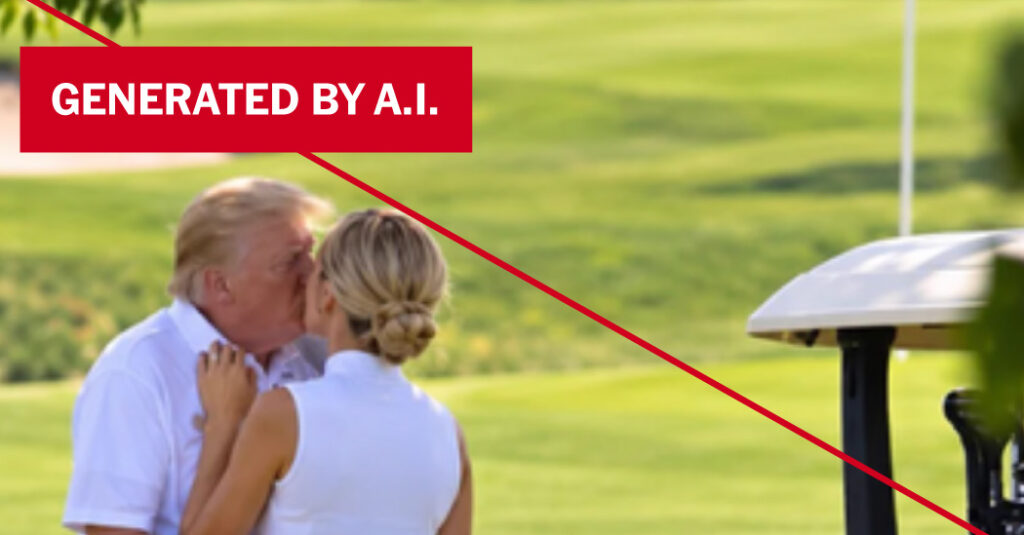
The first known instance of the fabricated image appeared online the afternoon of Sept. 14.
It was small, too blurry to make out much detail. Yet it seemed to show President Trump on a golf course locked in a kiss with a woman.
The woman can be seen only from behind, but resembles his personal assistant, Natalie Harp, whose role in Mr. Trump’s White House has become fodder for political attacks from Democrats. And from there, imaginations ran amok.
The image was posted on Threads, the social media platform, by a user who described himself as “the Rebel Scum Trump is warning you about.” From there it caromed to Facebook and Instagram, all platforms owned by Meta, and to X, the platform controlled by the world’s richest man, Elon Musk. A higher-quality version appeared as a thumbnail for the YouTube show of Keith Edwards, a Democratic political strategist and online influencer.
Disinformation researchers and digital forensics experts who scrambled to verify the image ultimately agreed that it was a fake generated by artificial intelligence, but that took many hours. Despite numerous red flags, the image racked up tens of millions of views and comments by users, who either believed or acted as if it were genuine.
The viral image exemplified how difficult it has become to trace fabrications to their origins, given the advances in technology and the variety of ways images can be altered as they are shared — perhaps intentionally. The diffusion of such a dubious image also served as a stark warning, ahead of the midterm elections on Nov. 3, that audiences online are highly susceptible to narratives that seem to affirm their own beliefs.
“They’re not even hiding it anymore,” a teaser on Mr. Edwards’ show claimed, promoting an unsubstantiated and vulgar commentary about Ms. Harp’s sudden prominence in Mr. Trump’s political orbit.
The White House promptly denounced the image as a fake. The half dozen researchers and experts who spoke with The New York Times concurred, though the consensus was not conclusive on the exact source and the origin.
The White House accused Democrats of being behind it; there is no evidence of exactly who created the image.
Whatever the case, Mr. Trump found himself the target of a practice he and his aides have embraced: posting manipulated, even fantastical images generated by A.I., including ones denigrating his political opponents and people protesting administration policies.
A reconstruction of the image’s spread by The Times shows how A.I.-generated images are quickly outpacing efforts to detect them, as social media is increasingly inundated with A.I. slop.
In this case, the image was made as if paparazzi had furtively captured Mr. Trump in an unguarded, intimate moment. That gave a sense of authenticity compared to the obviously artificial, cartoonish images that A.I. tools often create.
“It is a well-crafted little viral image, I have to admit,” said Darren L. Linvill, a co-founder of the Media Forensics Hub at Clemson University, which tracks how disinformation and propaganda spread online. “Fuzzy. Peeping through the trees. Spying on young love. It seems genuine.”
The post on Threads, which according to the account’s biography belongs to Martin L. Dart, “is what made this go viral,” Mr. Linvill said. Mr. Dart did not respond to messages on the platform.
As the image spread, many treated it as a smoking gun, saying it illustrated the Republican Party’s hypocrisy when it comes to personal conduct by its leader.
More discerning users immediately viewed the image with skepticism.
Some turned to A.I. tools to enhance the image, making it crisper and easier to study. That version contained telltale signs of A.I. — the woman appears to have six fingers — but it was difficult for experts to say whether those details were in the original or added by the enhancement.
Some A.I. detectors seemed to confirm the image was real, even though the tools frequently make mistakes. Other detectors found the opposite.
X added a community note to some posts suggesting it was likely to be a fake, but numerous other posts with the image remain online without a note. X did not respond to a request for comment.
Snopes and Lead Stories, two online fact-checking sites, also questioned the uncertain provenance of the image. No photo agency or photographer had claimed credit for it. Mr. Edwards, the podcaster, did not respond to questions about his post of the image, but a representative of his show told Snopes that they had found it online.
According to PeakMetrics, an analytics company, four distinct versions of the image surfaced online. All seemed to derive from one original, based on the position of the couple near a golf cart, framed by a white flagstick and trees along the fairway.
Mr. Trump had spent the previous weekend at his golf course in Ireland on an official visit, causing some users to think the image was from his trip. But the treeless landscape at that course differed significantly from the one in the image.
There were other clues casting doubt on the image: Mr. Trump is almost always photographed wearing a hat while he golfs, but was not wearing one in this image. Also, Ms. Harp, the aide, is not known to golf, though she has accompanied him on his frequent outings on the links. Some users pointed out that Mr. Trump in real life now appears far heavier than he does in the image.
The blurring in many of the images that spread made it more difficult to detect the role of A.I., according to the experts and researchers. Hany Farid, a professor at Dartmouth College and a founder of GetReal, a company that detects fakes, suggested that might have been the point.
He said the company’s analysis found that while the original was apparently A.I. generated, the reproduction of it as a thumbnail had the effect of erasing the digital fingerprints that identified it as an inauthentic image. Many companies add hidden watermarks to A.I.-generated images to help researchers identify fakes.
One low-resolution version of the image had no watermark, Mr. Farid said. Another sharper, higher-quality version looked like an authentic photo but did have embedded watermarks from either Google or OpenAI. Yet another version had a weak but different watermark.
Within a couple days, the fact-checks and official denials largely put the matter to rest, and the internet moved on, though the images remain online.
Mr. Farid, one of the world’s foremost digital forensics experts, said the speed of the image’s spread was startling. “It went from zero to millions really fast.”
His team’s attempts to retrace the image’s online trail was “pretty messy,” he said.
“We were really struggling to figure out what was going on,” he went on. “You can usually draw a little tree, like ‘this one is derived from that, and this one from that.’ We just couldn’t do it in this case.”
The post An A.I. Image of Trump Kissing a Woman Was Fake. It Spread Anyway. appeared first on New York Times.