The biblical command to observe Yom Kippur, the holiest day of the Jewish calendar, is straightforward. “This shall be to you a law for all time,” the Book of Leviticus declares. “You shall practice self-denial and do no manner of work … for on this day, atonement shall be made for you to purify you of all your sins.”
In some ways, Yom Kippur, which begins on Sunday evening, has stayed remarkably consistent across the centuries. Many Jews continue to mark the day by fasting, engaging in introspection, seeking forgiveness or committing to self-improvement. By some counts, fasting on Yom Kippur is the most observed American Jewish ritual after the Passover Seder.
But today, the holiday presents challenges that ancestors of American Jews could never have imagined — from choosing between in-person and online services to navigating coffee withdrawal.
We wanted to hear about what Yom Kippur looks like in 2026 for those American Jews who choose to mark it. So we asked Times readers and others to tell us about their experiences, receiving hundreds of responses and conducting dozens of interviews with people across the country. Here’s what we learned.
Many spend all day in synagogue, even when it’s hard.
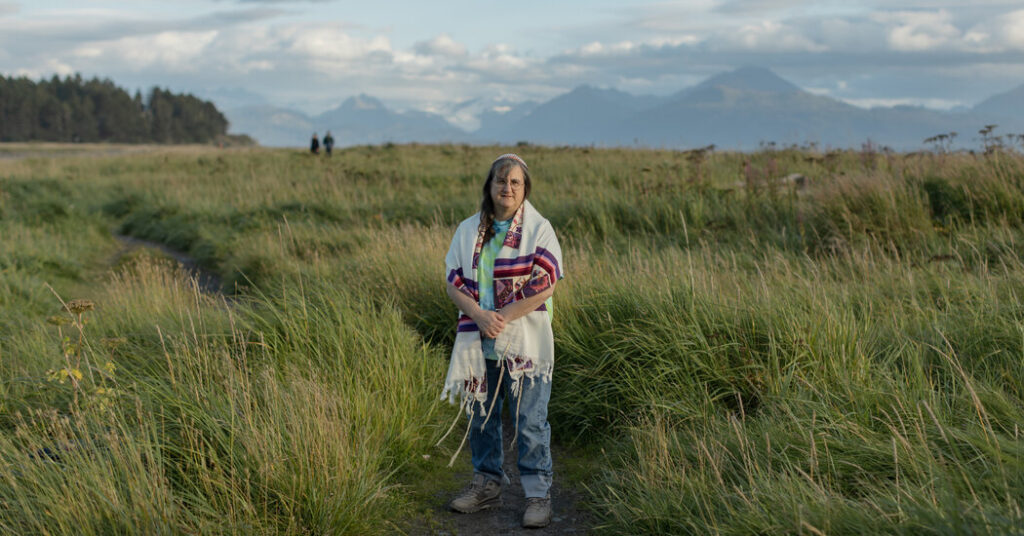
People go to great lengths to observe Yom Kippur, but few go as far as Yonah Lempert Luecken. A 58-year-old resident of Homer, Alaska, she drives more than 200 miles the day before the holiday to attend services at Congregation Beth Shalom in Anchorage (website: frozenchosen.org). After arriving, she makes an obligatory Costco run, then has a final pre-fast meal of local sushi.
In recent years, Ms. Luecken has begun chanting the Book of Jonah for the congregation. The biblical story, which tells the tale of a recalcitrant prophet who flees from God and is famously swallowed by a fish, is traditionally read on Yom Kippur afternoon. Jonah appeals to Ms. Luecken not just because she shares a name with “that slacker prophet,” but because “I think that a lot of people, myself included, have gone through phases in their lives when they were selfish.”
On the other side of the country, Isaac Himmelman will be wearing special sneakers for the trek to his Brooklyn synagogue — but not because it’s particularly far away. Rabbinic tradition prohibits not only bodily pleasures on Yom Kippur, but also luxuries like leather footwear. And so Mr. Himmelman, a 38-year-old Modern Orthodox filmmaker with a “Hasidic orientation,” laces up a dedicated pair of neon Nikes.
For Mr. Himmelman, the holiday is about much more than these trappings, however. “Growing up, I mostly focused on the prohibitive nature of the holiday: I can’t do this, this and this,” he said. “But as I’ve gotten older, the prohibitions have taken a back seat to the privileges of the day.” During the rare respite, “I can step outside everything in my life and think about my relationship to God and the things that are truly meaningful to me.”
You make meaning wherever you are.
Not all Jews who observe Yom Kippur do so in synagogue. Last year, Penina Crocker, a 27-year-old Boston resident, was cycling from Portugal to Singapore and decided to spend Yom Kippur on a silent meditation retreat in northern Thailand. She expected a more philosophical experience, and so was surprised when participants were invited to prostrate themselves before a statue of the Buddha.
“On Yom Kippur itself,” she said, “I thought that would be a little much.” She ended up passing much of the day quietly reciting the Yom Kippur liturgy from a machzor — a High Holidays prayer book — that she had brought with her, technically against regulations. It was “Yom Kippur on hard mode,” she recalled, but also “a pretty powerful davening,” or prayer, “experience.”
Pearl Sapirstein, a 23-year-old senior at Mount Holyoke College, does not commune with a congregation on Yom Kippur, but with nature. Ms. Sapirstein, who describes herself as “culturally Jewish” but not “religiously observant,” sometimes fasts and sometimes doesn’t. But every year, she drives into the Berkshire Mountains, where she hikes and takes stock of her life.
“Yom Kippur is my favorite holiday,” she said. “It has always been a way for me to consider my identity and place in life: Who am I and what do I want to become? How am I progressing? What do I need to understand about myself in order to become a better person?”
It’s about what you don’t eat, and also what you do.
“I actually look forward to fasting,” said Simon Gilbert, a 26-year-old financial professional in Brooklyn. “Our modern world affords us many conveniences, physical convenience chief among them — I’m glad I can mark the day by trying to let go of them.”
Other interviewees shared struggles with aspects of the fast — whether the challenges that come with age or the difficulties of forgoing water and coffee. Erika Berg, 45, a science editor in Washington, D.C., now takes caffeine pills to mitigate migraines over the holiday. “No one is perfect,” she said.
To some, eating on Yom Kippur is its own statement. In the 1890s, secular and anarchist Jews in New York deliberately staged public festivities on the holy day, leading to street fights with traditionalists, immortalized in The Times under the headline: “Mob of Hebrews Again Attacks Diners in Division Street.”
Russell Robbins, a Reform Jew and physician from Connecticut, recalled how his grandfather, who lost most of his family in the Holocaust, would mark Yom Kippur “by making it the only day of the year he would eat a ham sandwich,” in a purposeful protest. Mr. Robbins and his family, however, observe the fast themselves — and break it with shots of Manischewitz.
Indeed, just as important to many Jews as the food they eschew on Yom Kippur is the food they consume when it ends. Some host elaborate break fasts, sharing favorite dishes with family and friends, in a practice that has given rise to the confusingly named genre of “Yom Kippur recipes.”
Others have simpler, but no less significant, traditions. In the 1960s, Peter Wunsch and his sister were returning from their Bronx synagogue after Yom Kippur and stepped into a nearby deli. The two teens did not have any money but they knew the shop’s owner and he spotted them a bag of chips, knowing they would pay later.
“Over 60 years later, we both still break the fast with barbecue potato chips,” said Mr. Wunsch, 76, “even when we are not together.”
It’s not just repentance, but remembrance.
Two months before Alexander Litvak was scheduled for surgery in 2020, he ordered a new tallit — a traditional prayer shawl — from Israel. “He wanted to live,” Mr. Litvak’s wife, Jody, of West Hollywood, Calif., recalled.
Mr. Litvak died shortly after the operation, and Ms. Litvak, 68, now wears the shawl in his stead on Yom Kippur. “Now, mind you, he was a little bit under six feet; I’m 5 foot 2,” she said. “It’s ridiculous on me, and I don’t care.”
For many Jews, Yom Kippur is not just about repentance, but remembrance. At the heart of the holiday service, Ashkenazi congregations recite Yizkor, a special memorial prayer that commemorates deceased loved ones.
“My kids’ great-grandfather passed away just a few weeks ago, and one of his legacies was sending thousands of Rosh Hashana cards over the years,” said Yael Buechler, a Bronx rabbi. “This year, in his memory, my kids mailed cards to friends and family, too. On Yom Kippur, we’ll also take some time to look at the cards he sent us.”
Some Jews light yahrzeit candles that burn throughout the holiday in memory of those they have lost. Warren Poland, a 93-year-old retired psychoanalyst who was raised Orthodox but describes himself as a “Jewish atheist,” is one of them.
“I don’t think I’ve been in a shul except for a funeral in decades,” he said, using the Yiddish word for synagogue. “But there is a sense of family tradition.”
It’s framed by sacred bookends.
The beating heart of Yom Kippur is its prayers, several of which are recited only once a year. The holiday opens with Kol Nidre, an evening meditation on the power of words and the perennial human failure to live up to our commitments. The text is Aramaic and the formulation legalistic, but to many, none of this matters because the traditional tunes are majestic.
Leonard Nimoy, the “Star Trek” actor who got his start in his synagogue’s choir, once described Kol Nidre as “a haunting melody of ineffable power.”
“It makes me cry every time,” said Elissa Miller, a 34-year-old defense analyst who attends a Reconstructionist synagogue in Maryland. “There is nothing else like it I’ve ever experienced that makes me feel so closely connected to my family, my ancestors, and an entire global community.”
She pictures Jews who came before her and around the world experiencing this moment together. “We are all singing the same prayers and tunes, thinking about the last year, and missing our loved ones,” she said. “I think I could be anywhere in the world at a Kol Nidre service and feel that I am right where I am supposed to be.”
The holiday concludes with another showstopper of a prayer, Neilah, which literally means “locking.” It is the moment when the gates of heaven are said to be closing, and the congregation offers up its final entreaties to the Almighty. The ark containing the Torah scrolls is opened, and all who are able rise to their feet for the entire service, pushing themselves to the limits of their endurance.
“There is a special beauty during Neilah, where your hunger almost subsides in that final hour,” said Hannah Miller, a Harvard law student who discovered Neilah for the first time in college.
“You’re torn open at that point,” said Jeff Gottesfeld, 70, a children’s book author in North Hollywood, Calif. “I’ve basically been contemplating my own death and the meaning of my own life. Then Neilah comes, and the light is fading, and it’s like memories of however many Neilahs that have been before, going back years and decades now to when I was a little boy.”
“It’s just very, very real.”
The post How American Jews Find Meaning on Yom Kippur appeared first on New York Times.