Amid an oppressive stretch of extreme heat and Florida-esque humidity that has been punishing much of California, consider, for a moment, the Ice Age.
For millions of years, Pacific mastodons — huge, hairy relatives of modern elephants — roamed a vast and lush range that included California, Oregon, the northern Rocky Mountains and parts of Mexico.
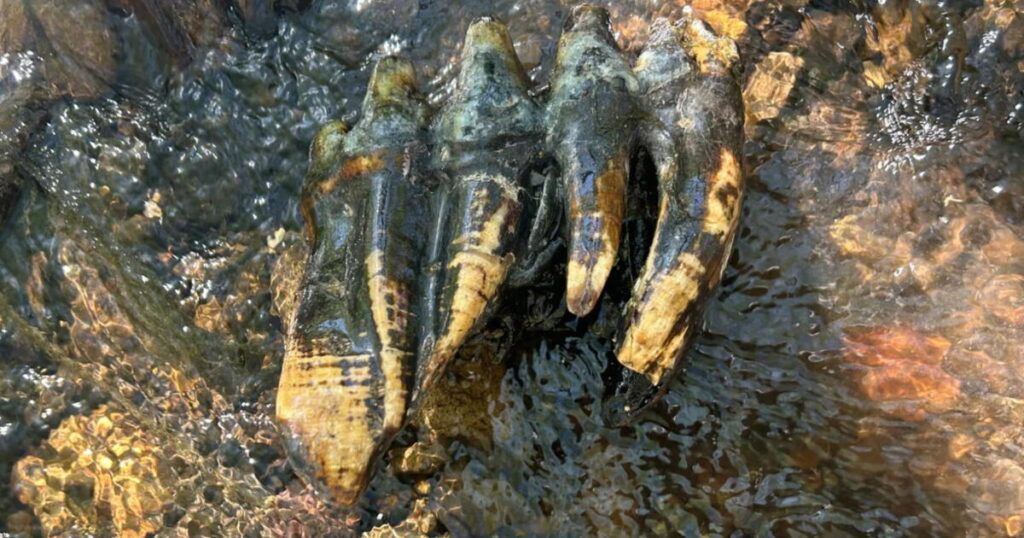
They’re all gone now, long extinct just like the saber-toothed cats and dire wolves that walked the earth with them. But around 10,000 years ago, one of those Pacific mastodons left behind a big tooth that was recently discovered in a Bay Area creek — a find that has thrilled scientists, who say it will provide important clues about a distinct species of mastodon that has only been officially recognized since 2019.
The Midpeninsula Regional Open Space District, a public agency known as Midpen that has preserved more than 70,000 acres of open space in the Bay Area, announced this week that a scientist recently discovered a remarkably preserved adult molar in a San Mateo County creek bed.
Brigid Lynch, a geomorphologist with the hydrology consulting firm Balance Hydrologics, was doing field surveys for a habitat enhancement project supporting the threatened California red-legged frog when she found what appeared to be an oddly shaped rock, according to a Midpen news release.
“As a geologist, I’ve gone out and seen stuff in the field, but definitely nothing as exciting as this,” Lynch said in a statement.
The agency did not say when the tooth was found or which creek it came from. A spokesperson could not immediately be reached for comment.
The fossilized tooth is believed to be at least 10,000 years old.
“It’s the most complete mastodon molar from our area, and the most spectacular mastodon molar that I’ve ever seen,” Wayne Thompson, a paleontologist and owner of the firm Pacific Paleontology, said in the news release. “I had chills and shivers up and down my spine. It’s another puzzle in the Ice Age saga that we can put into place.”
Midpen donated the ancient chomper to Stanford University’s Doerr School of Sustainability, where researchers will use carbon dating to determine its exact age.
Stanford scientists will also perform a 3-D scan and print a copy of the tooth for Midpen to use for public outreach and education.
“Fossils are our only opportunity to see into past biodiversity,” Christine Garcia, curator and manager of the Geoscience Specimen Collection at Stanford, said in the news release, adding that they not only help to understand what has been, but also “help us make better predictions and better decisions about how to help our ecosystems and biodiversity thrive into the future.”
The Pacific mastodon (Mammut pacificus), the newest species of mastodon to be recognized, is distinguished from the American mastodon (Mammut americanum) by its narrower teeth and thicker leg bones, as well as different tusks.
Researchers believe the giant herbivores roamed during the Pleistocene epoch, spanning from 2.5 million years ago until their extinction about 11,700 years ago.
“Unlike mammoths, which were also present in the region and fed on grasses, mastodons were considered browsers, using their massive trunks to strip leaves, soft shoots or fruits of high-growing, generally woody plants,” the news release states.
In ancient California, they are believed to have existed alongside other extinct native species, including bison-sized Jefferson’s ground sloths, Columbian mammoths and western camels.
It’s not the first time in recent years that a fossilized Pacific mastodon tooth has been discovered in the region.
In 2023, a woman walking along Rio Del Mar State Beach near Santa Cruz spotted a foot-long object that looked like a piece of driftwood. Finding it peculiar, she posted a photo on Facebook and asked if anyone could help identify it.
Someone in the comments section tagged Thompson, who also works as a paleontology adviser for the Santa Cruz Museum of Natural History.
“This is … an extremely important find,” Thompson wrote in response to the woman. “Give me a call when you get a chance.”
He identified the object as a Pacific mastodon molar, and it was added to the Santa Cruz museum collection.
Thompson told The Times then that it was one of only three known specimens found in the area.
The post Rare Ice Age mastodon tooth discovered in Bay Area creek appeared first on Los Angeles Times.