President Trump made more than $2 billion last year — far exceeding his presidential salary of $400,000. His growing fortunes are raising questions about his allegiance to investors, particularly foreign ones, as he makes policy decisions and shapes the direction of the country.
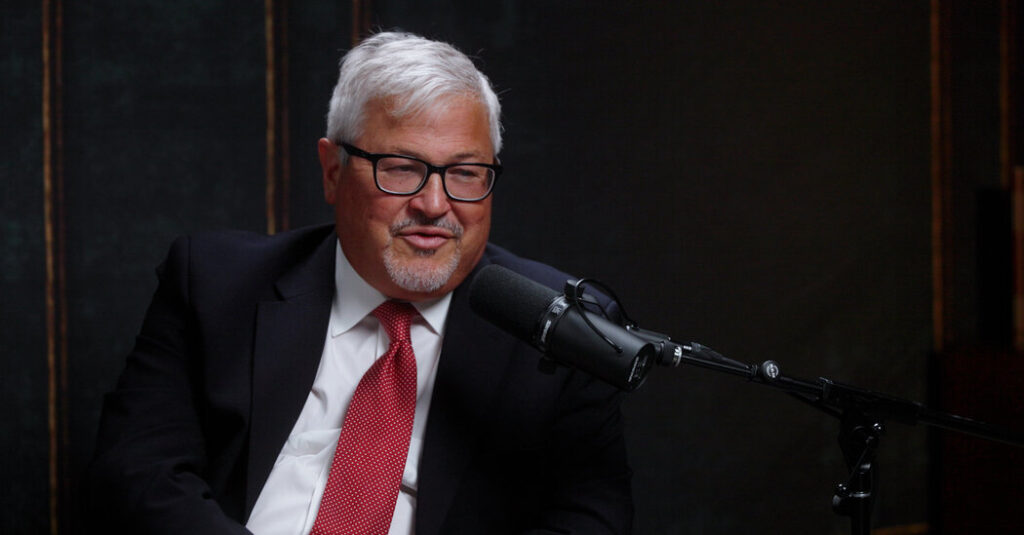
The contributing Opinion writer Christopher Caldwell and the Harvard law professor Jack Goldsmith discuss how the president has amassed this fortune, whether it’s legal and if the United States is becoming a kleptocracy.
Below is an edited transcript of an episode of “Interesting Times.” We recommend listening to it in its original form for the full effect. You can do so using the player above or on the NYTimes app, Apple, Spotify, Amazon Music, YouTube, iHeartRadio or wherever you get your podcasts.
Christopher Caldwell: Jack Goldsmith, welcome to “Interesting Times.”
Jack Goldsmith: Thank you for having me.
Caldwell: Why is it so unusual for a president to be getting rich the way Donald Trump is? Maybe you can tell us what’s normal for a president.
Goldsmith: What’s normal for a president is to strictly separate himself off from his personal finances, usually through a blind trust — a well-run, strict blind trust — to ensure that the president’s public policies are not influenced by his private business dealings such as they are.
Now, George Washington was very wealthy, other presidents have been wealthy. But, we’ve never had a president with the business dealings and business organization that Donald Trump has. They are sprawling, interconnected, hard-to-follow organizations that do a lot of business outside of the United States. Which makes it especially dangerous because they are sources for foreign monies to be given to the president through these various entities.
Caldwell: Can you lay some of these out? What’s he doing to make all this money?
Goldsmith: Sure. I mean, the most prominent ones have involved crypto, which provides channels that are anonymous and at scale for foreign entities to invest in Trump entities, to give them money. And there’s been a lot of that: $1.4 billion reported in Trump’s disclosures from 2025.
That’s been the main innovation of the second term. There have been others — the selling of access to Truth Social for $100,000 for a faster peek at what the president’s going to say, and a whole bunch of other measures — but the crypto stuff is where he’s made the new chunk of money.
And just to give a couple of examples: Entities in the U.A.E. invested, I believe, almost half a billion dollars — $400 or $500 million — in World Liberty Financial for a 49 percent stake.
Caldwell: World Liberty Financial is the crypto firm founded by the sons of Donald Trump and the sons of Steve Witkoff, who’s associated.
Goldsmith: Primarily — I believe primarily. And there may be other people involved, but yes, it’s a Trump-related entity for sure, and definitely Trump’s sons are involved. The U.A.E. national security adviser is involved in investing and buying a 49 percent share of this moneymaking machine.
So there’s a lot of money coming to the Trump families from entities outside the United States, which is unprecedented, especially at this scale. There’s just been nothing like this in American history.
Caldwell: And how does it align with other things that we might consider abuses of power in the White House, even if they don’t involve putting money in the presidential pocket? Things like dynamiting the East Wing of the White House to rebuild a ballroom structure with donor contributions rather than congressionally appropriated money.
Is that the same sort of thing, or is that a different family of ——
Goldsmith: I would say it’s on a continuum. So you might think that campaign finance contributions and/or even contributions to the building of the White House — depending on how you look at what he’s doing with the White House — you might think those all come within the American political democratic system.
Those things are regulated by law, to a probably much greater extent, than these crypto dealings and related dealings outside the United States. So they’re both closer to home; they’re both more heavily regulated.
The really bad thing that I haven’t mentioned is the concern — and this was a concern of the framers of the Constitution — is especially with foreign governments giving money to a U.S. official in a way that may distort policy.
The worry is — and this is the essence of this form of corruption — is that the president will focus on how to make money, and give away policy in exchange for that money.
First of all, the president should be focusing on serving the public and serving the public interest, and not focusing on making money. But to the extent that the president is making money, the concern is that these foreign entities who are giving the president money are going to get policy favors — access favors and the like — in return. And therefore, that American policy will be skewed. I think there’s every reason to be concerned about it.
I don’t think we can prove that policy’s been distorted, but there’s tons of circumstantial evidence that it has been.
Caldwell: There’s a word “kleptocracy,” which has, I think, a special meaning. I mean, there’s always venality in all political systems. But I think that kleptocracy means a system in which enriching the leader is the primary goal of a political system.
Do you think we’ve gone that far?
Goldsmith: Well, and just to specify — enriching in a financial sense. There may be other senses in which presidents and officials become enriched. They may become famous — they may be able to trade on that fame after they leave office and the like. I think what you’re talking about is financial enrichment.
I do think it’s fair to say that we have, in part. I mean, it’s not the only thing driving policy, but that corner of policy that is being influenced by the president — making money off of foreign entities giving his entities money — does count as a kleptocracy. And you might think that, to the extent that that is a large part of the president’s time — and it tends to be — that we are moving in that direction.
I mean, there’s a lot of things going on in Washington. But I would say that that is kleptocratic, yes.
Caldwell: A lot of this does look sleazy when you look at it, but do we have actual violations of law? And more importantly, has the president violated the Constitution?
Goldsmith: So this is a harder question than you might think. The president is not subject to the conflict-of-interest regime that the rest of the federal government — except for the vice president — is subject to. So he’s basically opted out of the core conflict-of-interest regime.
The reason for that is, one remedy for a conflict of interest is recusal. The president can’t recuse; he’s in charge of everything. So in the last 50, 60, 70 years, we developed alternate strategies to deal with conflicts: norms that every president until Trump, with tiny little deviations, followed. So there’s not a whole lot of law governing it.
There’s the bribery laws, which are very hard to meet. And while there is, as you say, lots of seeming mischief going on, I haven’t seen a clear claim of bribery yet.
So you asked about the Constitution, and the main provision there is the foreign emoluments clause. And the foreign emoluments clause says that no person holding an office of profit or trust can, without the consent of Congress, receive an emolument, a transaction involving profit or financial gain, from a foreign state. That’s a paraphrase, but that’s basically what it says.
Caldwell: That’s very interesting because in domestic law, it would seem you really have to prove a bribe, like a quid pro quo, as opposed to just a gift. But in these foreign contexts, the distinction between a gift and a bribe is less important?
Goldsmith: Well, there’s no question of intent. It’s not a criminal prohibition, it’s just a constitutional prohibition. The idea is that we don’t want foreign states giving presidents presents, titles and emoluments without Congress’s consent, which would kind of clear the conflict. And there’s no intent requirement; it’s just a matter of whether it happened.
Now, while it seems clear to me that these transactions violate — and I hate to use this word, but I’m going to — the spirit and the aim of the emoluments clause, there is a legal question about whether a private business receiving private transactions counts as an emolument.
I don’t buy that argument, but the point is it’s not clear whether he has violated the emoluments clause. So I think it should all be looked at because these corporations are so closely tied together and connected to Trump.
These are huge amounts of money going to the Trump family or Trump businesses from a senior official — a national security official — in the U.A.E., who is also running these companies. And there are benefits going back the other way to the U.A.E.
I’m not suggesting quid pro quo. I’m not suggesting a tie. We don’t have enough information yet. But these all raise suspicions, and the American people should know whether its policies are being distorted so that the Trump administration can make a lot of money.
Caldwell: Right. And there’s a couple of things that make the U.A.E. a special case, and one, I’d say, is its link with China, right?
Goldsmith: Well, as I understand it, the Biden administration was wary about giving high-level chips — Nvidia chips, I believe — to the U.A.E., for fear of their relationship with China. That this might be a way for Nvidia chips to be either transferred to China, or that they would be used to build facilities that would aid China. I believe that was a concern during the Biden administration.
Obviously, we don’t know why the Trump administration changed the policy, but that policy was changed. And they were given the chips.
And this happened I wouldn’t say in connection with but in the same general time frame as the Trump administration was receiving lots of money from entities associated with senior officials in the U.A.E.
So that just screams for the American people to understand what was going on. The president’s pockets are being lined. There’s a major policy change where national security is at stake. Maybe there was a genuine reason to shift the policy, but it at least raises suspicions and it needs to be investigated, if that’s what you’re asking.
Caldwell: Is it also significant that, in fact, we are now fighting a war partly on the U.A.E.’s behalf? I mean, the president’s authority as commander in chief is pretty broad, and he’s got a lot of discretion, and I wouldn’t want to suggest that he doesn’t have that discretion. But tell me how we ought to think about these foreign-policy-making prerogatives in the light of big transfers of money from a foreign country.
Goldsmith: This is the central concern. Not only is the export of the chips a major national security issue — we’re involved in a very significant war throughout the Middle East.
The president, as you say, is the commander in chief, with basically almost limitless discretion on how to act. And this is precisely the core concern of the emoluments clause. The worry was that foreign governments would be giving the president or another official an emolument in a way that would distort the national interest.
I don’t know if the policy in Iran right now has been distorted because of these relationships. It would be hard to imagine that it wouldn’t impact them. But this is another way of getting at the concern that the emoluments clause seeks to get to.
Caldwell: So you have policy change, but do you have actual institutional damage? I mean, can you point to institutions that are being altered by the needs of this new type of relationship to money in the presidency?
Goldsmith: If you mean by institutional damage that the institution of government will be fundamentally changed because of what Trump is doing here, that I think remains to be seen.
This may be a unique Trump phenomenon that lasts for three more years, and then we’ll have an accounting of it and then we’ll decide as a country whether we want to change the rules on this. I do think they need changing.
But it could be that all of the institutions of conflicts of interest snap back. And the reason I say this is because it’s hard for me to see — and maybe this is a failure of my imagination, or my cynicism. It’s hard for me to see a Democrat who’s going to come into office and take advantage of the ways that Trump has manipulated the government toward these ends to line their pockets and alter policy in the same way.
Now, a Democrat might not win the next election. But I just think that while it’s terrible for the institutions, I think it’s also terrible for confidence in government. And I think it’s potentially terrible for U.S. foreign policy and other policies. I don’t worry about institutional change in this context as much as I do in others.
Caldwell: I’m not necessarily talking about an institutionalization of kleptocracy. But for instance: You’ve served in the Justice Department. Something like the anti-weaponization fund that Trump tried to pass, or tried to put through some months ago — is that an example of something where you could get a permanently more politicized Justice Department in that regard?
Goldsmith: So I think that topic, to me, moves off of the kleptocracy point to what I think of as the weaponization of government. By which I mean, the president using all the tools of his executive discretion to help his friends in questionable ways and to harm his enemies. That I very much worry about.
And I worry that there already have been institutional changes, and there will be more, no matter who the next president is. But I don’t see that in the same basket as the kleptocracy point.
Caldwell: Well, then, let’s ——
Goldsmith: Although let me just say: The I.R.S. fund. There was the fund for the Jan. 6 folks, to help your friends and send signals. Then there was the I.R.S. settlement, which was intended as a way for the president to make money and avoid liability in using government tools. That’s a little closer to what we’re talking about.
Caldwell: So what should we do? What changes in law or in government are going to be helpful as we go forward?
Goldsmith: So the first thing I would say is, don’t elect presidents who have sprawling global businesses that they’re very keen to make money off of during their presidency. That may seem like a flippant answer, but I really mean it.
Caldwell: I don’t think he’ll be the last to want that.
Goldsmith: Maybe. I hope he is. In terms of the scale of what he’s doing — and as I suggested earlier, it’s not clear to me why other politicians would have at least the same scale of this — but I’m not suggesting there’s no worry.
So there’s lots of things that could be done. Congress can regulate in this area. The emoluments clause that I paraphrased said that the president is not allowed to accept these emoluments without congressional consent. That is a hook for Congress to define what an emolument is more clearly, to provide a way, a system, for people to sue, to bring lawsuits, to enforce it, or use that power and other powers Congress has to, for example, force presidents to have financial arrangements of greater integrity.
This gets into the blind trust area. This gets into ensuring that the president is legally barred from running a business. It gets into the idea that federal officials cannot be associated with entities that trade in crypto. There’s a whole bunch of regulations and laws that could be brought to bear, to tamp down on this problem. And I think they should be considered.
By the way, a lot of this stuff was apparent after the first term. The massive loopholes in presidential accountability for conflicts of interest was crystal clear, and the Biden administration didn’t seem interested in working on that.
President Trump himself, when he was asked earlier this year — I think by The New York Times — and I’m going to paraphrase again: Why are you more forward-leaning in your foreign adventures with your family’s companies? And he basically said, because I learned that no one cared.
Caldwell: Oh.
Goldsmith: And I think that was the lesson. The lawsuits against him failed; Congress didn’t do anything about it. It was all out in the open and nothing happened.
Caldwell: Well, it’s funny — Donald Trump, in his last campaign, argued that the government already was weaponized. And in a certain way, you can say he had a point: You had four prosecutions against him that were clearly coordinated, at some level, to fall during election season. And it seems to be the case that one man’s weaponization is another man’s accountability.
Goldsmith: I think that there is truth in the fact that aspects of the government were weaponized against Donald Trump before he came to office. I’ve talked about this before.
If I could just get a definition of weaponization on the table: Weaponization, as I see it, is the use of discretionary executive power to use the tools of government to try to harm or destroy your enemy.
Now, the problem with that definition is it kind of depends on what the intent is. The Democrats thought: Trump had acted illegally, and they were just getting accountability, and therefore, it wasn’t weaponization because they had a good intent. And the Trump administration saw them as having a bad intent.
The conglomeration of lawsuits against him — including not just the New York lawsuits, not just the federal lawsuits, not just the Georgia lawsuits — but the 14th Amendment effort to get him removed from office and taken off the ballot: Elements of it, because of the unusual nature of some of it and how some of it was conducted, definitely seemed like weaponization.
And I would also add to that some elements of Crossfire Hurricane, the investigation into the Russia matter. So I do think that the Trump administration, and I could go on, on this score — there’s more things — but I do think that they had grounds for grievance about the weaponization of government.
The last thing I’ll point out is, it was a very serious thing for the Biden administration to prosecute a former president, for the first time in American history, who was also the president’s opponent in the election.
I thought that the documents prosecution was justified. I was less convinced that the Jan. 6 prosecution against Trump was justified. But whatever, that was a momentous decision in American history, to bring that prosecution against your opponent.
And that was a norm violation. Whether it was a justified one or not, people are going to debate about. It’s going to have a huge impact ——
Caldwell: You’re saying that Biden violated the norm of ——
Goldsmith: I wouldn’t say that Biden did because he was nominally out of it, because there was an independent counsel. But yes, he did, because, of course, The New York Times reports that Biden was furious that former U.S. attorney general Merrick Garland was sitting on his hands. And Merrick Garland got that message.
That was certainly a violation of the norms. He was meddling, through The New York Times, in the Justice Department’s business. So the Biden administration was not clean on this.
And then there was the state stuff and other stuff that, to Republicans, seemed like Democratic weaponization. And I think it’s, frankly, a fair charge. I don’t think it justifies what Trump is doing. And Trump, for what it’s worth, has gone so far beyond it. He’s really taken it and run with it, including in his so-called anti-weaponization initiatives, which are weaponizing initiatives. And this is why I worry very much about the tit for tat. Because if we have increasingly spiraling upward tit-for-tat weaponization, where one party uses the tools of the executive branch, enhanced by the unitary executive, to try to destroy, in effect, the candidates and infrastructure of the other party, that’s unsustainable for this country.
Caldwell: But this is a very classic dilemma in a democracy ——
Goldsmith: Yes.
Caldwell: Because if your opponent forges a weapon to use against you, what any party will do is hold it until it’s ineffective. So you get these accidental stalemates that can demilitarize, if that’s the ——
Goldsmith: I hope that happens, and I think there’s a chance that that could happen after Trump.
Another dilemma, by the way, that’s related, is the dilemma of: If there’s wrongdoing by a prior administration, do you use legal tools to go after them? Do you investigate them? We’re now in three cycles of investigations of past administrations.
Caldwell: Yeah.
Goldsmith: There’s a massive trade-off there between accountability and the rule of law.
But on the other hand, it is extremely dangerous and corrosive to do these things. And I would say that all of the people who were insisting on these rule-of-law prosecutions against the Trump administration, and about how it was necessary to uphold the rule of law — I think the rule of law is in a worse place now because of those.
Caldwell: They really do back politicians into a corner, and they may wind up offering incentives to bad presidential behavior.
Goldsmith: Agree.
Caldwell: But another thing that Trump has said is that he believes that the constitutional pardon authority applies to him. And I think that that’s created a certain, let’s say, fatalism on the part of a lot of his political adversaries.
But I think that certain people who study the Constitution have said there’s no reason to be so fatalistic. It’s not obvious that a president can pardon himself. Do you come down anywhere on that question?
Goldsmith: So I’ll answer that question, but I just want to explain first why I don’t think the self-pardon issue is as important as some people make it out to be, if I could.
So the pardon power is a power to relieve the consequences of a criminal prosecution or a criminal investigation. It’s to wipe out the effects of the crime, effectively. It’s not clear that there’s any crime being committed here.
Caldwell: OK.
Goldsmith: It’s not clear that there could be a — in fact, it’s far from clear that there’s any crime being committed here. It’s not clear that there would be an investigation of Trump, in time, if there were a crime for him to even be able to assert the self-pardon.
The pardon power is stated in a way that doesn’t answer the question. It says the president has the power to pardon. Some people think that a pardon involves a bilateral relationship, and therefore the president can’t pardon himself.
Some people think that, as the Office of Legal Counsel once said in the 1970s, no man — and I’m paraphrasing — can be a judge in his own case. That’s not necessarily a constitutional principle, but it makes sense.
Caldwell: It’s an ancient and common English law principle.
Goldsmith: Yeah. Makes sense.
Caldwell: Yeah.
Goldsmith: There are other arguments that say because a pardon is not allowed, a pardon cannot cover an impeachment; that maybe the framers thought that the president could pardon himself because he could be impeached. I don’t find that argument terribly persuasive.
I’ve looked at this question a lot — a lot of people have. My candid judgment is that I don’t know the answer. I do believe that Trump will pardon himself, along with a lot of other people, at the end of his term.
But I doubt it will ever be adjudicated. I don’t think we’re ever going to reach the stage where he will assert a pardon to stop an investigation. That’s so many years down the road, and I don’t know if he’s going to be around then.
And it’s not even clear that a prosecution of Trump after he leaves office is in the country’s best interest. So I tend to think that the self-pardon issue is just not terribly salient. But to answer your question, it’s not clear. Sorry about that.
Caldwell: To put this in a broader historical perspective, there is a kind of irony about this because Donald Trump ran on a number of very popular things. From limiting immigration, to more dignity for working-class people.
Goldsmith: I agree.
Caldwell: But one of the key things that he ran on was cleaning up corruption. Draining the swamp. When you have a bureaucratic — what he would call a deep state — when you have an administrative state like that, you have a certain amount of opacity that does allow people to claim certain privileges out of sight of the public.
Has there been any progress on that front, against which this other kind of corruption might be considered a price?
Goldsmith: So you’re asking me, has he cleaned up the deep state? And I take it, more concretely: Has he made inroads against the deep progressive bias of the deep state?
Caldwell: Yeah.
Goldsmith: I think that that’s still out to lunch, but I’ll tell you what I think on that score. It is clear, in many agencies, that the Trump administration has cleared out a whole range of career officials. They’ve done so on a whole number of criteria, and they’ve done so, in my judgment, because they want to get rid of the influence that you’re talking about.
Republicans and conservatives have long seen the federal bureaucracy and the deep state part of the federal bureaucracy, as a font of asymmetrical power by the Democrats and progressives. So they’ve clearly made progress in diminishing that. And, especially in the department I know best, the Justice Department, the career officials have really been decimated there.
And again, I’m just focusing on the Trump perspective. I think a lot of what the Trump administration is doing is trying to dole out punishment against the sources of political cultural power where they have always felt disadvantaged, in the hopes that they will have raised the cost so much that it will never go back. That’s one of the most important things I’m going to be watching for after Trump.
Caldwell: And the U.S.A.I.D. firings might be the archetypal example of that.
Goldsmith: Yes, that’s an archetypal example. But there are others.
Caldwell: So if you view the problems of the American government the way most Republicans did at the start of this, when they voted for Trump, then there is a real benefit to having a goal-oriented businessman to cut through some of this stuff.
Goldsmith: So, yes, I would say that from that perspective, there’s a benefit. It comes at a cost.
Caldwell: Yes.
Goldsmith: Because a lot of the stuff that they’ve been doing — the inside-the-government initiatives, in addition to the cruel ways in which they’ve done it — but just focusing on legality: The legality of what they’ve done there is quite contested, and there’s actually more executive branch authority to effectuate those changes than I would have thought at the beginning of the term.
A lot of the other initiatives trying to achieve similar ends — going after big progressive law, going after my university, for example, going after some media properties — a lot of these things are being done, in my judgment, through clearly illegal means.
And yet it’s still effective. They can lose in court and still win because the law firms are settling. They want to avoid the whole hassle. The media companies are settling — some of them are. They want to avoid the hassle. They don’t want to cross Trump.
Caldwell: I think their spines are stiffening a little bit lately.
Goldsmith: They’re starting to stiffen a little bit, some of them. But the university, same thing — my university had a spine on this. But the question is not just what’s happening now, but what’s going to happen in the next round. And will these — what I view as vicious and often illegal — attacks on these institutions, with the end of destroying these progressive power centers, have this deterrent effect down the road?
There are so many things that are going to happen, assuming a Democrat wins once Trump leaves office. This will be one of the big things to see — if that snaps back. Does that make sense?
Caldwell: Yes, it does. I’m just trying to imagine what a Democratic president could do that would be analogous, but maybe that’s too speculative?
Goldsmith: Well, there’s a lot of things. So I think we’re now shifting to a slightly different topic, but it’s related. I have no doubt — this is, by contrast, what I think is going to happen with the corruption, conflict-of-interest stuff.
I could be wrong — maybe I’m not cynical enough — but I don’t think we’re going to see President A.O.C., or whoever the president is, come in and start monetizing the government for her personal benefit. I just don’t think that’s going to be high on the agenda. Because Trump is really a unique figure in this regard.
But what we’re talking about now — weaponizing the government to destroy the infrastructure of your enemies — I think it’s going to be very hard for the Democrats not to use these tools. They’re going to be huge — sorry, go ahead.
Caldwell: Yeah. No, no — that’s interesting. I would say in a more general way, there’s kind of a new normal that arises from the vast sort of crypto-governmental power that private corporations have.
I mean, Google used to go around saying, we can predict epidemics better than the Centers for Disease Control. There’s tremendous governing power in a lot of these private businesses. And any president is going to need to use them, lest they be used against him.
Goldsmith: Or use them or co-opt them the way Trump has been doing. I mean, Trump has done an extraordinary job of co-opting these major firms to give him money, give him fealty — to basically keep him off their backs, to get the policies he wants from the companies.
And there’s just a mirror image of what can happen when the Democrats do that — going after conservative power centers, I think. And there’s going to be an enormous temptation to do that, I think.
Caldwell: There’s also kind of an ethics of the free market that has been developing for a much longer time than Donald Trump has been on the scene. And I’m wondering if maybe the president, and some of the people around him, part of what they’re expressing is just stuff they’ve absorbed in the general culture.
I wonder if you — looking back over the last 30 or 35 years — think maybe we’ve given money a little bit too much credit for being an aid to good governance?
We’ve always said these things like, well, you can make much better decisions if you have skin in the game, and that kind of thing. And: This guy’s a better politician; you should vote for him because the other guy’s never met a payroll.
And people who’ve been successful earning money in any walk of life think that that gives them a certain credential for reordering government in the same way.
Goldsmith: Oh, I think this is a fair argument, if I understand it. This came up most clearly, I thought, when David Sacks became the crypto czar early in the Trump administration. I think he also had another portfolio — there were all these questions about conflicts of interest. And he was a special government employee, so he had to be subject to different types of ethics rules.
Some Republicans have made this point in the past, that it’s a good thing to have members of the private sector in the government. These are people who know how the world runs, and they know how to make money. And so we shouldn’t worry about the conflict of interest rules so much, because they’re going to have better government.
And in fact, on this view, conflict of interest rules are designed for the deep state. These are people who are less competent and who are less expert at really getting things done — I’m just telling you what the argument is.
And I think there’s certainly something to be said for that theory in a world in which — and this is clearest in A.I. policy, but it’s clear in other areas — the government is going to have to be drawing on the private sector more and more for expertise, for technology, for innovation.
There’s an argument for this new theory or — I wouldn’t say new conception, but for this other conception of conflicts. But I think that’s different from — just to go back to where we started — I think that’s different from the weakening conflict of interest rules in the service of getting private-sector people in the government to bring their expertise to bear. That strikes me as quite different from Trump making money off of the U.A.E.
Caldwell: But we seem to be entering a sort of new period here.
Goldsmith: I agree.
Caldwell: And I think when you look back at America’s quarter of a millennium, you have to say we’ve been incredibly fortunate in the way our leaders have dealt with money.
You had a couple of scandals in the 20th century — well, you had the Grant administration, the aides to Ulysses S. Grant: Many of them profited off of railroads and other arrangements. You had the Teapot Dome scandal under Warren G. Harding. Then you’ve had some ethics scandals, from Richard Nixon to Bill Clinton.
We’ve been quite lucky. In each of these cases where we’ve had scandals like these, they’ve led to more congressional oversight, or oversight from some other quarter of government. Do you see that happening now?
Goldsmith: I am pessimistic.
I mean, yes. Especially, as you know, in the 1970s following Watergate, following Vietnam, following the Church Committee’s investigation of the C.I.A. — especially Watergate on this front, the country was for this, and that’s the most important point: There was a concerted effort to bring ethical rules to the presidency.
And it was not just Congress. Congress did its bit with a whole bunch of statutes, some of which — like the Ethics in Government Act, which introduced the independent counsel — made things worse, not better. But a lot of which made things better.
But at the same time — and this is really important — there was a parallel track where presidents, starting with Gerald Ford and Ed Levi in the Justice Department, but then Jimmy Carter — they adopted a whole set of very important norms. A norm is a rule of right reason that’s not legally binding, but that, if it works right, has political consequences if you don’t follow it.
And those norms worked remarkably well for, say, the next 50 years. And they were starting to frazzle — I don’t want to blame Trump only for the diminution of the norms or the blowing up of the norms, but in his first term, he tried and failed.
And in his second term, they thought about it more, and they’ve massively succeeded on a scale that’s hard to fathom. So your question about whether Congress can or will do something about this is going to depend on how important it is — they could have done something in 2021 — and on who the next president is. I mean, one really interesting question is: If a Republican wins in 2028, does it continue this or change this?
So it’s very hard to predict, but I do think the country is much more aware of the problem now than they were after Trump’s first term.
Caldwell: It seems that it’s really a democratic problem. It’s really in the hands of voters. I mean, there were ——
Goldsmith: I couldn’t agree more.
Caldwell: There were a number of attempts after 2020 by Democrats, a little bit too concerted, to hold Trump to account. One of them even resulted in a guilty verdict.
But when the American people voted in 2024, they essentially vacated those convictions.
Goldsmith: Yeah. I agree.
Caldwell: And so it’s kind of up to them now, in the coming midterms and in 2028, to decide what kind of regime they want to be living under. And I will say that a recent poll indicates that about 90 percent of Americans consider their government, in general, to be quite corrupt. And what’s surprising is that it’s very high among both parties.
So I wonder what you’re expecting that democratic verdict to be? I mean, are you seeing people running on this issue in the midterms? Do you think it’s gaining any purchase in the public?
Goldsmith: It’s hard to tell. I hear a lot of people saying it’s not getting any purchase. I think that the drumbeat of stories about Trump lining his pockets, set alongside stories of Americans not doing so well — people are shocked and surprised that this connection doesn’t seem to be getting purchase, alongside Trump pledging to drain the swamp but not draining the swamp in this respect.
People say, well, why isn’t more happening? Part of the problem is that the Republicans control Congress. If there were a Congress opposed to the president, this would be a little bit different.
And part of the problem is that democracies work slowly. Especially since Trump has shut down the internal executive branch check — totally shut it down — and Congress has shut down and the courts have not been dealing with these issues terribly much — these issues of ethics that we’re talking about, and conflict of interest.
I do sense that Democratic politicians are trying to make an issue of this. I do sense that Republicans are on their heels about this. It’s extremely difficult to defend.
But I couldn’t agree with you more that this ultimately lies with the American people. Norms, which used to work in this area — they work if the people care and they express that care through their politicians and in other ways.
Ultimately, this all depends on who the American people elect and how they respond to how the person they elect acts. I couldn’t agree more.
Caldwell: Jack Goldsmith, thank you so much.
Goldsmith: Thank you.
Thoughts? Email us at [email protected].
This episode of “Interesting Times” was produced by Sophia Alvarez Boyd, Victoria Chamberlin and Raina Raskin. It was edited by Jordana Hochman. Mixing and engineering by Pat McCusker and Efim Shapiro. Cinematography by Marina King. Video editing by Dani Dillon, Julian Hackney, Arpita Aneja and Steph Khoury. The supervising editor is Jan Kobal. The postproduction manager is Mike Puretz. Original music by Isaac Jones, Sonia Herrero, Pat McCusker and Aman Sahota. Fact-checking by Kate Sinclair, Mary Marge Locker, Julie Beer and Michelle Harris. Audience strategy by Shannon Busta, Kristin Lin and Andrea Betanzos. The executive producer is Jordana Hochman. The director of Opinion Video is Jonah M. Kessel. The deputy director of Opinion Shows is Alison Bruzek. The director of Opinion Shows is Annie-Rose Strasser. The head of Opinion is Kathleen Kingsbury.
The Times is committed to publishing a diversity of letters to the editor. We’d like to hear what you think about this or any of our articles. Here are some tips. And here’s our email: [email protected].
Follow the New York Times Opinion section on Facebook, Instagram, TikTok, Bluesky, WhatsApp and Threads.
The post Crypto, Gold and Foreign Money: Is This What the Presidency Is Now? appeared first on New York Times.