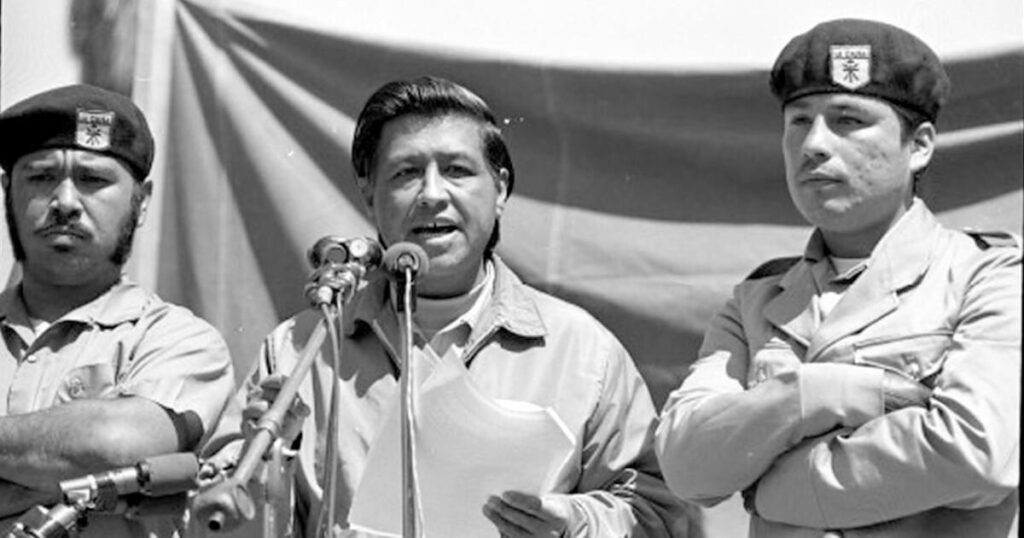
A woman who worked for labor leader César Chávez and the United Farm Workers organization he helped found is suing a pair of related nonprofits for negligence, sexual harassment and civil rights violations, claiming they facilitated her abuse and did nothing to protect her and others from his unwanted sexual advances.
The woman, identified as Jane Doe in a suit filed last week in Kern County Superior Court, says Chavéz sent her husband away on union business over her 33rd birthday in 1973, plied her with alcohol at the party he’d arranged and pursued her so aggressively she hid from him in a bathroom.
After she rebuffed his advances, the suit alleged, Chavéz lay in wait at her home in La Paz, the former tuberculosis sanatorium in the Tehachapi foothills where the union boss and his top lieutenants lived. There, she said, the charismatic icon who’d been the best man at her wedding raped her in her marital bed while his bodyguard stood watch outside.
“He planned this, he knew how to make it work so he could do these things,” said the woman’s attorney, V. James DeSimone. “[The bodyguard] is standing guard to make sure ‘the chief’ could get away with whatever he wanted to do.”
Years later, the lawsuit claims, Chavéz summoned the woman to his home, where he “forcibly pulled [her] head down to his crotch” against his erection.
“Employees and others there within UFW were aware of the abuse but failed to respond to this knowledge in any manner,” the suit alleged. “Instead, despite this knowledge, the UFW employees ensured that any abuse was done in closed quarters, outside of visibility of others.”
Doe, 86, sued UFW Foundation and the César Chávez Foundation as Chavéz’s employers, saying the nonprofits enabled his attacks, ignored and rebuffed contemporary complaints about them, and covered up evidence they had occurred.
The UFW Foundation did not immediately respond to a request for comment. The Chavéz Foundation said in a statement it had just become aware of the complaint.
“We are reviewing with our legal counsel and will respond in a way that stays true to our mission and values,” foundation spokesman Daniel Herrera wrote in a statement.
Doe joins a growing chorus of women who say they were privately terrorized by the country’s most famous union activist. Among them is movement leader and longtime ally Dolores Huerta, who told the New York Times she gave away two daughters conceived when Chavéz raped her — once in the early 60s and again in 1966 — and agonized over the violence in secret for decades.
“I carried this secret for as long as I did because building the movement and securing farmworker rights was my life’s work,” Huerta said in a statement following the Times exposé. “I have kept this secret long enough. My silence ends here.”
The paper’s investigation, reported across five years and published in March, revealed a pattern of abuse and exploitation enabled by a cult of personality around Chavéz and an institutional culture that punished dissent and relegated women and girls to second-class status.
In addition to Doe and Huerta, who say they were abused as adults, former acolytes Ana Murguia and Debra Rojas told the paper Chavéz groomed and sexually assaulted them while they were still in junior high.
“The article reported that Chavez’s relatives and former UFW leaders had been aware of various allegations of sexual misconduct for years, but made no efforts to investigate the allegations, acknowledge the victims, report to abuse to authorities, or halt the abuse from continuing,” the new suit alleged.
In January, California opened a so-called “lookback window” for adult survivors to sue institutions that made a “concerted effort to hide evidence of sexual assault” by their employees.
Doe’s attorneys say they expect more women will come forward with similar claims before the window closes at the end of next year.
Chavéz, whom the lawsuit called “a folk saint,” has been venerated across California for decades, with scores of schools, streets, parks and public buildings named in his honor. In 2014, his birthday was made a national holiday.
For Doe and other accusers, those public honors brought private agony.
“She was able to get out of the organization and go on to live a life where she did meaningful work, but that fear never left,” said Mike Arias, another attorney for the woman. “When you have someone they’re building monuments to, naming roads after, it’s a [constant] reminder of how powerful he is.”
She and others also feared hobbling the movement they’d spent their lives building up.
“Everybody thought the movement was too important to allow this to be a distraction,” Arias said.
Attorneys for the woman said they hope the suit will hold the institutions accountable.
“You don’t want to take down the institution, but it has to hurt,” Arias said. “And if it hurts, hopefully it motivates those who are in power to make sure that when these things come to light, they put a stop to it.”
The post Woman accuses César Chávez of sexual assault in lawsuit against two nonprofits appeared first on Los Angeles Times.