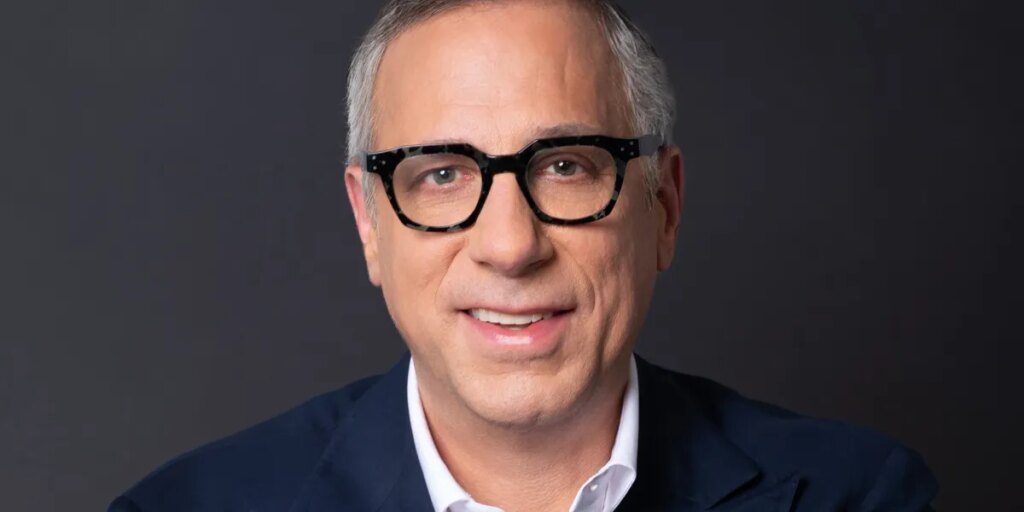
For the past 18 months, Brian Franz has overseen all data, technology, and analytics at Estee Lauder, the first-ever C-suite leader to fill that role at the beauty giant. As of Tuesday, his role promises to be even more transformative.
This week, the M.A.C and Clinique purveyor, which ranks #315 on the Fortune 500, announced Franz has been appointed to the newly expanded role of chief technology and transformation officer, where he will continue to oversee the global IT team, further integrate partnerships with Shopify and Accenture, promote more internal and external use of artificial intelligence, and be tasked with leading enterprise-wide initiatives focused on supporting revenue growth and improving productivity.
“We have amazing brands and really great history, insights, and data for 80-plus years now,” says Franz, who previously served as CIO at financial-services firm State Street, liquor maker Diageo, and food behemoth PepsiCo. “But, we had to really position ourselves for where we need to be in the future.”
What that has meant for Franz is ensuring that all 14,000 of Estee Lauder’s employees have broad access to AI productivity tools including Microsoft Copilot and ChatGPT, while also investing in more narrow AI use cases to speed up formulations and improve efficiencies at the company’s manufacturing facilities. AI is also changing how millions of consumers shop for beauty brands on chatbots like Gemini and Claude, further complicating and accelerating a discovery process that’s already been upended by TikTok, Instagram, and other social media platforms.
Transformation has been a key theme at Estee Lauder, which only two years ago was facing weaker demand for cosmetics and fragrances and facing criticism that the company hadn’t pivoted speedily enough to the digital world that has driven consumer purchase patterns. Stephane de La Faverie, a 14-year Estee Lauder veteran, was hired to serve as its new CEO to formulate and execute a turnaround plan called “Beauty Reimagined.”
Beyond vowing to increase advertising spending and remove complexity in how Estee Lauder’s teams work, de La Faverie also lured in new talent for his C-suite, including hiring Franz from State Street and Nestlé alum Aude Gandon, who serves as chief digital and marketing officer. Fiscal fourth-quarter results from Estee Lauder in August have shown these efforts are beginning to pay off: strong demand for luxury fragrances and skincare drove results above Wall Street’s expectations and Estee Lauder’s annual profit forecast for the current year also had positive upside.
Franz says his mandate will include all technology efforts that can improve product formulation, better forecast demand, smooth operations at the manufacturing plants, and boost worker productivity. All of these investments are intended to support his three key priorities: creating an omnichannel shopping experience that’s as frictionless as possible, unifying disparate sources of data across a decades-old organization, and adding a dash of “AI everywhere” for buyers and employees.
“The running and operations of technology every day has to get more and more productive,” says Franz. “And then, we have to shift as much of the investment into these consumer-facing, revenue-enhancing, or margin-expansion activities.”
His AI bets have included working alongside Google Cloud to launch a consumer-facing, AI-enabled scent advisor for Estee Lauder’s Jo Malone London brand, working closely with software provider Adobe to use more generative AI for the company’s digital marketing campaigns, and launching a “formula navigator” AI tool that’s improved product development efficiency by 20%.
Another AI use case is “Ella,” which stands for Estee Lauder Line Assistant, to help operators address equipment issues and lessen the time needed to switch manufacturing lines between different product runs.
To bring employees along the journey, Franz says Estee Lauder has embraced the “reverse mentor” model that empowers younger team members who are early technology adopters to teach more senior leaders about the latest AI tools. There are also AI champions that have been identified within each of Estee Lauder’s brands—the company has more than 20 within its portfolio—to help spearhead usage, which more recently, includes idea sharing around building AI agents.
“Adopting new ways of working is always something that takes incredible effort,” says Franz. “Culture and change drive all the outcomes. The technology doesn’t adopt itself.”
Franz also recently hired professional services firm Accenture for the parts of the business that Estee Lauder outsources, which includes running the company’s technology applications and environment, as well as performing many of the finance, accounting, procurement, human resources, and e-commerce marketing functions.
Yet another key vendor that Estee Lauder has tapped is e-commerce platform Shopify, which is helping run Estee Lauder’s direct-to-consumer omnichannel business and making it easier for online shoppers to buy beauty products with fewer clicks. Next month, Estee Lauder will also turn on Shopify’s agentic feature—which helps brands get discovered on AI chatbots—for the first time beginning with M.A.C.
Consumer and retail brands like Estee Lauder are only recently wrapping their heads around generative engine optimization, or GEO, which refers to the tactics that need to be honed to promote accurate product discovery across the large language models that underpin chatbots.
“The LLMs decipher what real consumers are saying, and what it is that they understand about the products we make,” says Franz. “What we’re focused on is that they find us in the LLMs, but then, within a click or two clicks, buy that product. It is still early.”
John Kell
The post How beauty giant Estee Lauder’s top technologist is betting on ‘AI everywhere’ to fuel its turnaround appeared first on Fortune.