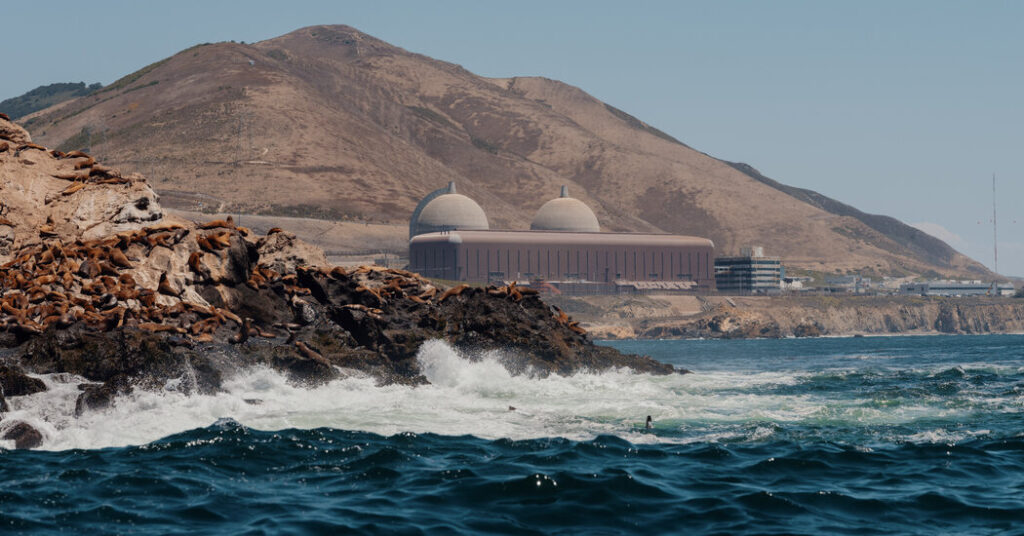
The Diablo Canyon Power Plant, which sits on a cliff on California’s Central Coast, has been the subject of ceaseless protests and political battles since it was proposed in 1963.
Now, the plant is at the center of yet another major debate. After shuttering all the state’s other nuclear power plants in recent decades, California is considering extending Diablo’s life and lifting a moratorium on new reactors.
That these decisions are even on the table in California is a testament to the substantial change in public views of nuclear energy, which for decades has been reviled by the liberal lawmakers and environmental groups that wield tremendous power and influence in the state.
Many of its leaders, including Gov. Gavin Newsom, have expressed support for nuclear energy. The California Legislature last month passed a bill to commission a study on partly lifting the ban on new reactors.
Much of the change of heart has to do with the growing concern that California will need nuclear reactors to achieve its 2045 goal of getting 100 percent of its electricity from clean energy sources, a category that includes wind, solar, geothermal, hydropower and nuclear.
State lawmakers prohibited new nuclear plants a half-century ago until the federal government found a place to permanently store the spent but still radioactive fuel removed from nuclear reactors — a goal that has not yet been achieved. Spent fuel has long been stored at nuclear power plants.
But lawmakers in California now are much less worried about the storage of spent fuel and more concerned about meeting their clean energy goals.
“Reducing greenhouse gas emissions is vital to the health of Californians and California’s economy,” Assemblymember Lisa Calderon, a Democrat who sponsored the bill to study the lifting of the state’s nuclear moratorium, said in a statement. “Nuclear energy could significantly contribute to reducing these harmful emissions that have increased the frequency, severity and costs of wildfires, floods and extreme heat events in California.”
The big question now is, what will California do? Its decisions could influence lawmakers in other states and play an important role in the success of the Trump administration’s plans to build scores of nuclear plants, including new designs being developed by start-ups, some of which are based in California.
While the state’s politicians are more open to nuclear energy, many residents and energy experts remain opposed to the technology. These people contend that California would be better off doubling down on renewable energy and batteries, a move that would allow the state to hit its clean energy goal at lower cost and with fewer concerns about nuclear safety and waste storage.
Nuclear opponents do have one thing going for them: California has managed to keep the lights on while relying more and more on cleaner energy sources.
Solar, wind, hydropower and geothermal energy accounted for 70 percent of the electricity generated last year in the state, according to the Energy Information Administration, a federal agency. That number is up from about 49 percent in 2020. But those figures do not include the electricity that California buys from other states, a portion of which is generated by natural gas, coal and nuclear plants. California imports about a quarter of the electricity it uses, the most of any state.
“The fact of the matter is solar, wind and batteries are the cheapest, fastest-to-deploy power there is because the technology has caught up to the problem,” said Bob Keefe, executive director of E2, a national research and advocacy group that works on economic and environmental issues, during an August summit at the University of California, San Diego, on nuclear waste.
But California’s electricity system has its problems, chiefly that its average power prices are the highest of all states except Hawaii. In June, the typical California household paid $347 for 1,000 kilowatt-hours of energy, compared with $183 nationwide, according to E.I.A. data.
Mr. Keefe and other energy experts said that adding more nuclear energy would drive up those rates further because new reactors cost billions of dollars and that most projects ended up costing a lot more than planned.
Established nuclear plants like Diablo, however, tend to produce relatively affordable power. Some energy experts who say new reactors are too expensive and risky support extending the lives of old plants until renewable energy and batteries can be expanded to meet 100 percent of electricity demand.
Diablo Canyon’s two reactors began operations in 1985 and 1987, more than 20 years after the plant was proposed and in a different location, partly because of public opposition.
The reactors generated more than 8 percent of the electricity produced in California last year. Diablo is a massive facility. Its two towering concrete domes sit just behind a long turbine building that runs the length of two and a half football fields and faces the Pacific Ocean.
The plant had been scheduled to close by the end of 2025, but Mr. Newsom and the Legislature extended its operations through 2030 — a decision that some residents and environmental groups unsuccessfully challenged in the courts. The Nuclear Regulatory Commission, a federal agency, has approved the plant’s license through 2045, but state lawmakers need to agree to keep it running that long.
The federal Energy Department is helping to keep Diablo Canyon going. The department contributed $271 million in August to support the plant’s operations and said it could receive as much as $1.1 billion for new equipment, fuel purchases and other expenses through a federal program, depending on the results of spending audits.
Proponents of nuclear energy say that, despite the success California has had with renewable energy, the state will need nuclear reactors if it wants to phase out fossil fuel use. Without nuclear energy, they argue, states will have to build lots more solar, wind and battery projects to ensure they can meet their energy needs 24 hours a day, 365 days a year.
Pacific Gas & Electric, which owns and operates Diablo Canyon, says the plant helps to keep California’s electricity costs lower than they otherwise would be. And it helps lower greenhouse gas emissions by avoiding the use of fossil fuels, a reduction equivalent to removing 1.6 million gasoline cars from U.S. roads every year.
“It stabilizes the grid,” Maureen Zawalick, a senior vice president and the chief risk officer for PG&E, said during a tour of the plant. “It’s one of the highest performing, safest plants in the country.”
Diablo became the sole nuclear power plant in California after the San Onofre Nuclear Generating Station in Pendelton, between Los Angeles and San Diego, shut down in 2013 because of costs related to the replacement of its steam generator. Two other plants closed in the 1970s and late 1980s.
Utilities in the state also own part of a nuclear power plant near Phoenix, the Palo Verde Generating Station, which sends some of its electricity to California.
Energy experts said they wouldn’t be surprised if California kept Diablo open longer, but expected a bigger fight if the state moved to build new reactors.
Last month, the Legislature passed a bill directing the California Energy Commission to study the feasibility of using advanced nuclear energy technologies to cost-effectively meet the state’s energy needs and the 2045 clean energy goal.
Executives of electric utilities in California, including Edison International, which owns Southern California Edison, say they are encouraged that state lawmakers are more open to nuclear energy.
“Whatever the tool is, we will need sustained, clean firm generation,” said Pedro Pizarro, president and chief executive of Edison International, referring to energy generated from zero- or low-carbon power sources that can supply electricity whenever needed. “I think that this is terrific for California to be looking at this. It’s going to be a long road.”
The post Why California Is Reconsidering Its Decision to Shun Nuclear Power appeared first on New York Times.