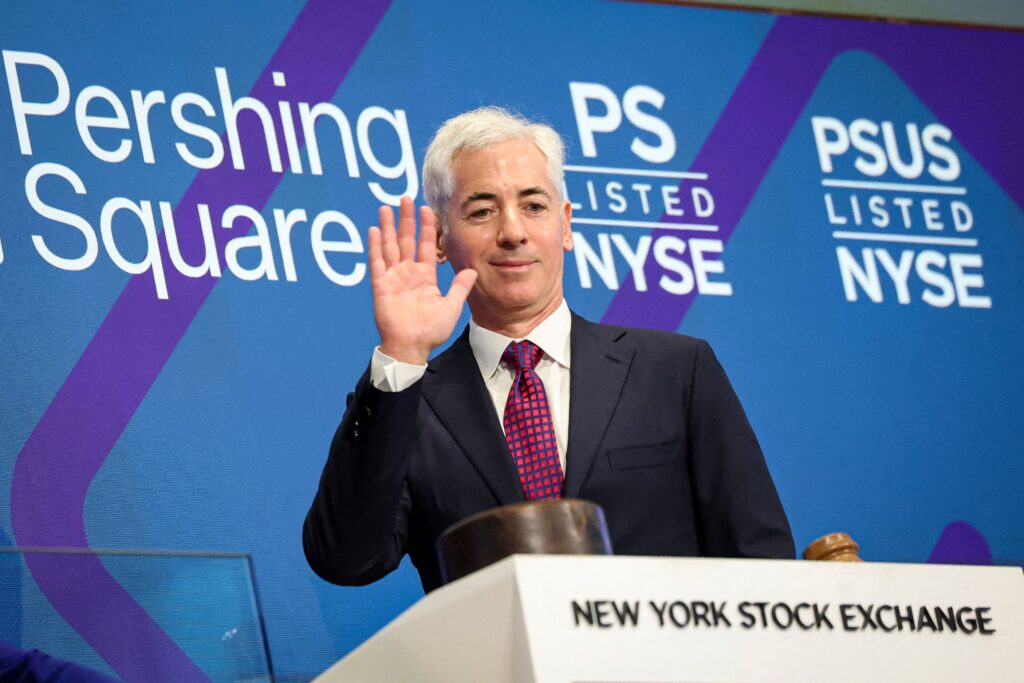
Billionaire Bill Ackman’s life was upended this February when his 26-year-old daughter collapsed in her Brooklyn apartment, suffering a brain hemorrhage that would render her unable to move, speak or see.
The hedge fund manager did what any good father would do — at least, any father with vast financial resources and what friends describe as a “Mr. Fix-It” tendency. He sprung into action, getting her topline care at New York City’s Mt. Sinai Hospital and consulting a network of well-connected friends all over the world. He helped her access a novel cell therapy that has been gaining traction among longevity enthusiasts, who are seeking ways to prolong human life. And then — motivated by a newfound desire to accelerate scientific research — he vowed to spend more than $400 million to launch an institute dedicated to longevity and brain health.
“Our goal is to build the world’s greatest brain research, rehabilitation, recovery, human optimization, and longevity institute,” he said on X, where he has documented his personal saga in characteristic detail and swagger to his 2.9 million followers in recent weeks. He posted this week that the U.S. Food and Drug Administration, in May, gave his daughter Lucy’s medical team a first-time emergency authorization to transplant mitochondria — the energy-producing part of human cells — from her leg muscle to her eyes, in the hopes that the tiny cell powerhouses would facilitate healing in her optic nerves and perhaps even restore her vision.
Ackman’s story highlights the increasingly prominent role of the ultra-wealthy in making expensive medical bets on longevity treatments and other novel therapies, altering the direction of research as federal funding for science declines in the second Trump administration. But his saga is a deeply personal one, spurred by his daughter’s medical crisis.
The focus on longevity by Ackman, who made billions on Wall Street as a hedge fund manager, is aligned with similarly ambitious efforts from some of Silicon Valley’s biggest names. OpenAI CEO Sam Altman has backed Retro Biosciences, a start-up whose goal is to add 10 healthy years to the human lifespan through cellular reprogramming. Amazon founder Jeff Bezos is reportedly a funder of Altos Labs, which focuses on cellular rejuvenation and resilience. (The Washington Post has a content partnership with OpenAI, and Bezos owns The Post.)
Billionaire investor Peter Thiel, Google co-founder Sergey Brin and Oracle co-founder Larry Ellison are also deeply invested in life-extension methods and attempts to rewrite the biology of aging. Billionaire Elon Musk co-founded the brain implant company Neuralink, while Neuralink co-founder Max Hodak’s latest start-up, Science, has raised hundreds of millions for a retinal chip that restores some vision to people suffering from age-related macular degeneration.
Many of these figures, including Ackman, are supporters of President Donald Trump, whose administration has taken positions and appointed leaders that are friendly to the longevity movement. Health Secretary Robert F. Kennedy Jr. has said he takes experimental longevity protocols. Jim O’Neill, a longevity focused investor and former colleague of Thiel, stepped down from a senior leadership position at the Department of Health and Human Services earlier this year, and is Trump’s current nominee for director of the National Science Foundation. An FDA panel recently voted to allow greater access to several peptides that are popular with biohackers, reversing an earlier stance. Longevity advocates are also pushing the U.S. Food and Drug Administration to classify aging itself as a disease.
At the same time, the administration has cut off funding for science: There were at least 2,700 fewer scientific projects supported by the National Institutes of Health in fiscal 2025, about a 15 percent cut in the number of competitive grants compared with the previous fiscal year, according to a Post analysis. The administration has terminated more than 100 advisory committees to science agencies, according to an April report in the journal Nature, and has prompted a staff exodus within the FDA, which regulates new drug development. Billionaires, with their pet interests, are increasingly stepping into the gap.
Ackman declined to comment for this article.
The therapy given to Ackman’s daughter Lucy, known as mitochondrial transplantation, is of great interest not only to people who have suffered injuries, but to longevity-focused scientists who believe that mitochondria may hold promise for reversing some of the effects of aging. Mitochondria have long been known as the cell’s energy powerhouse, converting the food people eat into adenosine triphosphate, or ATP, which acts like a battery store for energy within the cell.
In recent years, scientists have discovered that mitochondria have many other functions beyond converting food into energy. They serve as clearinghouses for damaged cells, opening up the possibility that they can help with cell regeneration and healing, said Daria Mochly-Rosen, professor of chemical and systems biology at the Stanford University School of Medicine and co-author of “The Life Machines: How Taking Care of Your Mitochondria Can Transform Your Health.”
“I am one of those who believes that focusing on mitochondrial health is a way to address many human diseases, including aging itself,” she said. “It’s exciting.”
The first transplant of mitochondria from one part of the human body to another was reported in 2017, from an abdominal muscle to the heart. Since then, dozens have been performed, including a transplant to the brain in 2024, but never to human eyes until now, Mochly-Rosen said.
In an interview over email, David Putrino, a Mt. Sinai neuroscientist responsible for Lucy Ackman’s care, said that he, Chris Kellner and other colleagues had been working on mitochondrial transplant research for about a year through the Mt. Sinai Cohen Center for Recovery from Complex Chronic Illness, which Putrino directs. In April, they read a study in the journal Nature, in which a mitochondrial transplant was successfully used to help a mouse recover from an injury that crushed the animal’s optic nerve. The study convinced the Mt. Sinai medical team that it was time for a therapeutic attempt in humans — a moment Putrino described as “extremely serendipitous” because he happened to have a patient that could be a candidate for such a procedure.
Lucy Ackman’s doctors approached her family with the idea, and the team ultimately applied for a time-sensitive regulatory permission to obtain the drug, known as an eIND, something Putrino said he had done only two times before in his career. In those cases and in this one, he was “amazed at the rigor, speed and compassion” of the FDA scientists that reviewed the request, he said. The authorization, known as “compassionate use,” allows for immediate access to investigational therapies when no alternative standard treatments are available to save someone’s life.
“This is an important first step in validating the safety and tolerability of an extremely promising novel therapy,” he said. “We are hopeful that this treatment may be applied to a diverse range of neurological conditions as we learn more.”
The FDA did not respond to a request for comment.
Still, Mochly-Rosen said that some scientists are skeptical that injecting a small number of mitochondria can be beneficial when the body requires trillions of mitochondria to function, and think mitochondria can’t easily survive the process of implantation. “There are people pushing back on whether it is all real,” she said.
For the first few weeks, the treatment — an injection into her eyes — provided Lucy Ackman with a modicum of benefit. She regained the ability to perceive light, according to a paper that Putrino’s team has submitted to the journal Nature, but has not been peer-reviewed. The paper noted that it caused no harm to the eyes, which was important to measure since this was the first time it had been done in a person. After about a month, the benefit appeared to wear off.
“We are working on a method to inject her eyes with more frequency,” Bill Ackman posted this week, adding that mitochondria “has amazing potential.”
Ackman is a longtime philanthropist and a former Democrat, who at one point gave some of his biggest donations to causes like putting undocumented immigrants through college. During the coronavirus pandemic, he went through a political transformation and turned toward the right.
The change in his politics was prompted, in part, by what he felt was a lackluster and insensitive response at his alma mater, Harvard, to the Oct. 7, 2023, Hamas attack on Israel, when compared to how Harvard and other universities responded to the police killing of George Floyd in 2020. He said that a focus on “diversity, equity and inclusion,” or DEI, was a major contributor to antisemitism, because it separated groups into an oppressor-versus-oppressed framework and labeled White Jews as oppressors, according to extensive interviews he gave The Post in a 2024 profile.
That year, he helped lead the charge, through a series of multi-thousand word online jeremiads, to oust Harvard’s first Black president, Claudine Gay.
Ackman became active on X — a platform he hadn’t used before the pandemic — interacting more with right-leaning tech figures, a crowd that is steeped in talk of human optimization and longevity. This crowd — including the health podcaster and Stanford University professor Andrew Huberman — was among the first to cheerlead his post about mitochondria. “You anticipated this approach,” Huberman called out on X, tagging a longevity scientist who he had hosted on his podcast.
Both in his crusade at Harvard and in his activist shareholder letters, Ackman is known for long missives and going all-in on a cause. After the Harvard campaign, he also announced that he was launching a think tank, now called the Carob Trust.
His initial post about his daughter was over 1,900 words. It featured his characteristic solutions-oriented energy, his tendency for linguistic detours — including a discussion about how he had successfully acquired the real estate for the laboratory from a university whose portfolio had lost value — and his flair for a boldly stated plan of action. He said he has tapped a Nobel laureate, a leading neuroscientist and the CEO of the pharmaceutical company Regeneron to serve on its board. He also said that he considered creating a brain institute several years ago, when his wife Neri Oxman’s mother died of Alzheimer’s, but “couldn’t make the math work.”
Since then, he said, universities had become “a much less attractive place to work due to politics outweighing meritocracy, protests that disrupt learning, the curse of antisemitism and a decline in funding” — enabling him to acquire space and recruit talent.
He said he is calling the institute the Ackman Oxman Institute — “or the AOI for lack of a better name” — and that it will be focused on patients.
“It will not be an academic research institute that produces lots of papers,” he wrote.
As for Lucy, he said the recovery will be hard but he was “optimistic” she would one day “return to normal function.” He said he meets with her medical team for an hour each day on Zoom. The hardest of all her faculties to regain will be her sight.
s
The post She lost her sight. Her billionaire father bet on a daring new treatment. appeared first on Washington Post.