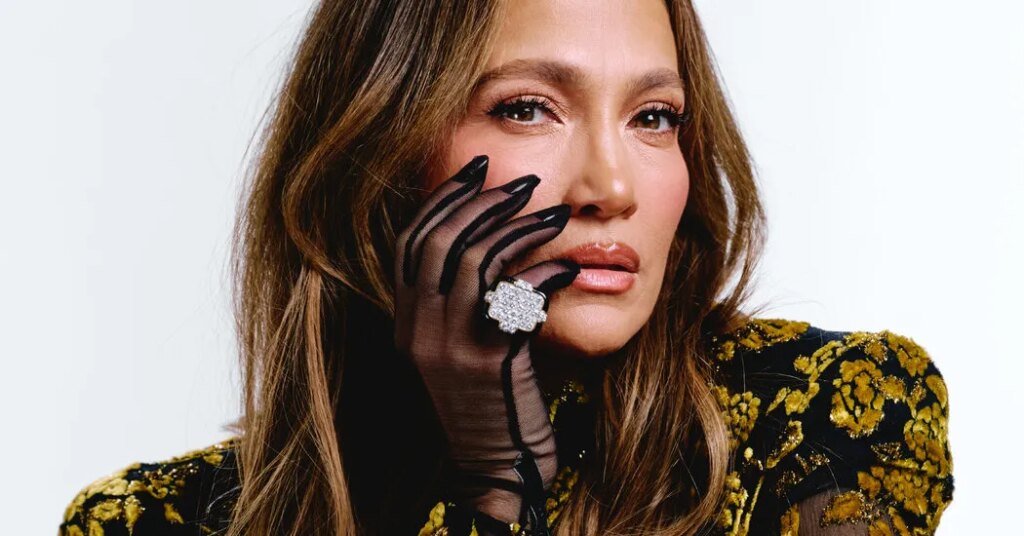
Watching Jennifer Lopez perform in “The J. Lo Show” — a two-hour Thanksgiving concert special on CBS and Paramount+ — provides a glossy, dazzling and unrelenting view into the art that’s shaped her. The concert is Lopez’s ode to Las Vegas, to the musical theater of the 1950s and ’60s, to the club music of her younger years. She covers Barbra Streisand, Elvis Presley and … Lana Del Rey. She is working hard to make those connections appear seamless, and, like in much of her classic work, she does not show sweat.
Lopez, 57, is one of the few entertainers of her generation still interested in the sort of old-fashioned extravaganza that takes in music, theater and dance. “The J. Lo Show” also comes on the heels of a tumultuous stretch in which Lopez commingled professional and personal to unsteadying, distracting effect. In 2024 she released a trio of projects: an album, “This Is Me … Now”; a self-funded, ambitious movie musical, subtitled “A Love Story,” to accompany it; and a behind-the-scenes documentary, “The Greatest Love Story Never Told.”
A monument to her romantic reconnection with Ben Affleck after two decades, the slate of projects captured Lopez with a level of vulnerability that, for a performer so committed to smoothness, was startling.
The couple split soon after its release, divorcing following two years of marriage, and Lopez canceled the associated tour.
Now she’s back on more familiar ground. “I feel like I am a better performer today than I was 20 years ago. I’m a better singer today. I’m a better actor today. And I only am those things because of the life that I’ve lived,” Lopez said on Popcast, The New York Times pop culture show. “I don’t say that with any sort of arrogance. I say it in loving myself and appreciating who I am and how I’ve grown. I don’t think that there’s anything wrong with that.”
This peace of mind also means that Lopez is, maybe for the first time, letting go of reckoning with legacy.
“You have artists that all their lives are just giving, giving, and sometimes in the middle of it they peak, and sometimes at the end they peak, and sometimes after they’re dead they peak,” she said. “If you’re going to live as an artist, you’re going to have to really just accept that your life is creating things, and whether people love them or hate them, you’re still going to do the same thing.”
In conversation with Jon Caramanica and Joe Coscarelli, Lopez spoke about being a rigorous performer well into her 50s, her long-running tussles with media coverage of her life, and why certain stripes of public vulnerability are no longer for her.
JOE COSCARELLI This new live show is indebted to your Broadway musical heroes and the showmanship of a Las Vegas revue. It all amounts to one of the most athletic showings that I’ve seen from a pop performer at your age — it’s like Tom Brady, LeBron James, Jennifer Lopez and Madonna. Can you talk about how you’ve maintained your athleticism? Is it technological, medical or strictly discipline?
JENNIFER LOPEZ I think it’s discipline. From a very young age, I was an athlete first. I did gymnastics when I was very little, then I ran track for a while, and it really set in me a discipline to work hard and to know there was nothing physically that I couldn’t do. Then I became a dancer first, and I fell in love with that. So when I started making music and I started doing movies and all of that, everything came from a place of dancing and athleticism for me. Everything was blocking, everything was rhythm, everything was cadence. Everything was about stamina.
JON CARAMANICA When you were in your pop emergence, 20-plus years ago, that was an era of real maximalist extravaganzas, delivering a Broadway scale within the space of a music video. And then pop got kind of casual after that. Was it about a different kind of emotion that needed to be expressed?
LOPEZ It was Michael Jackson, Janet Jackson. I think the business changed, right? I think budgets changed. Because when I first started, they were spending one, two million dollars on a video. Now you have to do them for $100,000, $150,000. And it forces you to be more creative. We were able to do these big things, but now, who knows? With all of the A.I. and all of that, they’ll be able to do more extravagant things for less money.
You have to be who you are. My influences when I was coming up were my influences, which is why I made “The J. Lo Show” at this time in my career. But all of that stuff was in me from the first record I made, “If You Had My Love.” You know, it was theatrical. It was glossy and big. Because that’s what I grew up on.
COSCARELLI No imperfections, whereas today I feel like sometimes people lean into the imperfections.
LOPEZ Right. Well, look, I tried to lean into my imperfections in my last album. It wasn’t as received, right?
CARAMANICA Was that your takeaway from the last cycle for “This Is Me … Now?” To me, there is a vulnerability and a rawness in the behind-the-scenes film that I think most artists of your caliber of success would run from. Or they would choreograph it. I don’t sense that’s what was going on.
LOPEZ I was in full creative control of the music, which I made first, and then I was like, I want to make this little mini-movie musical. Those things, I was in total creative control. I was not in control of the other thing [“The Greatest Love Story Never Told”]. I allowed somebody else to be in control of it and I think it overshadowed the actual music project, which is all I really cared about. And so that, for me, was disappointing. I watched that recently with a friend who had never seen it.
COSCARELLI How was that experience for you?
LOPEZ I was like, wow, this was really ambitious. I’m proud of it, because I feel like I really was on a journey that I didn’t even understand I was just at the beginning of. And this is a thing when you create as an artist — you are making something and you are doing it instinctually, but you don’t really understand why you’re doing it completely until later. You look back at it and you go, I thought I was at the end of the journey. I was at the beginning of the [expletive] journey. What? Like, I blew my own mind.
COSCARELLI But you thought it was a happy-ending moment. You were like, this is the bow.
LOPEZ Right! I thought I had learned the lesson, got there. I was just about to get my greatest lesson and I didn’t realize it.
CARAMANICA Can I offer an alternate thought on that? Maybe it was a distraction from your original intent, but it opened a portal for you to come out on the other side. Now that people have seen a part of you that, candidly, probably had not been publicized for 20-plus years prior, and that maybe that affords you a different set of opportunities moving forward. Now people have seen the vulnerability, seen you crying on camera, seen the anxiety that you’re going through as a musician and artist and businesswoman, because you’ve laid out $30 million of your own.
LOPEZ $20 million. By the way, never again. Learned my lesson.
CARAMANICA Is there not a positive takeaway for you to say, “OK, well, now people have seen me in that place, what can I do with that?”
LOPEZ You know, it’s funny, when I’m done with a project, it’s there for the world. I obsess over it, its details and then it’s done, and whatever happens with it happens with it. And then I just kind of move on.
I think, what do I feel like doing now? It’s a different time now. I hadn’t made a lot of music — I’ve done a song here and there since “This Is Me … Now.” And it wasn’t until this year, when my kids were about to graduate and going away to college and I’m on my own and not in a relationship for the past — I don’t know what it’s been — two and a half years now, and I’m looking at an empty house, that I was like, “Oh, I have so many feelings right now,” that I went to go back into the studio. And I’m not even thinking about what I did before this. I’m just thinking, what feels good right now?
CARAMANICA And are the things that you’re interested in saying right now more consistent with this raw side?
LOPEZ It’s more of an unapologetic side.
COSCARELLI Benny Medina, your longtime manager, told us that you were making “coming-of-age music.”
LOPEZ Yeah, that’s what I call it. My kids are going out into the world right now. I remember leaving home, I didn’t look back. So now what am I looking at? And you realize, I’m still young. I still want to do things. And it’s another coming of age, because what happens is, for the first time — I think especially for me as a woman — I’m not thinking about my mom, my dad, a husband, a boyfriend, my kids. I can think about me. You’re free, and it’s scary and sad and also, like, [expletive] exciting and so hopeful.
COSCARELLI So what does the music sound like?
LOPEZ It feels really kind of aggressive, because I want to dance.
COSCARELLI I’m happy to be wrong, because from watching the Vegas special, my thought was, is pop J. Lo done? Is this her saying, I’m Barbra now, I am going to do the standards?
LOPEZ But look at Gaga. I mean, she went and did the whole Tony Bennett run. You don’t have to just be one thing or do one thing. I said, if I’m going back to Vegas, Vegas is very different than doing arenas and stadiums. It’s an intimate experience for people, and it needs a narrative. You just can’t play, you know, [expletive] hit after hit. It’s not like that. You have to entertain people. People are coming to your show who don’t normally come to your show.
CARAMANICA Do you feel like some of the leash you gave the director of that documentary to show some of those less varnished parts of yourself you’re now pulling back?
LOPEZ To be honest, I don’t know. I want things to be more sacred in my life and I’ve learned lessons about being out there with relationships. That’s not something I ever want to do again. But as an artist, I think if you lack the vulnerability, if you lack the introspection, you’re not going to make anything that matters. Or that matters to you. You won’t be able to. So you kind of have to still stay like an open, raw nerve. And people will pick at that, and it will hurt. But nothing’s going to stop me from doing and creating the things that I feel in my heart, because then it’s like, what is life about?
COSCARELLI You’ve tried every coping mechanism for the fact that your love life has been bandied about in public for decades now. What’s the best way for you to react to what’s inevitable?
LOPEZ Well, it’s like I just said, that’s not something I ever want to do again, as far as share that part of my life with people. It’s not that people won’t know — they’ll see me in the street. But at the same time, it’s not something I want to comment on. It’s not something I’m inviting people into. That’s not something that I’m interested in anymore, because I really feel this thing — this media machine — is a destructive, hurtful machine.
COSCARELLI Do you regret doing it in the past — any phase of trying to reincorporate the tabloid stuff into your art and career?
LOPEZ No, because the relationships that I was in, whether the media was there or not, they were not meant to be. So I can’t say, “Oh, it was the media that did this.”
COSCARELLI You don’t blame the media for what happened in any of these cases?
LOPEZ No, because it’s two humans, you know what I mean? And you have to figure that out. I don’t.
CARAMANICA Do you feel like you understand better, in the rearview, when you look at the choices, the people that you were choosing, why you made those decisions?
LOPEZ Like I said, the biggest lesson was coming. And after that whole thing fell apart, I was able to cancel my tour and sit in a rocking chair for like a year. Not work, be home for the kids, because it’s something that they went through, too, that was devastating for them, and just be there every single day. Like, waking up with the kids and seeing them off, and then just being there when they got home, and doing nothing.
COSCARELLI You’re among the most ambitious celebrities that we have. How do you do nothing?
LOPEZ Because I felt like it was so important for me to sit in the discomfort of what I had created for myself, in a way. Like, you can look at a relationship and go, “This person did this and this person did that and that person’s not capable of this.” But at the end of the day, any experience that you’re having is being created by you. And so you have to sit there and go, “What is it that I’m doing? Who am I? What do I need to figure out for myself so I can make better choices?” I didn’t even understand what love was. I didn’t know what a healthy relationship should even feel like.
COSCARELLI Into your 50s, you felt that?
LOPEZ Oh, yeah, into the last relationship that I had. I thought it was one thing, but really it’s something else, you know? And that was just because of how I was raised, and how becoming famous — you know, being a star is lonely.
But you learn a lot if you really sit there with yourself for a while. I had a therapist, I had a religious coach. I had somebody who was explaining, you know, addictions and things to me. I just searched in all the places to get back down to the little girl who did grow up in the Bronx, who was pure, and gained a better appreciation for that person.
I allowed a lot of people to come in and fill a space in me that I needed to be filling for myself. Now, walking through the world is so different for me, because I’m not looking for anybody else to make me happy. I make me happy. I appreciate the life I’ve created.
COSCARELLI We’re talking about this idea of worth through the lens of love and relationships, but I’m also interested in the way it’s manifested for you professionally, which is this sort of fight for critical respect.
You had these moments at the beginning, with “Selena,” “Out of Sight,” some of the earliest music, again with “Hustlers,” where it starts to feel within your grasp, from the outside at lest, that you’re going to get the respect you deserve as an artist. And then every time, it’s a little like Charlie Brown and Lucy with the football, where then it goes away. You’re going to headline the Super Bowl — it’s a co-headline. You’re going to be nominated for an Oscar — how about a Golden Globe? And I wonder how your understanding about your needs in relationships has developed alongside your understanding of your needs as an artist?
LOPEZ It all has to do with how you see yourself, and how you are thinking of yourself is kind of what mirrors to the world. If you’re not feeling like you’re worthy yourself, then why is anybody else going to think you’re worthy? But when you realize that you are really worthy, that you do deserve these things, that 30 years in this business is not a fluke, you start going, “OK, all right, I belong here.”
COSCARELLI Are you properly rated at this moment in time? Do you feel like your legacy is accepted for what it is?
LOPEZ My legacy is what it is. I don’t care.
COSCARELLI You don’t care?
LOPEZ I don’t care. I love what I do, and it’s nice when people go, oh, you’re nominated for these things. I have a whole wall full of awards at home. And they’re nice, but they don’t make me as excited as creating a new song in the studio. Even before anybody hears it, I’ve listened to it 150 times and loved it every single time. And then if it goes out in the world and people like it, that’s just a bonus.
Even with all of the hardships and heartaches and disappointments professionally — you didn’t get nominated for this, or you didn’t do that, this movie should have hit better, or whatever — I think my average is pretty good.
The post Jennifer Lopez Feels Like She’s Getting Better at Everything appeared first on New York Times.