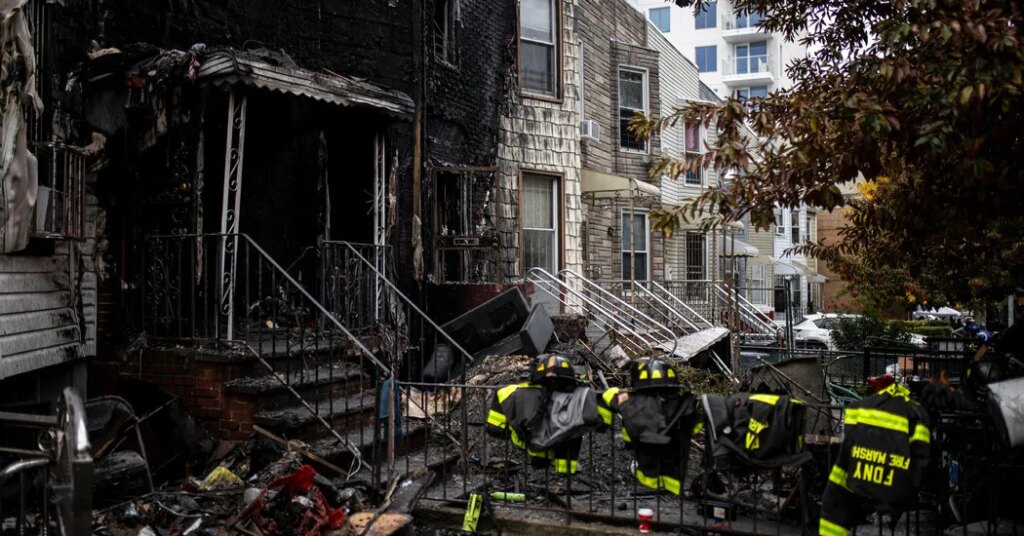
A family of four was about to sit down for a dinner of curry and rice on Feb. 9 when the smell of smoke wafted into their first-floor apartment in Queens.
Thick black smoke was making its way up from the basement. The home, their refuge since arriving from Myanmar, would soon become the scene of a nightmare.
It took firefighters less than five minutes to arrive at the three-story home on Dongan Avenue, in the Elmhurst neighborhood. But the building had already gone up in flames, killing a 34-year-old Dominican woman and her newborn daughter. It would also take the life of Thet Aung Oo, at 22 the youngest member of his family, on the first floor.
Mr. Thet Aung Oo, also known as Alex, was the 18th person to die in a fire in New York City this year, a number that had grown to 89 by Nov. 19. That’s substantially more than the 51 fire deaths recorded by this time in 2025, and the highest toll since 2023. Fire marshals have yet to determine the cause of the blaze that killed Mr. Thet Aung Oo.
But it was typical of deadly fires this year in the city, which have largely swept through older homes, and have killed some of the city’s most vulnerable people.
Fire marshals have not been able to point to an individual reason for this year’s increase. Instead, officials say a range of familiar dangers, from the lack of fire protection in older buildings to illegal living conditions, have contributed to this year’s toll. Deaths blamed on arson, sometimes just the reckless flick of a lit cigarette, and lithium-ion batteries, usually being used by delivery vehicles, have also ticked up.
The increase in fire deaths this year has shined another spotlight on the city’s affordable housing crisis, and represents a reversal of years of progress in fire safety.
City officials, including Mayor Zohran Mamdani, are worried about the start of the winter, when most deadly fires occur as people celebrate the holidays and try to stay warm.
“As the weather starts to get cold, we have concerns,” Chief John Esposito of the Fire Department said. “What we don’t want to see is the carelessness dealing with fire safety, dealing with electrical safety. The causes, unfortunately, are repeated year after year.”
There are more than one million buildings in New York City. Many of those are residential — townhouses, brownstones and walk-ups as tall as six stories — and were built roughly 100 years ago or more, using flammable materials, like wood, and without fire safeguards, like sprinklers and fireproof stairs.
Six of the deadliest fires to unfold this year occurred in such buildings, according to an analysis of fire and buildings data by The New York Times. And most of the victims have been poor people of color, older citizens, children and immigrants.
The City Council is scheduled to hold a hearing on Friday to address the rise in fire deaths. The hearing is expected to focus on lithium-ion batteries, which have been linked to nine deaths this year, an alarming spike after the death toll associated with them had dropped in recent years. In 2023, the City Council pushed for measures that helped reduce the number of fires tied to the batteries, which are often used to power delivery bikes.
The fire deaths linked to lithium-ion batteries include those of a woman and her three sons last month in the Bronx. Officials have theorized that the fires may be on the rise because the many batteries purchased for delivery vehicles during the coronavirus pandemic are now reaching the end of their lives.
The Council is also expected to look at the enforcement of fire safety laws. At least two fires have raised concerns about the city’s enforcement of rules addressing illegal living conditions, including one this month in Sunset Park in Brooklyn that killed six people. It was the deadliest blaze this year.
Sam Raskin, a spokesman for Mr. Mamdani, said the administration “is taking a coordinated approach to reducing fires and fire fatalities through stronger enforcement of housing safety requirements, public education, building inspections and long-term investments in safer housing.”
Another area of concern has been a spike in deadly arsons. This year, 19 people have died in fires that were deliberately set, compared to two in 2025, according to the Fire Department.
Seven of the deadliest fires this year have highlighted the city’s aging infrastructure. Those fires occurred in homes that were built before the city adjusted its rules in 1938, requiring most new buildings to have sprinklers and either fireproof stairwells or exterior fire escapes.
In older homes, the contemporary demand for electricity to power our gadgets and appliances is taxing outdated electrical wiring systems. Fires sparked by electrical wiring have killed 13 people so far this year, according to Fire Department statistics.
Many tenants use extension cords and surge protectors to power multiple devices, which can cause old wiring to overheat and spark a fire, Chief Esposito said.
“People need to have discipline about that,” he said. “The fact that you can plug those things into a power strip and it works doesn’t mean that it is safe.”
Some of the buildings that were the scenes of deadly fires had been converted into illegal dwellings that were difficult to escape. The city contains thousands of illegal basement and cellar apartments that are often the only housing some people can afford.
The city received multiple complaints that the building in Sunset Park, and the house in Flushing had been illegally subdivided. The city fined the owners in Flushing after inspectors found illegal apartments and hazardous extension cords.
In the Sunset Park case, the complaints were closed after inspectors were not granted access. Marshals have not determined the cause of the fire.
In the house on Dongan Avenue, several fire risks seemed to overlap.
The two-story, wood-framed building was built in 1920. The basement was crowded with people living in one or more illegal apartments, which were reported to the city in 2009 and 2022. The complaints had been closed after inspectors were not allowed into the building.
Tin Aung Oo, Mr. Thet Aung Oo’s brother, said the apartment that he and his family moved into two years ago had many electrical issues. Using the microwave and rice cooker simultaneously tripped the circuit breaker. There were no fire alarms or sprinklers, Mr. Tin Aung Oo said. When they complained to the landlord, he came over and tinkered with things but never fixed the problem, he said.
A man listed in public records as the owner of the house did not return phone calls seeking comment.
About 10 people lived in the basement, according to Mr. Tin Aung Oo. Among them was Miguelina A. Alcantara Garcia, an immigrant from the Dominican Republic who had given birth just 17 days before the fire.
Ms. Alcantara Garcia, a hospital housekeeper, and her daughter, Emma, never made it out alive. Emma’s tiny body was pulled from the rubble the next day.
Mr. Tin Aung Oo said he believed the outcome of the fire and others like it would have been different if the city inspected buildings more aggressively and forced landlords to remedy safety issues.
“If we had all the fire protection,” he said, “my brother and the lady who died with her baby would not have lost their lives.”
Kirsten Noyes contributed research.
The post E-Bikes. Arson. Illegal Homes. Why Deadly N.Y.C. Fires Are on the Rise. appeared first on New York Times.