BERLIN — The nationalist Alternative for Germany (AfD) party — labeled “right-wing extremist” by the country’s domestic intelligence agency and accused by others of xenophobia, antisemitism and Islamophobia — finished first by a wide margin in an election Sunday in the eastern state of Saxony-Anhalt, according to projections by ARD, the public broadcaster.
The projections put the AfD at 44.2 percent, with the Christian Democratic Union, led by Chancellor Friedrich Merz, a distant second at 18 percent. It was not yet clear whether AfD’s victory would be large enough to allow the party to form a government in the state on its own. Other parties had vowed not to join a coalition with AfD.
An outright AfD majority would be a watershed moment for Germany, which for more than 70 years has kept extreme political forces out of power.
Under Germany’s proportional representation system, AfD could win such an absolute majority with less than 50 percent of the vote.
AfD co-leader Tino Chrupalla, however, did not wait for the final tally and by Sunday evening claimed a mandate for the party to govern the state, calling the preliminary results “sensational.”
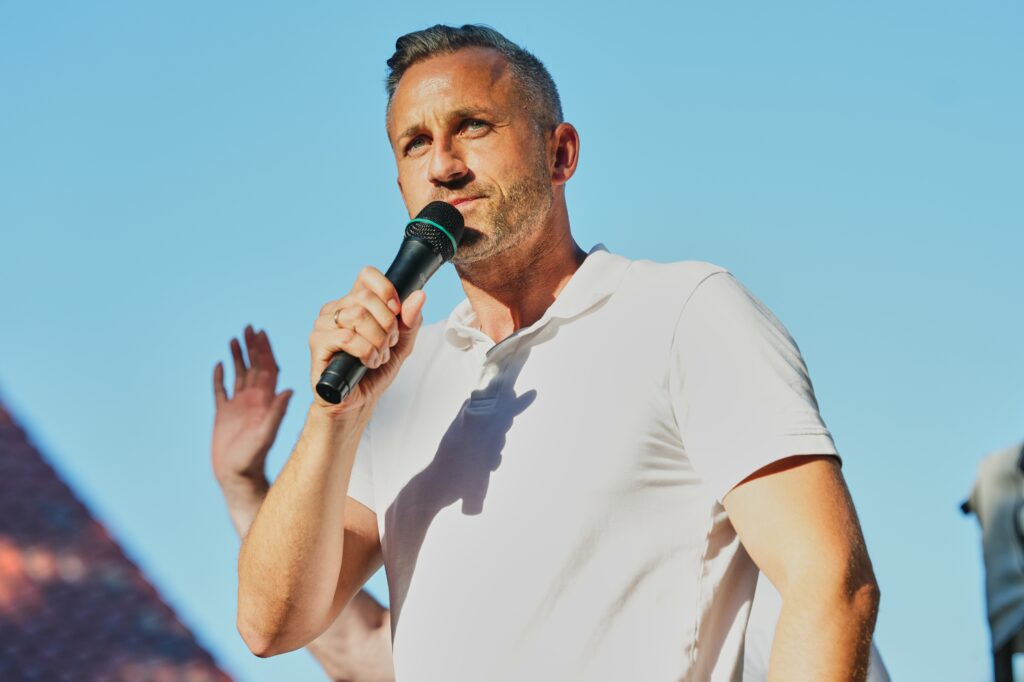
AfD’s campaign in Saxony-Anhalt was led by Ulrich Siegmund, 35, a former salesman turned social media star.
“Ulrich Siegmund will be the new premier of Saxony-Anhalt,” Chrupalla said, adding, “From here, we will change Germany.”
In a victory speech at the party’s headquarters in Magdeburg, the state capital, a beaming Siegmund declared that AfD “made history.”
“We have achieved exactly what we wanted; we have made history,” he said, adding that the result would “shake all of Germany.” Siegmund also took a swipe at media coverage of the race, saying that “regardless of how much fake news there was about us, we cannot be divided.”
Should the party fall short of an absolute majority, Chrupalla said, it would remain open to negotiations, and he suggested that other parties might accept an AfD minority government.
Inside AfD’s headquarters in Berlin, spirits ran high on Sunday, with supporters grilling bratwurst and clenching glasses of beer in anticipation of the results. Protesters gathered outside, holding up Pride flags, surrounded by dozens of police officers.
Last year, Germany’s domestic intelligence agency designated AfD as an “extremist endeavor,” upgraded from a “suspected” extremist group.
AfD is the largest opposition faction in the Bundestag, the German federal parliament. Other political forces have sworn off joining a coalition with AfD over its nationalist, anti-immigration agenda and under a “fire wall” agreement among mainstream parties that has blocked fascist, far-right and other extremist forces from forming a part of any government since World War II.
Despite the extremist label, which AfD disputes, the party has surged in polls — and has also received a warm reception from the Trump administration and influential members of President Donald Trump’s MAGA movement.
The world’s richest man, Elon Musk, gave a boost to AfD leader Alice Weidel by interviewing her live in English on his X platform last year, and he has urged Germans to vote for the party.
At a speech at the Munich Security Conference in 2025, Vice President JD Vance lashed out at German officials, criticizing efforts to exclude the party from the country’s political life.
Secretary of State Marco Rubio called the party’s designation by the intelligence agency “tyranny in disguise.” “What is truly extremist is not the popular AfD,” Rubio posted on X, “but rather the establishment’s deadly open border immigration policies that the AfD opposes.”
The AfD’s potential win has also alarmed security officials in Germany, who are concerned that the party appointees could share sensitive information with Russia.
Some AfD members have voiced support for Russia and praise for Russian President Vladimir Putin, along with opposition to Ukraine and Germany’s aid to the country, which has been fighting a 4½-year war against Russia.
The results in Saxony-Anhalt, a state of about 2.1 million people, will carry outsize significance for the rest of Germany, as Chancellor Friedrich Merz and the coalition led by his Christian Democratic Union (CDU) struggle with flagging approval ratings.
AfD leaders hope that a victory in Saxony-Anhalt would pave a path to future wins in the next cycle of federal elections in 2029. State governments in Germany wield broad powers over domestic security, education and culture.
The AfD has built its support in Saxony-Anhalt on a mix of historical grievances and modern-day challenges, with voters concerned about a stagnant economy, high unemployment, the wars in Ukraine and Iran, and overall distrust of Western liberal democratic values.
The state has lost jobs, and more than a quarter of its population, since German reunification, and East Germans still express a deep-rooted sense of being second-class citizens compared with those in states in the west because of lasting economic gaps and a lack of representation in senior government positions.
There is also fatigue with the CDU, which has led Saxony-Anhalt since 2002 but, in the eyes of many voters, failed to significantly improve their lives.
Anti-migrant sentiment is a resonant issue as well, despite Saxony-Anhalt having one of the lowest shares of immigrants in the country.
The AfD’s plan for Saxony-Anhalt includes using a special task force to deport migrants, cracking down on what it calls left-wing propaganda in German authorities’ pro-LGBTQ+ stance and overhauling the local education system to foster a patriotic upbringing in future generations. This would include shifting the history curriculum away from what the AfD sees as an excessive focus on the Nazi era, toward more “positive aspects” of German history.
One of the AfD’s central and most controversial positions is the concept of remigration, which the party officially defines as using incentives and legal measures to deport migrants.
Some regional branches of the party, and some of its members, have voiced support for a broader understanding of remigration — one that would also target German citizens they deem insufficiently assimilated into society.
That moves the concept closer to the framework coined by Martin Sellner, an extreme far-right Austrian activist whose ideology draws on the “Great Replacement” conspiracy theory, which claims that White Europeans are being replaced by immigrants.
Siegmund had campaigned relentlessly across Saxony-Anhalt, one of Germany’s poorest regions, on a platform that mixed economic promises with hard-line anti-immigration politics.
Trump is rarely mentioned in AfD speeches here — the American president is broadly unpopular across Germany, and local residents are more concerned with the economy and regional issues.
But Trump-style MAGA politics are palpable in the party’s overall campaign strategy. Siegmund’s rallies mirror the pro-Trump fervor at Trump events, with impassioned speeches uncharacteristic of most German politicians, merchandise featuring Siegmund’s face and hours-long lines of supporters seeking a selfie or an autograph.
Like Trump, who has bypassed traditional media using platforms such as Truth Social, Siegmund has sidestepped traditional German outlets through TikTok and Instagram, where he projects a polished, friendly image directly to voters.
And like Trump, who dismisses most American newspapers and TV channels as fake news, Siegmund rails against Germany’s publicly funded broadcasters, ARD and ZDF, slamming them as biased, especially against his party.
He has said he wants to pull Saxony-Anhalt out of the interstate treaties that finance the broadcasters and replace them with what he called “neutral” alternatives.
Also like Trump, Siegmund and AfD have turned negative coverage into advantage, feeding a distrust of traditional media and institutions that had already taken root among Saxony-Anhalt voters.
When the influential German magazine Der Spiegel dubbed Siegmund “the most dangerous man in Germany” on its cover, his social media team promptly co-opted the label — and he now often autographs copies of the cover at campaign events.
On his months-long campaign trail, Siegmund has fielded hundreds of questions about ties to white nationalists and about the AfD’s challenge to what it labels “the cult of guilt” over Germany’s Nazi past and remembrance of Nazi crimes during World War II.
Hans-Thomas Tillschneider, an AfD lawmaker in Saxony-Anhalt who is regarded as the main architect of the party’s initiatives for the state, has pushed to reshape history education around the slogan “more Bismarck, less Hitler,” though the controversial phrase was later removed from the election platform.
“We want to spread the joy of being German,” Tillschneider said at a recent campaign event in Querfurt. “It is a celebration. Celebrate being German.”
The post Alternative for Germany scores first-place finish in key regional election appeared first on Washington Post.