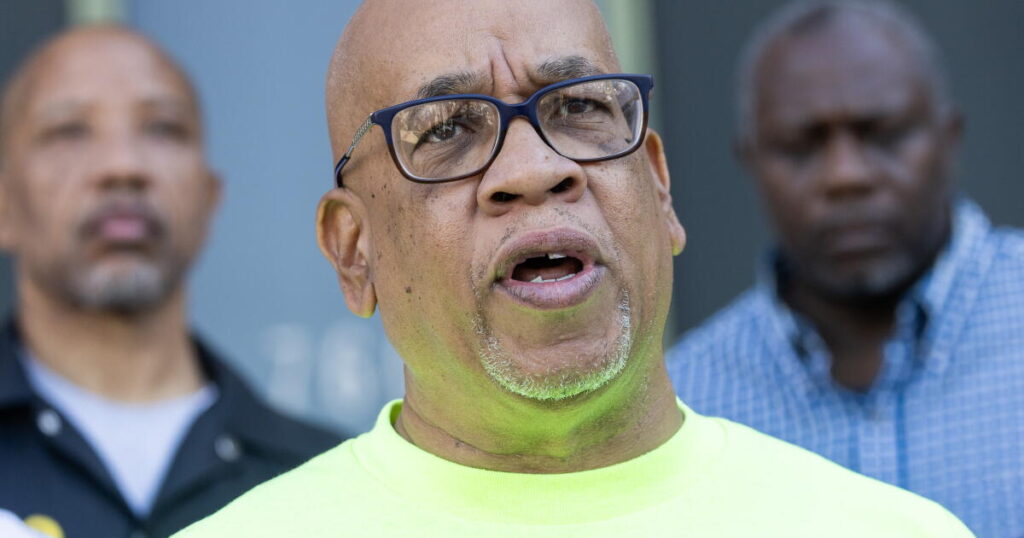
Like any parent, Skipp Townsend did what he could to keep his kids out of trouble.
So when he sensed his youngest son was slipping into gang activity, Townsend started to bring him along to work at the violence prevention group he runs in South Los Angeles. And he offered to pay for private school, where his son could pursue his football dreams.
Despite Townsend’s best efforts, his 19-year-old son Kody now stands charged with murdering one of his father’s outreach workers — a killing some suspect was motivated by a beef between rival gangs.
Skipp Townsend, 62, said that even before the case became public earlier this month he had seen less and less of Kody, the youngest of his 12 children, and in recent years the two barely spoke.
Police arrested the elder Townsend outside his office on Nov. 4 on the suspicion that he may have helped his son elude capture after a fatal shooting in the Hyde Park neighborhood in early August. Prosecutors declined to file charges against Skipp, who maintains he did nothing wrong. Kody remains a fugitive and could not be reached for comment.
The case has left Skipp, who spent years building a reputation as one of the city’s most respected gang interventionists, defending his work and lashing out against the LAPD. He has accused investigators of acting too hastily, before all the facts were known, and leaking news of his arrest to the news media in an effort to tarnish his name.
The charges have also sparked conversations about the complex lives of city-sanctioned peacemakers. Skipp and many others in his field were once gang members. They say they closed that chapter of their lives and began working instead to prevent killings by mediating disputes and encouraging would-be shooters to choose paths other than violence. Yet even if they have left the gang life behind, Townsend and his peers still regularly run into family members, childhood friends and acquaintances who remain active in the streets. Some remain a regular presence in each other’s lives; some only occasionally cross paths at a family Sunday dinner or over the holidays.
By the time of the August killing, Skipp said he and son had drifted apart, although it hadn’t always been that way.
Growing up, Kody was a “track star” who also flashed potential on the football field, Skipp said. Coaches began taking notice, he said, and Kody had an opportunity to play at a local private football powerhouse, Junípero Serra High School in Gardena.
Having worked with hundreds of other young men like Kody, Skipp understood what he was going through on some level. Coming from difficult backgrounds and trying to make their way in a world that still often sees them as a threat, many young Black and Latino people are drawn to the gang life, which — for all of its madness — provides a powerful sense of identity and belonging.
Skipp knew well the risks that come with the path that Kody was following. For much of his teenage years and early adulthood, he was running wild through the streets as a member of the Rollin’ 20s Bloods gang — which landed him in juvenile hall and prison on more than one occasion.
But as Skipp got older, his mindset gradually shifted. Becoming a father for the first time — he had 14 children in all, two of whom died in infancy — served a major wake-up call.
Skipp said he wanted the best for Kody as he did for all of his kids, and held out hope of better future for his youngest. He used to bring Kody around to 2nd Call when he was younger. The organization’s fluorescent-lighted office at the corner of Obama Boulevard and La Brea Avenue served as a haven, a controlled environment where Skipp says he could keep an eye on the youngster.
Occasionally, Skipp would let Kody tag along as he made his rounds, talking to younger gang members and imploring them not to follow the path he once did. He hoped that his constant message of positivity and self-determination would rub off on his son — while also seeing firsthand the grief, trauma and loss that can come from running the streets.
Townsend said he encouraged Kody to stick with football and offered to pay for any tuition costs at Junípero Serra that would not be covered by a scholarship. But Kody refused to go there, instead transferring from Hamilton High school to Westchester, and stopped playing football altogether.
“He wanted to be with people his age that he really aspired to be like,” Skipp recalled, saying his son preferred L.A. public schools. “We have a strained relationship, and I haven’t been able to reach him. So I just kept going.”
Gang interventionists know better than anyone the allure of the streets. Most are from the generation of Black and Latino men and women who survived the bloody gang wars of the ’80s and ’90s. Keeping their own children from following in their path can be tricky.
Even as he noticed Kody inching further and further away throughout high school, Skipp said he was proud about how 2nd Call was growing into a force for good in the community.
He started the organization in the early 2000s. In the early days, the group stayed afloat mostly thanks to small contracts, but it eventually earned more city and federal funding as it expanded its services. Word soon spread about his efforts to negotiate gang truces. The work can be confusing, nerve-racking, and exhausting — and most of it is done out of the public view, he said. But, there were successes along the way.
In 2022, Townsend helped arrange for members of the Rollin’ 60s Crips and the Inglewood Family Bloods to break bread at a restaurant in Manhattan Beach — something that some thought unthinkable for two gangs that had been locked in a 50-plus-year conflict. More recently, he said, he had turned his attention to trying to ease infighting between gangs belonging to “Hundreds” alliance.
Some politicians and senior LAPD officials took notice, and began regularly shouting out Skipp and 2nd Call at news conferences for their efforts in preventing retaliatory shootings. The efforts of his organization and others have been credited as a factor in L.A.’s plummeting homicide rate, which is the lowest it has been since the 1960s.
In late September, he was invited to a meeting at the district office of City Council President Marqueece Harris-Dawson, along with LAPD Chief Jim McDonnell, Assistant Chief Emada Tingirides and Deputy Chief Ruby Flores — who each talked about the importance of intervention work, singling out Skipp.
For many, intervention work can turn into a 24/7 job that can take them away from their families. Some try their best to keep their work and personal lives separate, knowing that mixing the two could unwittingly expose their loved ones to danger from rivals who are still bent on settling old scores.
Kody is charged with killing Reginald Foreman, 51, a former member of the 111 Neighborhood Crips gang who had put his past behind him and had been coaching girls’ softball and working for Skipp at 2nd Call.
According to police, Foreman and other 2nd Call workers were pulling weeds at a vacant lot near 59th Place and Crenshaw Boulevard on Aug. 6 when a young man in a medical mask walked up to the men and opened fire with an assault-style rifle. Foreman — also known as “Baby Ant” or “BA” — tried to run but collapsed about half a block away, mortally wounded.
Skipp rushed to the scene after getting a phone call about the shooting. He said he tried his best to support Foreman’s family in their time of grief in the weeks that followed. Almost right away, he began hearing whispers that the gunman was from the Original Blocc Crips — a gang that Kody had been running with.
The Blocc Crips had long had a shaky alliance with other Rollin’ 100s gangs that operated south of Century Boulevard — including the 111’s from the neighborhood where Foreman grew up. But, in recent years, the “Hundreds” had been consumed by infighting — particularly since the 2021 killing of another peacemaker from the Hundreds, Craig Batiste, according to some gang experts.
Skipp has denied any involvement in Foreman’s killing. Normally soft-spoken and diplomatic, anger creeps into his voice as he recalls the day he was arrested by the LAPD.
“All they had to do was say, ‘Skipp, come down and let us talk to you.’ And I would have came,” he said during a news conference outside the LAPD’s 77th Street police station, where he was briefly taken after his arrest. Instead, he said, law enforcement made a big show of going to 2nd Call’s office, as well as his home and that of his former wife.
He said he first heard the rumor that Kody may have been involved in Foreman’s killing a day or two after his former worker’s funeral.
“And I just was hoping it wasn’t true,” he said.
Foreman’s family was hearing the same thing, he said. And after initially accepting his offers of help, they suddenly stopped responding to his phone calls and text messages, Skipp said.
He said he saw his son only once more after that, giving him a ride home. They drove in silence, Skipp said, neither one of them bringing up Foreman’s shooting.
“You know we don’t talk about stuff like that and of course he wouldn’t tell me if he did it and I didn’t even ask him,” he said.
That was the last time he spoke to his son, he says.
A spokesperson for the Los Angeles County Attorney’s office said the case against Skipp and four others arrested had been referred to the LAPD for further investigation.
Even though no charges were brought, the ordeal has done irreparable harm, the elder Townsend said. As news of his arrest broke, some content creators who report on gang culture began posting reaction videos speculating whether his eventual release meant he was cooperating with police. Others gleefully shared cellphone footage of a handcuffed Skipp being led by officers to a waiting black-and-white LAPD squad car.
All the negative attention has already cost 2nd Call two contracts, he said. Without the funding, he can’t afford to pay his workers, many of whom have struggled to find opportunities given their criminal records and for whom the job has been a lifeline.
And, in a job where trust and respect are the only currency, he says the recent events have probably ruined any shot he had at mediating disputes between warring factions of the Hundreds.
“I mean, the trust is gone with Reginald Foreman’s neighborhood,” he said. “I don’t believe anybody west of Western is going to trust me now.”
But more than that, he says, he is struggling with the idea that Foreman’s family thinks that he might be somehow involved in his death.
“If it’s proven that [Kody] did this, I stand behind them,” he said. “I stand behind what’s right. And what’s right is that Reginald Foreman should be here.”
The post He’s L.A.’s most renowned anti-gang crusader. How did his son end up charged with murder? appeared first on Los Angeles Times.