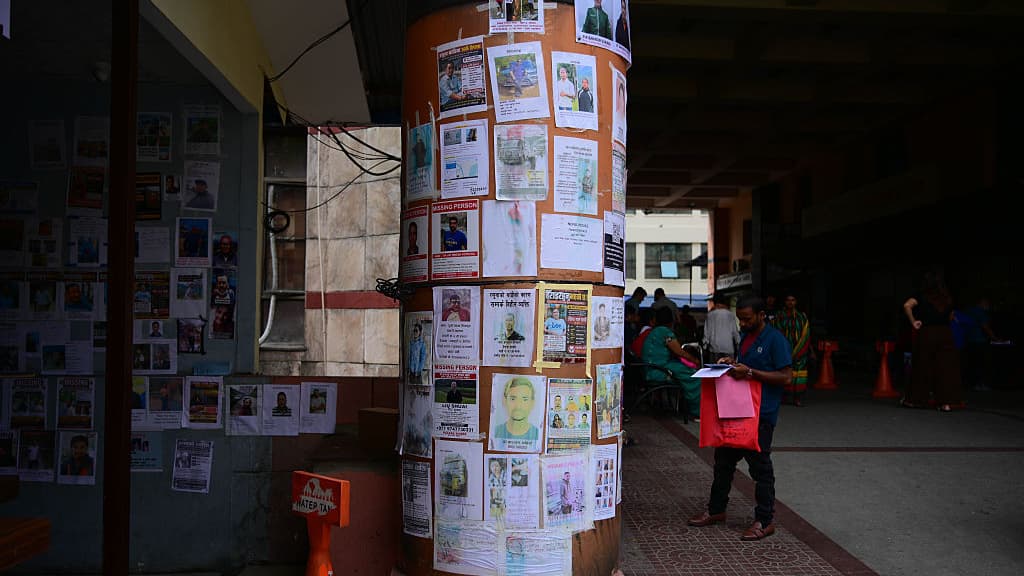
We are still burying or cremating our dead. We are still searching for our missing people. We are still gasping at the emptiness where our homes stood.
And we know something: the furious deluge that came crashing down from a mountain peak in northern Nepal, like a scene from an apocalyptic movie, and tore through the valleys of the Rasuwa and Nuwakot districts of our country was not a freak accident.
It was a warning from the Himalayas. Our majestic mountains and their glaciers are warming because of climate change caused by greenhouse gas emissions from industrialized nations that have been burning fossil fuels since the Industrial Revolution. We, in Nepal, produce a mere 0.1% of global greenhouse gas emissions. And it is time for the industrialized nations to take responsibility for it.
On Monday, Nepal’s National Disaster Risk Reduction and Management Authority estimated that at least 1,050 people have died in the floods, 292 are injured and 3,916 are missing. More than 90,000 people have been affected. Around 600 of the missing people are foreign nationals from 39 countries.
The first reports, which pointed toward an earthquake setting off the glacial rage, were quickly reversed. What the seismometers registered was a warming glacier shearing off Langtang Lirung mountain peak and slamming into the valley floor with enough force to register a magnitude 5.2 shock, sending a wall of rock, ice, mud and water thundering down the Bhotekoshi-Trishuli River valley at a ferocious speed that gave communities along the riverbanks almost no warning.
Chinese monitors clocked just six to seven minutes between the collapse and the moment the surge hit Gyirong Port at the China-Nepal border. In Rasuwa district, officials recorded the Trishuli River rising as much as nine meters in 30 minutes.
Nepal is familiar with a pattern of extreme climate events induced by climate change. In July 2025, a smaller flood washed away the Friendship Bridge, which connected Rasuwagadhi in Nepal with Gyirong on the Chinese side of the border. In Aug. 2024, a glacial lake let go near Mount Everest, tearing through Thame village and destroying homes, a school and a health post overnight. These natural calamities are becoming more frequent and fiercer.
Nepalis are resilient. Every time a disaster hits, we mourn our dead, rebuild, and carry on. We call it karma, or fate, or the mountains doing what mountains do. But this isn’t karma. The climate is changing, and human activity is changing it. Our resilience becomes a quiet abandonment, a way for the rest of the world to admire how well we absorb losses it helped create.
A Himalayan warning
In Oct. 2023, UN Secretary-General Antonio Guterres stood near Mount Everest and pleaded, “I am here today to cry out from the rooftop of the world: stop the madness…The glaciers are retreating, but we cannot. We must end the fossil fuel age.”
The Hindu Kush Himalaya is warming faster than the global average. Go up to the mountains and you can see it: bare grey rock where there was snow and ice just a decade ago. The region is often called the “Third Pole” because it holds the largest volume of ice outside the two poles. It is also one of the planet’s most important water towers, feeding ten major river systems and sustaining nearly two billion people downstream.
In March, the International Centre for Integrated Mountain Development (ICIMOD), an intergovernmental group working in the Himalayan region, confirmed what mountain people already feel: glaciers across the Hindu Kush Himalaya are now losing ice at roughly twice the rate they did before 2000, and have disappeared 65% faster between 2011 and 2020 than in the preceding decade. Nepal alone holds more than 2,000 glacial lakes.
An assessment by the Nepal government and ICIMOD identified 21 glacial lakes across the Koshi, Gandaki and Karnali basins of the country as potentially dangerous and capable of producing a damaging outburst. In 2016, the government of Nepal and UNDP worked together to lower water levels in Imja Tsho, one of the largest and most closely watched glacial lakes in the Everest region. The initiative successfully drained Imja Tsho to a safer level and installed community-based early warning and response systems.
But new lakes keep forming, and old ones keep growing, faster than any single country can monitor them. Imja took years of international effort and millions of dollars to make it safe. Nepal has dozens of glacial lakes like it. We don’t have a fraction of the money required.
The arithmetic of climate injustice
And here is the arithmetic of the injustice: Nepal is one of the smallest contributors to global greenhouse gas emissions, yet its people, from remote villages to the Kathmandu Valley, keep paying the price for it. Nepal has grown its forest cover to nearly 46% of its land and draws around 90% of its electricity from clean hydropower. The climate disasters we face are the essence of climate injustice: those least responsible for the crisis are the first and worst affected, and too often the least equipped to recover.
Just as Nepal was turning a corner, under a reform-minded government promising good governance and attracting foreign investment, this disaster could set this part of the country back by about a decade. Our finance minister, Swarnim Wagle, estimates that rebuilding will cost between four and five billion dollars, close to a tenth of our entire economy, against a national budget of around $14 billion for the year.
Every major disaster forces the country to divert scarce resources away from education, healthcare, infrastructure and development and back into rebuilding what was lost. A country that spends its future paying for someone else’s emissions cannot develop. It can only tread water. Nepal doesn’t need another pledge recited at another international conference. We need the international community to move from symbolic gestures to real action.
We need climate finance that actually reaches Nepal. We need a Loss and Damage Fund that pays out when a village needs it, not years after the water has receded. Nepal also needs investment in early warning systems, continuous monitoring of glaciers and glacial lakes, and disaster preparedness that reaches the most remote mountain communities. Six minutes of warning is not a policy failure of Nepal’s alone; it is what underinvestment in mountain monitoring buys.
And finally, the people who live in these mountains and the billions who depend on the water flowing from them deserve a voice in climate policy. Nepal should be central to that conversation. We are not debating what climate change might do. We are already living it.
Nature has a way of reminding us just how interconnected and interdependent we are. A glacier destabilized in one country can, within minutes, devastate villages, infrastructure, and livelihoods in another, while the bodies of the dead are found hundreds of kilometers downstream in another country. Nepal, China, and India share not only mountains and rivers, but also a common exposure to the accelerating risks of climate change. We need more regional cooperation, and Nepal, sitting at the head of these shared watersheds, must play a central role.
Nepal’s mountains are our identity. They feed our rivers, our tourism, our sense of who we are. Now they are also ground zero for the climate emergency. The world needs to heed this warning: we need shared, urgent, and just action before more mountains give way.
The post The Danger of Ignoring Nepal appeared first on TIME.