POTRERILLOS, Mexico — When José Carlos González Alarcón steps out of his truck in this small town in the mountains of Sinaloa state, he is greeted by a pack of hungry dogs. A motley assortment of mixed breeds, they race up the empty streets, tails wagging at the arrival of a rare visitor.
The owners who once kept them well fed have long since fled, most taking only what they could carry. Important documents, family heirlooms and even pets were left behind in the panicked scramble for safety.
González whistles and the dogs gather around. He doles out a few scratches behind the ears but hasn’t brought enough food for all of them.
Once home to a few hundred people, Potrerillos is now nearly deserted — a pueblo fantasma, or ghost town — one of many in a region where residents have abandoned their homes amid a brutal war between factions of the Sinaloa cartel.
González, 55, leads Mexico Human Rights, an organization that advocates for displaced families. He comes to check on their homes, maintaining a registry of deserted properties. By his count, at least 22,000 people in the state have been forced to move because of cartel violence in just the last two years. By some estimates, hundreds of thousands have been exiled from their homes nationwide over the last two decades.
Once he arrives in Potrerillos on this afternoon in February last year, he can’t stay long. Some of the few who remain in the town serve as eyes for the cartel. Barely 15 minutes tick by before a young man on a dirt bike buzzes past.
“There are always halcones,” he says — literally “falcons,” but also slang lookouts. “They inform their bosses about our presence. We must be careful to avoid repercussions.”
To get here, he was escorted by a convoy of state police officers clad in balaclavas and armed with automatic weapons. They set out early from the city of Mazatlán on the Pacific Coast and traversed a winding highway up into the Sierra Madre. I followed along as part of a film crew from Netflix producing “The Fall of El Mayo,” a documentary series about Sinaloa cartel co-founder Ismael “El Mayo” Zambada.
Zambada, 76, came from a poor family in rural Sinaloa and began trafficking drugs as a teenager, sowing small crops of marijuana hidden within rows of corn on mountainside fields. He rose through the ranks in the 1970s and ’80s and began smuggling cocaine — an estimated 3.3 million pounds over the years — eventually becoming arguably the most powerful and influential cartel figure in Mexico.
Zambada was a longtime partner of Joaquín “El Chapo” Guzmán. While El Chapo became a household name, infamous for brazen prison escapes and hosting the actor Sean Penn at one of his mountain hideouts, Zambada ruled from the shadows, corrupting officials at all levels of the Mexican government and holding sway over vast portions of the country.
In the mountains outside Mazatlán, González says, the cartels have taken complete control of the economy. The hillsides surrounding Potrerillos once offered work in logging and mining. Now there is only one employer: the cartel.
“They control the timber, they control the minerals, they even control the [supply of] beer,” González says. “They’re fighting over everything.”
The houses in Potrerillos are colorful, painted sky blue or turquoise with purple trim. One entryway is decorated with small ceramic statues of the Virgin of Guadalupe and San Judas Tadeo, the patron saint of lost causes. Inside are snapshots of lives uprooted in an instant. Children’s books spread across the dining room table. A pot of beans forsaken on the stove.
González has permission from the owners to go inside, and he enters one house that appears to have been ransacked, with possessions scattered across the floor. He takes pictures of what’s left behind. Under Mexican law, those who have been forcibly displaced can qualify for reparations, and part of his work is creating documentation for people to pursue their claims.
“You immediately know that they ran away in a hurry,” he says, tiptoeing around the mess. “You see all the clothes strewn about, you see suitcases upstairs. You realize they didn’t even grab their IDs.”
He estimates only around 20 people remain — mostly older men too stubborn to leave the only homes they have ever known. A handful of them, all clad in cowboy hats and boots, gather under a covered area, where local kids once played soccer and basketball. The tin roof above is pocked with holes, which they say were left by bombs dropped from cartel drones.
“Everything is abandoned,” says one of the men, who asked to not be named for fear of retaliation. “It was beautiful here. People would go out to play and have fun. But not anymore.”
He points to a piece of heavy equipment parked nearby. The windows were all shattered by bullet holes. It’s no longer operable, he says, thanks to cartel gunmen who came and disabled it, telling the townspeople they were being punished for perceived support of their rivals.
“We used it to cover the street holes and fill the ditches,” he says. “It’s useless now, just lying there. Those criminals shot it up. We had a [water] tanker and it was destroyed too. We had a trailer to load timber from the woods — it’s also destroyed.”
González says many families left town out of fear that their young sons would be conscripted by the cartels.
“They kidnap kids,” he says. “They take them away to make them hit men, because they’re running out of people.”
The cartel war in Sinaloa can be traced back to July 25, 2024, the day the long-elusive El Mayo finally ended up behind bars.
On that day, Zambada was lured to a meeting on the outskirts of Sinaloa’s capital, Culiacán, where he expected to mediate a dispute between two prominent politicians. He was summoned by one of El Chapo’s sons, Joaquín Guzmán López, who used the ruse to stage an ambush.
Guzmán López and his gunmen took Zambada by surprise, killing his bodyguards and one of the politicians who had shown up for the rendezvous. Guzmán López then kidnapped Zambada, drugging him and forcing him onto a private plane that transported them to a small airfield near El Paso, where U.S. federal agents were waiting to receive them.
Guzmán López, 40, admitted last year that he orchestrated the plot, saying in court that he had turned himself in and handed over Zambada in hopes of currying favor with U.S. authorities and receiving a reduced prison sentence when he pleaded guilty to federal charges.
Since the betrayal, forces commanded by Los Chapitos — a cartel faction led by two of Guzmán López’s half brothers — have been battling armed groups loyal to Zambada, a coalition known as La Mayiza. They are led by one of Zambada’s sons, nicknamed El Mayito Flaco, or the skinny little version of his dad.
His chief allies are the Cabrera Sarabia clan, a crime family that has long had a stranglehold on the neighboring state of Durango. For months, heavily armed sicarios, or cartel foot soldiers in the employ of “Los Cabrera,” have been methodically wiping out the Chapo mob, starting with remote mountain towns and descending into the more heavily populated lowlands.
Weaponized drones have become commonplace, including the type controlled through thin fiber-optic cables, like those widely used on the battlefields of Ukraine. The cartels also use steel plating to convert trucks into armored vehicles known as “monsters,” mounted with turrets and heavy machine guns.
In September, banners attributed to Los Chapitos appeared in the municipality of Concordia — which includes Potrerillos — accusing the government of backing Los Cabrera and La Mayiza. The messages, addressed to President Claudia Sheinbaum and her security chief, Omar García Harfuch, accused specific army officers and a state police commander of taking bribes, returning weapons and vehicles seized after confrontations, and staging operations that favored their enemies.
“Investigate them! The fight is not with the government,” said the message, emblazoned with a pizza slice logo associated with “La Chapiza.”
Civilians living on disputed turf are caught in the middle.
Although González does his best to track the number of displaced, he says it’s impossible to know the extent of the problem because the sierra is so isolated, with sparse cellphone service and limited contact with the outside world.
“People go missing, like in the Bermuda Triangle,” he says. “There’s no record of it. So when you hear somebody saying, ‘There’s X number of missing people or dead people,’ the number is actually higher.”
After about an hour in Potrerillos and some neighboring hamlets, the members of González’s police escort begin getting antsy, and their commander signals it’s time to leave.
The birthplace of many of Mexico’s most well-known narcos and the stronghold of the state’s eponymous cartel, Sinaloa has long been associated with drug trafficking. But while there have been periods of intense violence in the past, it largely has been spared the gruesome bloodshed that has beset other Mexican states in recent years.
Some credit Zambada with keeping the peace. Although he undoubtedly was responsible for many deaths over the years, he developed a reputation as a mediator who resolved internecine cartel conflicts without letting all-out war erupt in his home state.
Just over a year after he was double-crossed by El Chapo’s son, Zambada pleaded guilty to an array of federal charges, including racketeering, and was sentenced in July to life in prison, with no chance for parole. Appearing at the U.S. District Court in Brooklyn, he implored the cartel factions tearing apart Sinaloa to end their feud.
“Too many lives are lost, too many families are destroyed, and too many young people are trapped in a cycle that leads only to prison or death,” he said. “No one wins in a war like this.”
The entreaty seemingly has made little difference.
In recent months, the conflict has spilled down from the mountains and into Mazatlán. Sinaloa’s main tourist attraction — known for its Pacífico beer, fresh seafood, sandy beaches and golf cart taxi cabs called pulmonias — is one of the few remaining strongholds of Los Chapitos, though their grip has been weakened after the deaths of several key lieutenants in the area.
The Mexican government has flooded Mazatlán and surrounding countryside with soldiers, making the once-lively city feel as though it is under military occupation.
“You walk down any Mazatlán street and you’ll run into soldiers,” González says. “They search you, you go on, walk two blocks, and you’ll find more.”
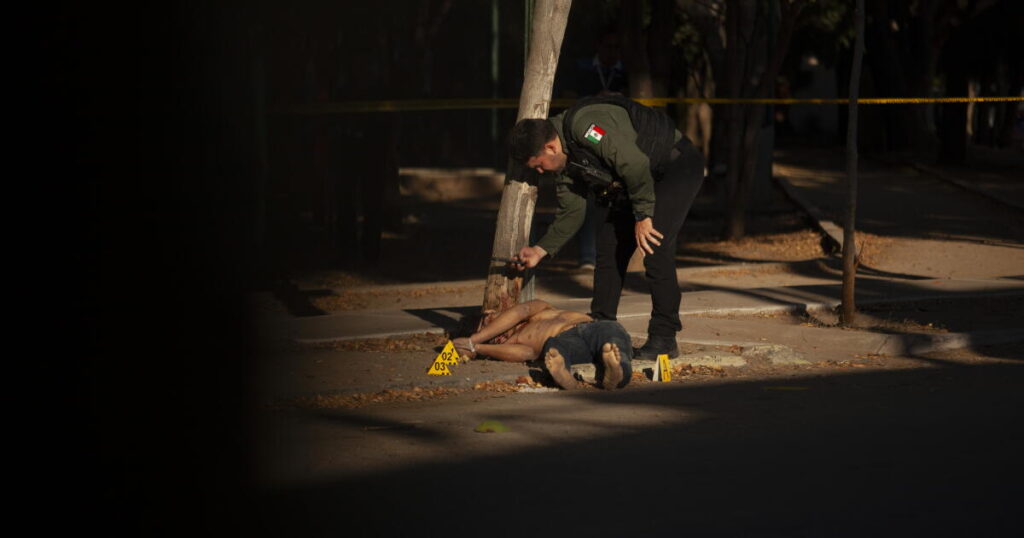
Still, the death toll has continued to climb. Last month included a stretch with 29 homicides in just four days.
Although the city’s “golden zone,” a strip of beachfront hotels, largely has been immune from the violence, fewer and fewer tourists are willing to risk visiting. Many business owners and officials fear the city will suffer a doom spiral similar to Acapulco, where once-grand resorts have crumbled and sat mostly vacant since an eruption of cartel fighting nearly two decades ago. In Mazatlán, problems are compounded by people who fled the mountains and struggle to find work in the city.
“We’re in a more difficult situation because there’s nothing up there, and now there’s nothing down here either,” González says.
Before he became an advocate for the displaced, González says, he was a businessman, working with international companies in Mexico City and Guadalajara. Then the COVID-19 pandemic hit in 2020 and he returned to his home city of Mazatlán, where he found many people had become homeless. Most had fled cartel fighting in other states.
“I didn’t even know what a displaced person was,” he says.
He felt all levels of the government — local, state and federal — were failing to address their needs and began using his connections to push for more resources, until it essentially became his full-time job.
He has been fiercely critical of Sinaloa’s elected officials — including the former governor, Rubén Rocha Moya, who, according to U.S. federal prosecutors, was corrupted by Los Chapitos and allowed the cartel to operate with impunity until he stepped down from his office this year. González’s outspokenness has made him a target: He says he has survived several attacks, including an incident in April when he reported being shot at while working in Mazatlán.
González, however, remains undeterred.
A day after his trip to the mountains, he and his partner visit some of the families displaced from Potrerillos and other places nearby, steering his truck to a cluster of ramshackle homes on the outskirts of Mazatlán.
Some of the structures are built from wooden pallets and black trash bags. Others are more permanent but equally inhospitable. The walls and ceilings of one two-bedroom house were blackened with soot from a fire. A woman with eight children — one of them suffering from cerebral palsy — found it abandoned and moved in, scavenging appliances and furniture from the local dump. She asked to not be identified by name because she fears being tracked down by the cartel.
She was forced to flee in September 2024, about two months after Zambada was kidnapped and Los Chapitos and La Mayiza went to war. Armed men came and dragged her out of her home in the mountains, then beat her in front of her children.
“They hit me, they called me swine,” she tells González’s associate. “They said I was passing information along and that they were going to kill me.”
They let her live, but she was too scared to stay in the mountains. “I can’t get over this,” she says. “I don’t sleep at night. I’m too afraid. My sister tells me to see a psychologist, but I’m afraid to talk.”
Many in the neighborhood share similar accounts of being abducted and interrogated under torture. Some say they were subjected to a Taser-like device called a chicharra — Spanish for cicada — which administers electric shocks that crackle like the insect’s hum. Others describe being waterboarded or hit with a baseball bat.
Another woman who met with González and his partner says she thinks she was targeted because her relative was a local police officer. She too asked to remain anonymous, fearing further persecution.
“They took my nephew along with me and my daughter too,” she recalls. “They kept our eyes and faces covered. And they kept threatening to kill us, treating us badly. Then they would talk among themselves and say to someone else, ‘Go get the gasoline, we’re going to burn them.’
“And we felt completely helpless, tied up, hearing that they were going to burn us alive. And all I could think about was my children, my family. I kept wondering, ‘Where will my children find me? How will they know where I was left?’”
Since arriving in Mazatlán, she and her relatives have been eking out a living by selling hand-embroidered napkins and tablecloths. She has no hope of returning to the mountain town where she was raised and lived peacefully until the cartel war broke out.
Asked whether she’d go back home if the government told her it was safe, she shakes her head.
“Honestly, no,” she says. “I’m afraid. I’d rather lose everything than lose my life. I’d rather be with my children, even if I have nothing.”
The post El Chapo’s son triggered a cartel war. Inside the Sinaloa ghost towns it created appeared first on Los Angeles Times.