What do we mean when we say a filmmaker has returned to form? Danny Boyle has made Oscar-winning movies (Slumdog Millionaire), great movies that people will remember forever (Trainspotting, 28 Days Later), and superb, expressive movies that not many people think about anymore (Sunshine, A Life Less Ordinary). Boyle has been making movies for so long now—and has been making them in such varied textures—that it’s hard to say what form, exactly, there is for him to return to. But Ink, which opens the Venice Film Festival, somehow feels both old-school—in the brash, Trainspotting way—and invigorating and modern; it’s almost as if Boyle were taking inspiration from himself, revisiting his catalog of ideas and revamping rather than repeating them. This is a bold, entertaining piece of filmmaking that also brings us back, perhaps to the precise year, when newspapers and other media organizations began veering away from serious news and toward the on-ramp of nonstop entertainment and stimulation. For that, we have news mogul Rupert Murdoch to thank. But as Ink tells it, Murdoch learned how to be Murdoch from a lesser-known player you may never have heard of: who the hell was Larry Lamb?
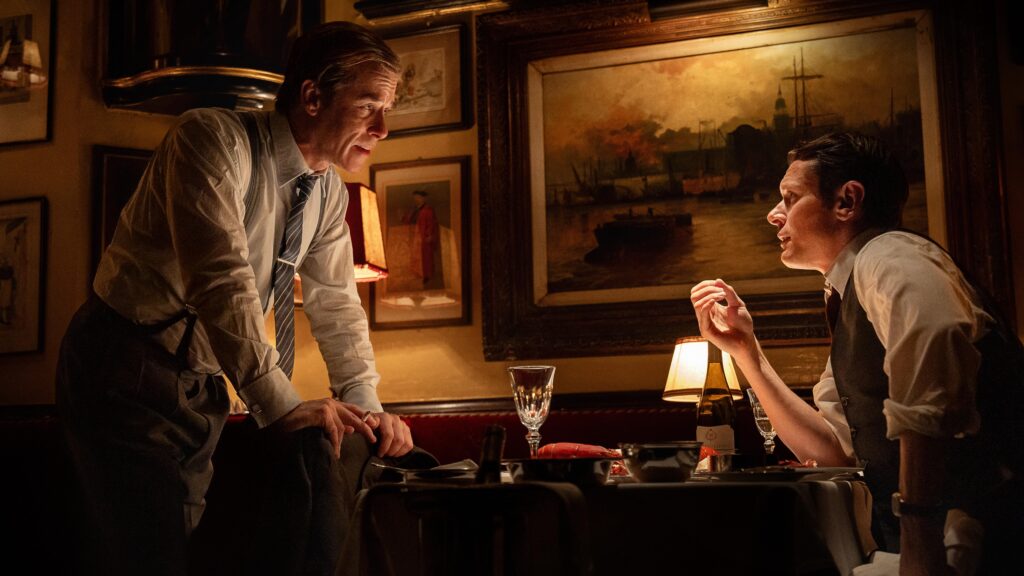
Ink, adapted from James Graham’s stage play and drawn from real life, opens in 1969 London on Fleet Street, the heart of the city’s newspaper business. The young, Australia-born Rupert Murdoch—played, with almost alarming charisma, by Guy Pearce—isn’t yet a mover and shaker in the news business. But he has a proposition for a brash Yorkshire newspaperman whose career has taken a nosedive. Would this guy, Larry Lamb—Jack O’Connell, crackling with roguish charm—like to spearhead the relaunch of a paper Murdoch has just purchased? The two meet in a tony London restaurant where newspaper deals are made, tussling like bulls as they outline their ideas of what news should be. Then they stride out into the night, and as they pass the paper’s offices, they drop down on all fours to feel the rumble of the printing presses belowground. Newspapers are in their blood; they can’t differentiate between their own heartbeat and the clanking of tomorrow’s edition rolling off the cylinders.
That image may sound corny, but as movie language, it works. Boyle and cinematographer Alwin H. Küchler (who also shot Sunshine) give the movie a zig-zagging, simmering energy. If Trainspotting mapped the euphoria and careless self-destruction of heroin addicts, Ink is the story of another kind of obsessive: guys in thrall to the big story, to power, and to money, maybe not even necessarily in that order. By 1969, London was already swinging, but not for these guys: In their trim but conventional Savile Row suits, they’re aware of the style revolution around them, yet they stay happily outside it, like gods smirking from Mount Olympus. It’s as if they’d long ago decided that their main job was to observe and reflect the world rather than actually live in it.
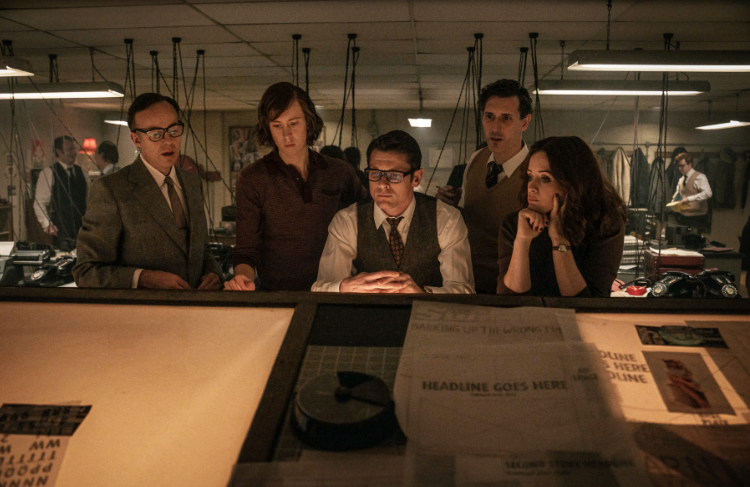
The first half of Ink tells the story of the Sun’s ascension, from its lagging position behind its hugely successful rival, the Daily Mirror, to a tabloid that seduced readers with new kinds of coverage. What, exactly, were working-class Londoners interested in reading about, Lamb would ask his assembled staff, including a starchily old-school deputy editor imported from Liverpool (Patrick Kennedy), a possibly over-the-hill sports editor (Christopher Fulford), and, most notably, the crackerjack newswoman Jules (Claire Foy, fierce as a firecracker), who’s been sleeping with the married Lamb for years in an arrangement that suits them both. He’s now given her the luxury of editing a “woman’s page,” which she’s free to fill with whatever she likes, including the radical feminist ideas that drive her. (She ends up printing an excerpt of the banned-in-Britain book The Sensuous Woman, a manual written to help women navigate and understand their own sexuality—though she makes it clear that it’s the guys who really ought to be reading it.)
.png)
In revamping the paper’s coverage, the list of key categories Lamb and his staff come up with includes the usual suspects (sport, the weather) but also some surprises. Everyone, the staff concluded, loves watching television, but newspapers weren’t covering it—why not? And the men, of course, loved looking at naked women, and thus the “Page 3 Girl”—basically, a tasteful nudie image—was born. That’s how Lamb remade the Sun, and made his name. In the movie’s second half, in a gracefully executed tone shift, Lamb’s newly forged reputation as a wonder boy is tested; suddenly, Ink becomes a mildly grim true-crime thriller, based on a real-life case. (The principals involved are played by Jonathan Hyde and Lucy Russell.) Boyle presents the details as if he were splashing paint on canvas, not carelessly but with controlled strokes of energy.
Does Lamb want to help solve the mystery at the heart of this crime, or is his job to stay out of it and let the police do their job? He’s too addicted to sensationalism to know when to stop. In the story Ink tells, Murdoch is in thrall to Lamb and his instincts, even as he frequently recoils from them. He sees what’s unsavory about Lamb’s approach and, more than once, moves to restrain him; then he sees the uptick in the Sun’s sales figures and zips his lip. If you’d prefer to think of Murdoch as an individual wholly devoid of sex appeal, Pearce’s performance might rattle you; his Murdoch is shrewd but not inhuman—even monsters were young once. Foy’s character is a composite and not based on a specific individual, but she avoids all the pitfalls of playing a symbol. Jules is a woman in an overwhelmingly masculine world, so devoted to her work she doesn’t want to be anywhere else, but she never makes it look easy. Foy plays Jules’ moments of doubt with piercing clarity—she sees the moral cracks in her boss-and-lover’s ambitious strategies, and she voices them, but there are no moments of obvious triumph. Jules lives and works in a space where standing your ground can only make you exceedingly lonely.
And still, O’Connell’s Larry Lamb is a guy you want to root for, even if, as a modern person with a reasonable awareness of what’s happened to the news media in the internet age, you can see he’s making the snowball that starts the avalanche. O’Connell plays Lamb as somehow disreputable and principled at once; it’s simply that he’d rather be right than do right. He’s the kind of brazen, disreputable showman you want to creep closer to—even the young Murdoch feels it. Ink works as both a fictionalized snapshot of a lost world and a forensic exploration of what happens when you give the people what they want, instead of what they don’t know they want. It’s a movie about the beginning of an end, brought about by enterprising men who just wanted to sell papers. So thrilled by the lede they were writing, they gave zero forethought to the kicker.
The post Ink Is an Exhilarating Portrait of the Beginning of the End of Newspapers appeared first on TIME.