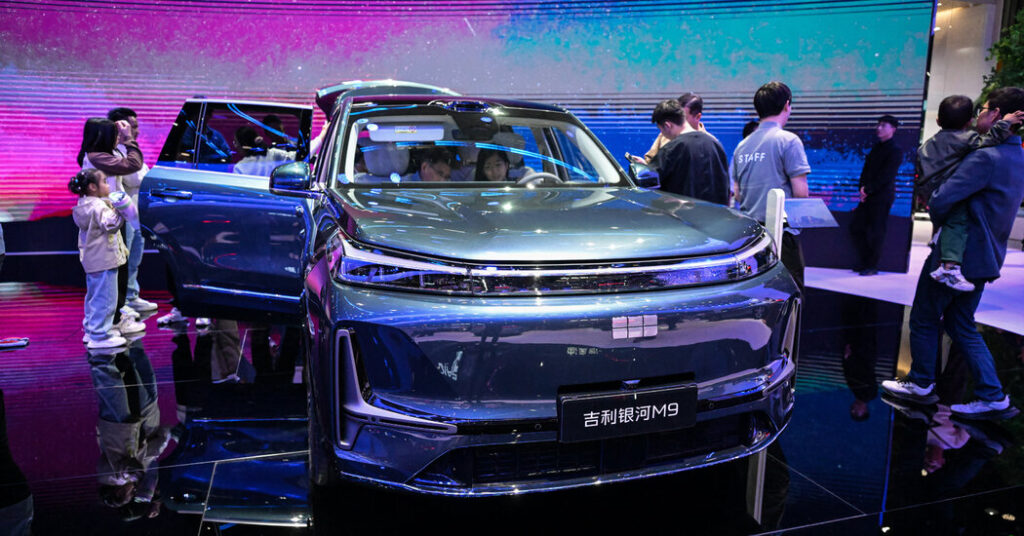
For car shoppers looking for a luxury three-row crossover S.U.V., the Galaxy M9 checks all the boxes: It has heated and massaging leather seats throughout, a 30-inch highly customizable video display and dual phone chargers.
A plug-in hybrid, the M9 can drive about 110 miles on battery alone. Combine that with the gasoline engine and the M9 can cover a whopping 660 miles.
The price for this top-of-the-line trim: an eye-popping $35,000. That’s if you’re in China. Made by Geely, this smooth-riding, driver-pampering crossover The New York Times tested for 10 days in February would cost more than twice that from any brand with an American showroom. Geely, founded in China just 28 years ago, now sells almost as many vehicles worldwide as the 123-year-old Ford Motor Company.
And this is when you’ll be able to buy it here:
Never.
That’s the hope of the U.S. auto industry as well as the U.S. military and intelligence establishment. And it’s the goal of two senators who represent states with a heavy industry presence: Bernie Moreno, Republican of Ohio, and Elissa Slotkin, Democrat of Michigan, who have sponsored a bill to permanently ban internet-connected vehicles from China from being sold in this country. (For good measure, it lumps in cars from Iran, North Korea and Russia.)
An existing 100 percent tariff and 2027 Commerce Department restrictions on connected vehicles from China make it impractical to import Chinese vehicles today. As a result, Polestar, owned by Geely, will stop selling vehicles here in 2027. The Senate bill, which has bipartisan support and has been unanimously voted out of committee, would codify that exclusion.
And it’s wide-ranging: Under the terms of the Connected Vehicle Security Act of 2026, any vehicle manufacturer that is more than 15 percent owned by a Chinese company would not be able to sell cars in the United States. Chinese software would be banned next year, and hardware in 2030.
Mercedes-Benz, which has close to 20 percent Chinese ownership, will be unable to sell its vehicles if the bill passes, unless the company reduces that percentage, the bill’s ownership limits are changed or the company receives a waiver from the Commerce Department.
Even Canadian or Mexican residents who have legally bought a Chinese vehicle in their own country would not be allowed to drive them across the border, even for a day trip.
The senators say the bill is needed for two reasons: economic and security. Chinese vehicles cost much less, they argue, because the Chinese government gives companies cash subsidies, free land, cheap electricity and low-paid workers.
“These vehicles are massively subsidized,” said Mr. Moreno, who made his fortune building an auto dealership empire in Ohio. “Our auto jobs are good jobs; in China they’re poor jobs.”
But just as important, internet-connected vehicles present serious security concerns, the senators and auto industry officials say. To achieve self-driving capability, the vehicles take dozens of photos per second, although few of them are uploaded. With today’s cars and trucks sporting a wide array of cameras, sensors and internet connectivity, they can capture extensive data, like identifying drivers, their location and their habits, or recording in-vehicle conversations or gaining access to phone data, among other risks.
“These are surveillance tools on wheels,” said John Bozzella, chief executive of the Alliance for Automotive Innovation, the trade group representing most of the nation’s automakers and sellers. “They know where you’re going, where you’ve been and who’s in the car.”
Ms. Slotkin, a former C.I.A. agent, agreed. “All the data that these cars are collecting from our military bases, from our infrastructure sites, individual information on a senior leader and where they are, all of that is being sent back to Beijing,” she said.
A high-ranking Geely executive, who spoke on the condition of anonymity owing to the political sensitivities involved, insisted the company would work within U.S. laws. “We will strictly comply with the laws and regulations in each market,” the executive said. “Not only safety and quality but also data privacy. Everything.”
The senators also insist that Chinese companies have unreasonable advantages. China “is subsidizing their cars for the specific intent of underselling all the other vehicles in a market to put them out of business,” Ms. Slotkin said.
“That’s 450,000 workers in my state alone who are connected to the auto industry,” she added. “So it’s a huge economic security issue.”
RJ Scaringe, chief of the American E.V. company Rivian Automotive, backs this up. “There’s a very real difference in the input costs necessary to build vehicles in China,” he said. “There’s no way for us to easily have that input cost structure.”
The current 100 percent tariff on Chinese vehicles vastly overestimates the unfair practices contributing to their price advantage, said Gregor Williams, associate director of the Rhodium Group research firm and author of a report on why Chinese vehicles cost less. A more appropriate tariff would be in the 30 to 50 percent range, he said.
Direct government subsidies for E.V.s are minimal, according to the Rhodium report. For Geely, it amounts to $64 per vehicle; for BYD, it’s $292.
Rather, as the report notes, Chinese car companies can keep prices low because of “deeper vertical integration, greater scale and lower overhead costs, including significantly cheaper R&D.”
Yet industry observers and Geely executives themselves argue that the truth is much more complex and not insidious.
“It’s not fair to say we only have subsidies,” the Geely executive said.
“We have software-defined vehicles and full automation,” the executive said. “We went from 4,000 workers in one plant to 1,500. Only our final assembly plants need blue-collar workers.”
The Chinese companies own their own parts suppliers, avoiding paying profit markups. And those companies typically pay the external suppliers they do use much more slowly than Western companies: 155 days for BYD and 149 days for Geely, allowing the companies to use the cash as no-interest loans to finance operations.
By contrast, Volkswagen’s standard payment terms are 30 days, with an average 53 days to pay across all its divisions. And Rivian, the American E.V. company, pays its suppliers in 30 to 60 days, Mr. Scaringe said.
Research and development and administrative costs are also lower on a per-vehicle basis, the report noted, as they can be spread out across a larger number of vehicles.
The result is a $4,700 price advantage for BYD compared with Teslas made in China and a $2,700 advantage for Geely.
“The ecosystem the Chinese created is what’s really powerful,” said John Helveston, associate professor of engineering management and systems engineering at George Washington University. “They have supply chain efficiencies. They built new factories from scratch, and their parts have very few rejects.”
The $35,000 six-seater M9 The Times tested comes with built-in wireless karaoke, a refrigerator, matrix adaptive-beam headlights, a flip-down second-row 17-inch video screen, a 27-speaker sound system, nine airbags and completely customizable alert sounds, allowing you to play Beethoven’s “Ode to Joy” or a Taylor Swift riff as you lock the doors.
When the M9 is parked, its seats convert into beach chairs or a full-size bed. Have trouble parking? Drag and drop an image of the vehicle into the desired space on the screen, and the M9 parks itself.
The ride is smooth and controlled; acceleration is rapid, typical of an E.V. Sensors anticipate road conditions ahead and automatically adjust the suspension.
None of this would matter if the vehicles China produced were undesirable. Based on a lengthy test-drive of the only Geely vehicle in the United States, it is clear that Chinese cars, if ever sold in the United States, would give the competition a frightening run for its money. (Its competition would be approaching the luxury tier, like the Mercedes-Benz EQS SUV; its price is more in line with a fully equipped Honda Civic.)
Which raises a question: If you were in the market for this type of vehicle, why wouldn’t you buy it?
It’s no wonder that Bill Ford, Ford’s executive chairman, said in July of Chinese vehicles, “we can’t expect to keep them out forever, and we have to be able to beat them at their own game.”
Ignore the costs, and the security issues remain.
Rather than ban Chinese connected vehicles outright, Israel, Poland and Britain (nations with small domestic auto industries) allow their sale but don’t allow them on military bases. In 2025, Israeli military officers who leased Chinese vehicles were ordered to turn them in.
“With the right tariffs, I wouldn’t be so concerned about selling Chinese cars to ordinary consumers,” said David Barzilai, chief executive of Karamba Security, an automotive cybersecurity company. “The average citizen is not the problem.”
But what the Chinese government might be able to do with the technology is unknown.
“It’s in our hands to force the Chinese manufacturers to meet our requirements,” Professor Helveston said. “And they’ll do it. They’ll jump through hoops to be here.
“Americans are not used to not having access to the best technology in the world. The cat’s out of the bag.”
The post Chinese Cars Could Be Huge in U.S., and That’s the Problem, Officials Say appeared first on New York Times.