What good comes from safe dance? Pageant, an artist-run performance space in Brooklyn, has only existed for four years, but over that time it’s become a rare and consistent place for dance to bud and blossom, for ideas to be tried out and discarded, for moments of brilliance and of failure. Failure is good, failure is learning.
Pageant is a room. It’s a nondescript loft with white walls and a large window overlooking Graham Avenue in East Williamsburg. Yet what is not visible to the eye is the unspoken, energetic exchange between artists and audience, both of whom seem to relish the idea that making something out of nothing is within the realm of possibility. Pageant is hope.
When a world-class museum invites such an organization to enter its fold, fear takes hold. Is this the beginning of the end? In August, Pageant had a studio residency at the Museum of Modern Art organized by Martha Joseph with Luiza Repsold França from the department of media and performance.
“We were sort of scratching our heads about what to do with a residence in the same city we have a residence at Pageant,” Lili Dekker, one of its five founders, said in a group interview at MoMA.
“Is Pageant us or is Pageant the community?” Sharleen Chidiac, another founder, said.
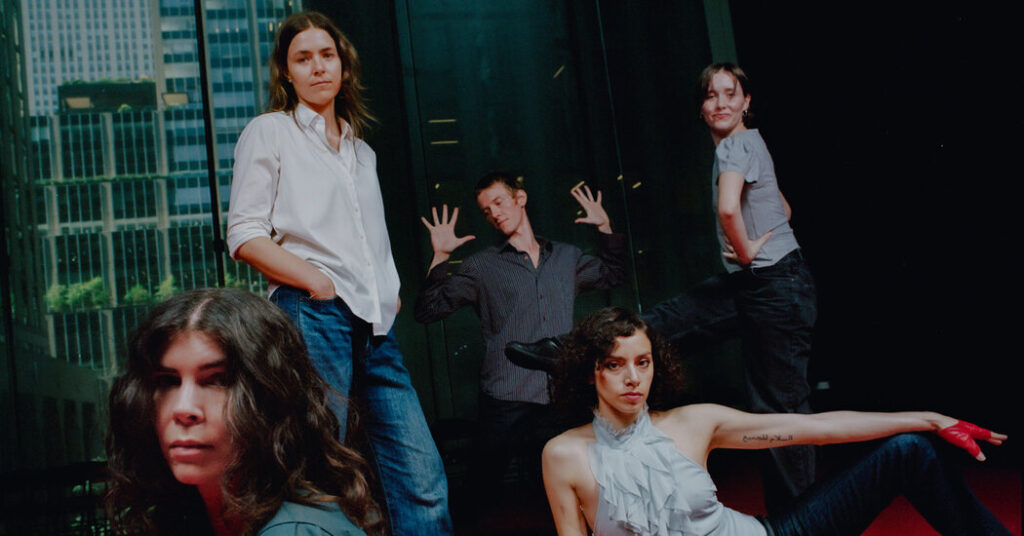
They are its anchor. But Pageant, led by Chidiac, Dekker, Jade Manns, Owen Prum and Alexa West, has grown into something larger than them. At MoMA, that’s what they wanted to show. As part of their Kravis Studio Residency, they took part in a moderated discussion and hosted “Pageant Presents Pageant,” a performance marathon featuring 25 artists in 10-minute works.
During the marathon, dances flew by or trickled along. Some of the work was polished, some weak; some of it seemed thrown onto the stage like a dare. But what the performances revealed, more than a unified aesthetic, was the sweetly striving D.I.Y. spine of Pageant.
In the fragile and fraught ecosystem of dance, Pageant is an unpretentious but serious setting for consistent curation, and this is rare. At Pageant, which opens its fall season on Sept. 17, there are two shows a month. Performances aren’t works in progress; they are complete entities. Choreographers get half of the door, and the other half covers rent. Every show makes it possible for more shows to happen, for more dance.
At MoMA, Prum said, Pageant is trying “to impress ourselves upon the space as much as possible versus being like, ‘Oh, we’re now in this museum or this museum’s affecting us.’ It’s like, we are going to affect the museum. We’re going to try to change it.”
And it’s true that there was a different energy invading the fourth-floor studio, which can feel more than a little sterile. The marathon was a celebration of experimental dance, a slice of the here and now, a shift from the many exhibitions and performances at museums that have focused on artists of the 1960s and 1970s. (MoMA is on a roll: Starting Sept. 15, the contemporary choreographer Sarah Michelson takes over the museum’s atrium with “nowhere.”)
At the marathon, there were whoops and hollers, laughter and hugs. The space, designed to mirror Pageant felt intimate. The stage, with seating on four sides, was a raised platform, painted red to match the door at Pageant. To mimic its bare-bones conditions, artists were given only one light cue and one sound cue.
“The initial concept was like, Pageant is a platform for these artists,” Dekker said. “So let’s make this residency a platform with a literal platform for everyone and give everyone a MoMA show, wink, wink.”
With the marathon in mind, the founders had tried to make a work together, but it quickly fell flat. The Pageant crew may appear in each other’s dances, but collaborators they are not. By placing their individual pieces at MoMA next to those by artists who have long been a part of the Pageant community, the marathon was making a point.
“We are putting our own work in that context of everyone, because that is also what Pageant is,” Chidiac said. “If you look at a yearlong program, we’re there among everyone else. We are not on the outside.”
It depends on how you look at it. They created the community. They’ve also become distinct choreographers, which points to another benefit of running a performance space: having a room in which to rehearse and to show work is one of the fastest ways to improve and refine your artistic skills. This has been true for each of the founders.
Chidiac, who is part of the band Voyeur, is experimenting with new ways dance can coexist with rock music. Dekker has an affinity for directing subtle shifts in presence through movement and text.
West has an aptitude for transforming space with sculptural dance, which she will put into practice on a large-scale at this year’s edition of Beach Sessions at Rockaway Beach in September. Manns has deepened her compositional prowess with trenchant and dreamy excavations of the natural world.
And Prum, choreographing and structuring robust movement for trained and untrained dancers with startling ease, is making work that speaks to the dividing lines between bodies. Do borders matter, physical or otherwise? His quartet “untitled,” a galvanizing extension of the last scene in his “Tristan und Isolde,” performed at Pageant in March, would have been a sharp way to end the marathon. It was a joy, fueled by spirit and sly camaraderie, tenants of the space itself.
But the event began on a superb note with Isa Spector’s vivid, witty “MoMAlogue #1,” which began as a solo — Spector tore and stuttered across the stage, stewing over how to paint a picture of dance in the museum in 10 minutes — and ended with the five founders holding their red-gloved hands while moving slowly in a circle for the remaining 30 seconds. Spector effectively turned the stage over to them as they performed a live version of Matisse’s “Dance.” (A preliminary study from 1909 hangs on MoMA’s fifth floor.)
The 10-minute formula was a good way to highlight the work of other choreographers, including Evan Ray Suzuki whose “5” featured dancers traveling methodically across the stage with haunting Butoh resolve; and Amelia Heintzelman, who in “How Dogs Play,” charged the space with a burst of energy wavering formidably between violence and vulnerability. In “Bonningham,” Maya Lee-Parritz was joined by four dancers, including Jodi Melnick whose back rippled like a snake in a duet with Lee-Parritz. In the end, Lee-Parritz feverishly shook her fists at Melnick, who ripped the band from her bun so quickly, her hair streamed like a firework. MoMA witches!
Joel Watson, an actor with deft physical control, presented “DESPERADO!!,” a simmering one-man tour de force. And in her sleek, ambitious “Snafu,” Benin Gardner glided across the stage with smooth footwork alongside Devi Rayne, creating a dance-theater work that felt like a spy movie or a hostage standoff. In the final moment, a performer held a sign requesting that the MoMA Film Archives return a film negative to the artist Robert Gardner. (He is the choreographer’s father.) Was it really only 10 minutes? This was strong.
An important member of the Pageant community, Gardner performed in two other works in the marathon. “We’ve learned that Pageant is the people who show up for each other,” Dekker said. “Pageant is the influencing and being influenced by.”
So much about the work presented at Pageant is about artists putting themselves out, taking themselves seriously even when the tone of a piece dips deeply into comedy or slick spectacle. What binds Pageant isn’t individual dances.
“Maybe it’s the relationship that we have to the work, but also to each other,” Manns said. “It’s like this historical way of working with other artists and insisting on yourself and creating something together.”
The post A Youthful, D.I.Y. Dance Spirit Storms the Gates at MoMA appeared first on New York Times.