RANGE, by Dorthe Nors; translated by Caroline Waight
The trespassing begins early in “Range,” the Danish writer Dorthe Nors’s new novel.
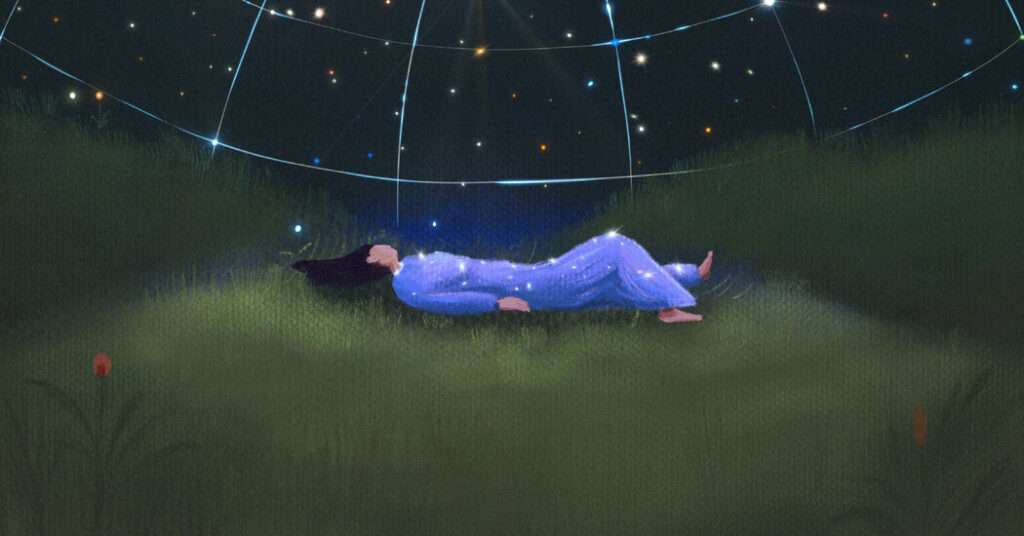
Gunn Haven, an astrophysics professor and oddball, has taken a partial leave from her job at “the Institute” in an unnamed city to live in the rural backwater of her childhood, recording gamma-ray bursts in the sky and writing a book about the stars.
Her explorations up and down the area’s muddy trails quickly lead her to what she thinks is an abandoned farmhouse, until she notices the cameras lashed to trees. Within minutes a dark blue BMW arrives and “a battle-clad woman” emerges, standing “with her feet planted wide” and bearing down on her interloper with a not-so-veiled threat: “This is private property, the road ends here.”
It won’t be the last time Gunn is confronted by the menacing figure she calls “Gable Woman.” And the episode is only one of many intrusions — geographical, interpersonal, existential — layered through this piercing, exhilarating novel of isolation and yearning.
“Range” is Nors’s sixth book to appear in English, this one translated by Caroline Waight. In both her fiction (including the International Booker Prize finalist “Mirror, Shoulder, Signal” and the story collection “Wild Swims”) and her travel memoir, “A Line in the World: A Year on the North Sea Coast,” Nors writes characters — including herself — who sidestep convention and pay a price for doing so. They are observant, mordant and in various ways dislocated; “misfit” is the common descriptor.
But Nors’s work is a sly rebuke to that word: Why must the individual be blamed for missing the fit? Why can’t society soften, open itself more generously to all of us?
For Gunn, this question is old, deeply internalized scar tissue. Now in her late 30s, she has long ago accepted her outsider status (“sometimes it feels like I turned left at the crossroads and everybody else turned right”), while also learning to camouflage herself in the pink pumps and blouses required of women in academia. Only in the classroom, surrounded by avid young minds, can she relax into herself, her equations clicking across the chalkboard in ribbons of inquiry and absorption.
But if the vast, dark sky is Gunn’s true home, both her workplace and playground, her interactions on the human plane can be awkward, provoking and even reckless. Despite the iron fences she’s erected around her own need for connection, the childless Gunn fosters what she sees as the unrecognized potential of various adolescents in the novel, defying their parents’ authority by asserting her own. She takes her teenage neighbor, Jenny, under her wing, teaching her about cosmology and astronomy, despite unwelcome prying from Jenny’s gossipy mother. (Gunn reserves some of her most caustic observations for motherhood, that “consensus-based competition.”)
And meanwhile she longs for contact from “the boy” — the 23-year-old “protégé” she’s mentored since he was a child, whom she has sent on a road trip across America with instructions to “learn to orientate himself,” and to occasionally text her his coordinates.
“Let the weird children come to me,” she narrates, the once-bullied strange kid now on a mission to nurture those whose families don’t see them.
Let the children whose parents are ashamed of them come to me. The ones with the spineless dads, the needy mums? Just let them come. And let the offspring of bad relationships trickle in. Yes, the chronically hungry grown-ups’ equally hungry kids. Let them show up at my door, jam a foot in, plead for membership to be extended.
This is an obliquely composed novel of advances and withdrawals and buried clues, and the reader, like the astronomer, must patiently “observe, note, conclude.” As you watch and wait you’re sometimes rewarded with a narrative burst of fiery activity, or a subtler, more beautiful afterglow of revelation. It is a novel whose language and structure delicately enact its wrenching themes, most of all the heartache of enduring one’s own chosen and carefully guarded loneliness.
In Waight’s translation, Nors’s prose is scrubbed clean and often luminously poetic (the “woollen darkness,” a “quilt of light and rain”). Passages are often intriguingly structured, building chains of soothing descriptions only to end in a flare of some surprising, unbidden truth. If her protégé’s parents knew where he was at the moment, she imagines, “they’d be standing in their open-plan kitchen right now gazing anxiously at each other. They would adjust the light above the kitchen island with that dimmer switch his father had installed, and they would agree to direct their anger toward Gunn.”
In halting steps through the novel we uncover her history and her private hurts: the sudden death of Gunn’s mother when she was little, the bottomless love for her inept father who did his best, the “grieving blade” of her earlier homesickness while studying abroad in America.
The “range” in this novel is not only the grand stretch of the universe, but also the space between freedom and tether, the push and pull of distance and connection. But the kind of freedom Gunn desires can come at a terrible price, and there are reckonings to be made: not only with the monstrous Gable Woman but with Gunn’s deepest, most estranged self.
In an era when all language is subject to relentless algorithmic flattening, when books are so often rewarded for easy comprehension and bland sentiment, “Range” is a rebellious celebration of the singularity, and mystery, of humankind. We need more fiction like Nors’s. Let the weird children come.
RANGE | By Dorthe Nors | Translated by Caroline Waight | Graywolf | 312 pp. | Paperback, $18
The post A Luminous Novel of Isolation and Yearning Beneath the Stars appeared first on New York Times.