Irish poets and American presidents have long spoken of Kashmir: its beauty and its dangers.
The question of Kashmir has shaped the trajectories of India and Pakistan since the end of British rule and their birth as nation-states in August 1947. Both countries claim Kashmir in its entirety, have fought multiple wars over it, and each controls a separate part of the territory. Historically, references to Kashmir have largely focused on the dispute between India and Pakistan, or on the most visible troubles in Indian-administered Kashmir.
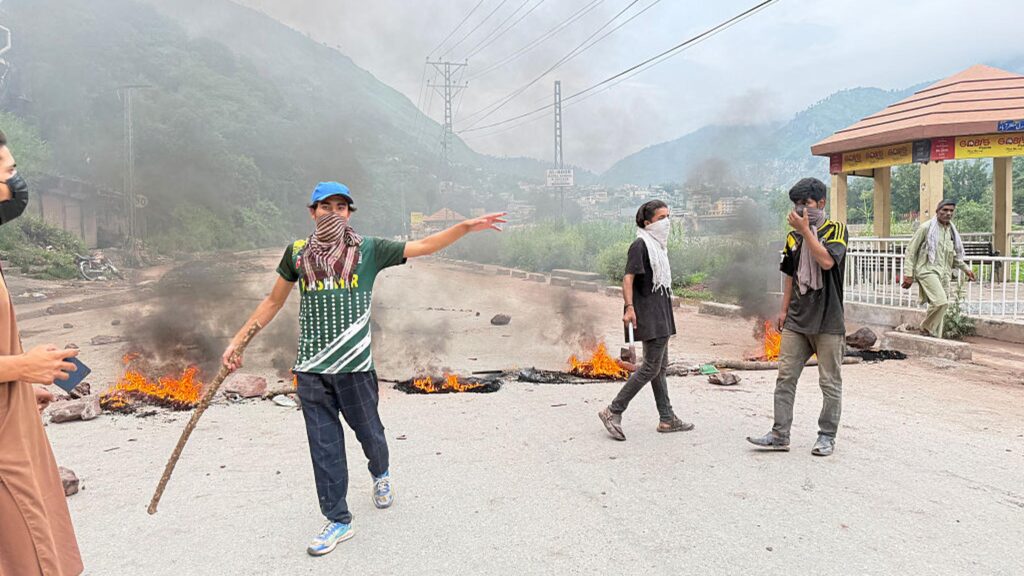
Global attention has rarely lingered on the part of Kashmir administered by Pakistan. Yet, since an outbreak of protests in the region in June, more than 80 peoplehave been killed by security forces. A different kind of political struggle has been gathering momentum there—one that is less a contest over sovereignty than an expression of long-simmering grievances over the conditions of daily life, from unaffordable electricity bills and rising food prices to a scarcity of jobs.
Pakistan-administered Kashmir has not been insulated from the wider economic crisis in Pakistan. Rising prices, fiscal pressures, energy deficits, and repeated International Monetary Fund bailouts have pushed successive governments to reduce subsidies and raise utility prices. The people of the region, already squeezed by inflation and unemployment, experience these policies not as fiscal prudence but as evidence of how little influence they have over the decisions that shape their lives.
Kashmir and the making of a protest movement
Kashmir is home to major hydropower projects that feed Pakistan’s national grid, and many residents argue that local tariffs should better reflect the territory’s contribution to power generation. The grievance is not new: protests over rising electricity and basic commodity prices have erupted periodically since 2022.
The failures of the local government to resolve these issues created an opening for a new form of political organization. Citizens committees emerged across districts, bringing together traders, lawyers, students, and community leaders. In September 2023, these committees coalesced into the Joint Awami Action Committee (JAAC), a unified body intended to coordinate mobilization across the region.
The JAAC initially demanded lower wheat and electricity prices, an end to official privileges for ministers and bureaucrats, and empowered elected local governments. It has remained outside Pakistan’s political party system. Rather than aligning with the major parties—the Pakistan Muslim League (Nawaz), the Pakistan People’s Party, and the Pakistan Tehreek-e-Insaf—it presented itself as a nonpartisan platform.
The movement’s appeal seems to rest on its ability to unite constituencies across partisan divides around everyday economic and governance concerns. In response to the JAAC’s organizing, authorities arrested its members on criminal charges and restricted its meetings. But these measures failed to subdue the movement, which pressed on through shutdowns, transportation strikes, and local protests. The protest movement’s strength lies in its decentralized structure, with its chapters across small towns and villages offering a grassroots network that can be activated across the region.
In May 2024, after the government pledged to consider its demands but delayed making any substantive concessions, the JAAC called a long march and a shutdown strike. The mobilization drew hundreds of thousands of protesters toward the capital, Muzaffarabad, in one of the largest episodes of mass mobilization in the region’s history. Attempts to prevent the march backfired, broadening the movement. Protests continued to swell in Muzaffarabad despite arrests, roadblocks, and restrictions on internet and cellular communications.
Clashes during the May 2024 march left at least four people dead, including three protestors and a police officer. Islamabad ultimately intervened with a relief package reportedly worth about 23 billion rupees ($82.9 million), which included subsidized electricity tariffs and lower wheat prices. But the government’s repressive response turned a campaign over utility prices into a broader test of whether the people of Pakistan-administered Kashmir could exercise meaningful political agency.
Citizens or subjects?
The May 2024 settlement demonstrated that collective action could compel Islamabad to address immediate economic grievances. But it did not resolve the broader issue of political accountability: how Pakistan-administered Kashmir is governed? The territory has its own president, government, legislative assembly, and courts, but Pakistan retains decisive influence over key administrative, security, and external affairs.
A council chaired by Pakistan’s prime minister used to be a major source of Islamabad’s formal control over legislation, finances, and development planning. Although a constitutional amendment in 2018 stripped many of its powers, reducing it to a largely advisory body, significant authority still rests with the federal government. Key civil servants—including the chief secretary and the inspector general of police—are appointed by Islamabad, leaving the regional elected government with limited control over crucial aspects of administration.
Pakistan has long defended this exceptional arrangement in Kashmir as necessary for an exceptional situation: administering a territory whose international status remains contested. For residents, however, it has created a persistent gap between political responsibility and political authority. Elected politicians are expected to answer to voters, but the decisions that shape their daily lives are made in Islamabad.
The electoral system of the region adds another layer of complexity. The legislature of Pakistan-administered Kashmir has 53 seats. Eight of those seats are reserved for women, religious scholars, technocrats, and overseas citizens. Lawmakers are elected for the remaining 45 seats through elections. Thirty-three of those lawmakers are elected by the people living in the region. Twelve more seats in the legislature are reserved for refugees from Indian-administered Kashmir who live elsewhere in Pakistan—an arrangement introduced in the 1960s and formalized in the 1970s. Critics argue that these 12 seats significantly dilute the political weight of the territory’s voters and make it easier for whichever party rules in Islamabad to shape the assembly’s composition.
In June, the top court of the region ruled that those 12 seats enjoy statutory protection, and that any change would require a formal constitutional amendment. The ruling affirmed the government’s legal position, but it did not address the political question at the heart of the dispute. Can a legislature in which more than a quarter of directly elected seats are filled from outside the territory truly reflect the will of the people who live there?
The trouble with military hegemony
The dominant role of Pakistan’s military further constrains political space. Pakistan is governed by a hybrid regime in which civilian governments function within boundaries imposed by the military, which continues to exert tutelary control over national security, foreign policy, and even political competition. Pakistan-administered Kashmir reflects a concentrated version of this wider political order.
The geopolitical stakes of the Kashmir dispute are high, leaving the room for independent political action quite narrow. The Pakistan Army’s 12th Infantry Division, commanded by a major general and headquartered in the hill town of Murree, exercises operational control over the region, giving the military a direct hand in maintaining security.
Human rights observers have long documented the influence and the abuses of Pakistan’s military and intelligence services in the territory. The JAAC and rights activists argue that organized political activity and free expression are readily treated as security threats, narrowing the room for dissent. Elected institutions, they say, are reduced to a facade while the security apparatus determines whether political discontent can be expressed and mobilized.
The consequences of this militarized approach were on display during the renewed mobilization in the summer. In June, Pakistani authorities banned the JAAC under anti-terrorism laws, declaring it a threat to public order, and launched a broader crackdown on protesters ahead of regional assembly elections planned for Jul. 27 to Aug. 10. In late July, scores of protesters were killed, according to the leaders of the JAAC. Pakistan defended the tactics of its security forces, and a federal minister described the protesters as “militants.” While the number of civilians killed remains contested, but the political significance of the state’s response is clearer: treating a largely peaceful movement rooted in economic and democratic demands as a terrorist group reinforced the perception among the JAAC’s supporters that Islamabad would rather break heads than count them.
The JAAC had called for a boycott of the vote, making the abolition of the 12 refugee seats one of its central demands. The first phase of voting recorded a turnout of about 46%, while officials put turnout in the second phase at roughly 50%, lower than the 60% recorded in the previous two elections in 2016 and 2021. Voting in the third phase was postponed because of continued unrest.
Preliminary results gave the Pakistan Muslim League-Nawaz, the governing party of Pakistan, 24 general seats, though the delayed contests meant the election had yet to be finalized. The results lend credence to the JAAC’s contention that polling alone cannot resolve who exercises meaningful political authority in Kashmir. This is particularly true when the ruling party in Islamabad can draw on state resources and the military establishment’s backing to shape both the electoral environment and, ultimately, the composition of the legislature.
This manipulation begins well before polling day. Critics say officers from Pakistan’s Inter-Services Intelligence and Military Intelligence, operating under the area’s army command structure, use pressure tactics and patronage to favor candidates who endorse Kashmir’s integration with Pakistan. The 12 refugee seats, critics argue, are not simply a constitutional problem but an additional lever through which politically loyal candidates can be brought into the assembly.
The movement’s durability suggests that it is more than a dispute over economic disparities; it reflects a broader crisis of affordability, legitimacy, and accountability. In that sense, the deeper shift is one of political expectations. Support for the JAAC, particularly among young people, reflects a growing impatience with political subordination justified as a geopolitical imperative.
The unrest also reveals an uncomfortable contradiction in Pakistan’s official position on Kashmir. For decades, Islamabad has accused India, not without justification, of gross human rights violations against Kashmiris on its side of the Line of Control. Pakistan’s foreign policy rests on the claim that Kashmiris possess a moral and legal “right of self-determination” and that Kashmir’s final status should be decided through a United Nations-administered plebiscite. Yet those claims are difficult to sustain when Islamabad’s own governance of Pakistan-administered Kashmir falls short of the very standards it invokes in criticizing India.
For Islamabad, the lesson is clear. Stability cannot be bought with temporary economic relief that leaves the underlying structure of political power intact. Nor can it be secured through repression, which amplifies alienation, fuels anger, and breeds broader resentment toward the Pakistani state. Stability depends on meaningfully addressing the local demand for responsive and credible government, and on recognizing that the people of Pakistan-administered Kashmir are citizens with political rights, not supplicants dependent on Islamabad’s largesse.
Kashmiris are not merely demanding lower bills and cheaper bread. They are demanding respect and representation. In the towns and valleys of Pakistan-administered Kashmir, these aspirations cannot simply be suppressed by force.
The post The Other Side of Paradise: How Pakistan Crushed Protests in Kashmir appeared first on TIME.