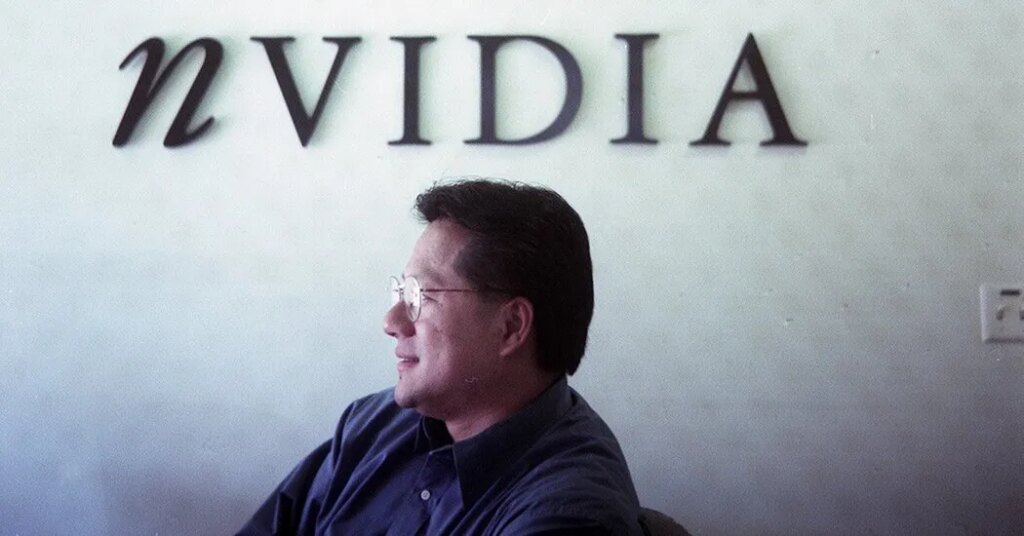
Advice to Nvidia’s board: Choose a techie.
As the chip giant’s directors seek a replacement to Jensen Huang, the history of successions at Silicon Valley companies suggests that the odds of long-term success are better with a person steeped in technology and product development rather than finance, sales or marketing.
Replacing a founder is a defining moment for any company, whether it’s been planned for years or a sudden departure, whether the company is thriving or faltering. For Mr. Huang, Nvidia’s co-founder and former chief executive, the fall came remarkably quickly. He resigned on Thursday after the disclosure of affairs with a woman identified by U.S. intelligence as a Chinese spy and with an executive who reported to him.
Nvidia’s business as the leading chip supplier to artificial intelligence data centers is flourishing. Mr. Huang’s hasty exit, analysts say, will have little near-term effect on the company’s business, despite a big stock-market reaction. (The company’s shares have fallen 14 percent in the last five days.)
But the best tech leaders steer their companies toward opportunity. At Nvidia, founded in 1993, Mr. Huang recognized more than a decade ago that chips used mainly for image-processing in computer games could be repurposed as the hardware engines for A.I. software. It was a huge bet for the small company — and paid off.
“You can coast on the founder’s work for years with good execution,” said Steve Blank, a Silicon Valley entrepreneur and investor, who is an adjunct professor at Stanford University. “But you can lack the founder’s vision to see over the horizon and identify what’s next. That’s why the best successors have a lot of technical acumen as well as business acumen.”
Over the years, the results for tech companies replacing founding executives have been decidedly mixed.
In 1985, Apple co-founder Steve Jobs was forced out after clashing with his chief executive, John Sculley, who had come from Pepsico. Under Mr. Sculley, Apple enjoyed years of rising profits. But the company eventually struggled to compete against lower-cost personal computers based on Microsoft’s Windows software and Intel’s microprocessors. Mr. Scully left Apple in 1993.
Three years later, with Apple’s survival uncertain, Mr. Jobs returned and became chief executive. A renowned product team leader, he led a corporate renaissance, introducing new digital devices including the iPod and the iPhone that transformed the product categories of music players and cellphones.
In 2011, shortly before he died, Mr. Jobs named Tim Cook as his successor. Mr. Cook has a degree in industrial engineering as well as a master’s in business administration. While some analysts said Apple lost some of its innovative spark, today the company is valued at $5.16 trillion, the most valuable in the world. (In September, Mr. Cook became executive chairman and John Ternus, a mechanical engineer and product development executive, became chief executive.)
Intel didn’t fare so well. While Andrew Grove didn’t found the chipmaker, he was among its first employees and led the company for nearly two decades. Mr. Grove immigrated from Hungary, learned English and earned an undergraduate degree and a Ph.D. in chemical engineering.
Mr. Grove led Intel’s drive to dominate the market for microprocessor chips, the electronic brains of personal computers. He became the face of Intel and one of the architects of the personal computer industry, named Time magazine’s “Man of the Year” in 1997.
Mr. Grove’s immediate successor in 1998, Craig Barrett, was also a technologist. But later successors less so — and Intel’s fortunes declined precipitously. As part of efforts to help revive chip manufacturing in America, the U.S. government said last year that it would invest nearly $9 billion in Intel for a stake of just under 10 percent.
Some of the biggest tech companies have learned that technical expertise at the top is indispensable. Bill Gates, co-founder of Microsoft, stepped aside as chief executive in 2000 and handed the job over to his longtime business partner, Steve Ballmer.
Mr. Ballmer was known as a brilliant sales and business development executive, and a tireless, hands-on manager. During his years as chief executive, from 2000 to 2014, Microsoft’s sales and profits rose steadily. But Mr. Ballmer’s lack of tech expertise contributed to an erosion of Microsoft’s reputation as an industry leader. Big-spending initiatives, especially trying to compete with Apple in smartphone software and hardware, failed.
Satya Nadella, who holds undergraduate and graduate degrees in computer science, as well an M.B.A., succeeded Mr. Ballmer in 2014. Mr. Nadella quickly refocused the company.
“He recognized that the future for Microsoft was not going to be mobile,” said David Yoffie, a professor at the Harvard Business School. “It was going to be the cloud. And he very effectively drove the company in that direction.”
Today, Microsoft is a leading provider of cloud computing services, its software programs are available on the cloud, and it is investing heavily in A.I. The company is valued at $3.88 trillion.
For Nvidia, its next leader is going to have to chart a long-term strategy. With a 90 percent share of the current market for advanced A.I. chips and cash flooding in, the company will be able to bankroll its next moves.
Still, Nvidia’s very market dominance invites competition. Google, for example, has developed chips designed for A.I. And companies in the United States and China are working on open-source alternatives to CUDA — Nvidia’s software platform for its chips — that are free to use and modify. The CUDA software, used by an estimated four million developers, reinforces Nvidia’s grip on the market.
Nvidia’s current business is racing along. “But the company has not really mapped out and articulated a future yet,” said Michael Cusumano, a professor at M.I.T.’s Sloan School of Management.
The travails of Mr. Huang, 63, are also evidence that he was not as laser-focused on the business as he once was, Mr. Cusumano said. Seeing the next A.I. market turn could take fresh eyes.
“Jensen Huang has done an incredible job over the years, but it may not be a bad time to replace him,” Mr. Cusumano added.
The post Nvidia Lost Its Founding C.E.O. Can It Keep Its Momentum? appeared first on New York Times.