Americans’ paychecks are losing ground to inflation.
Again.
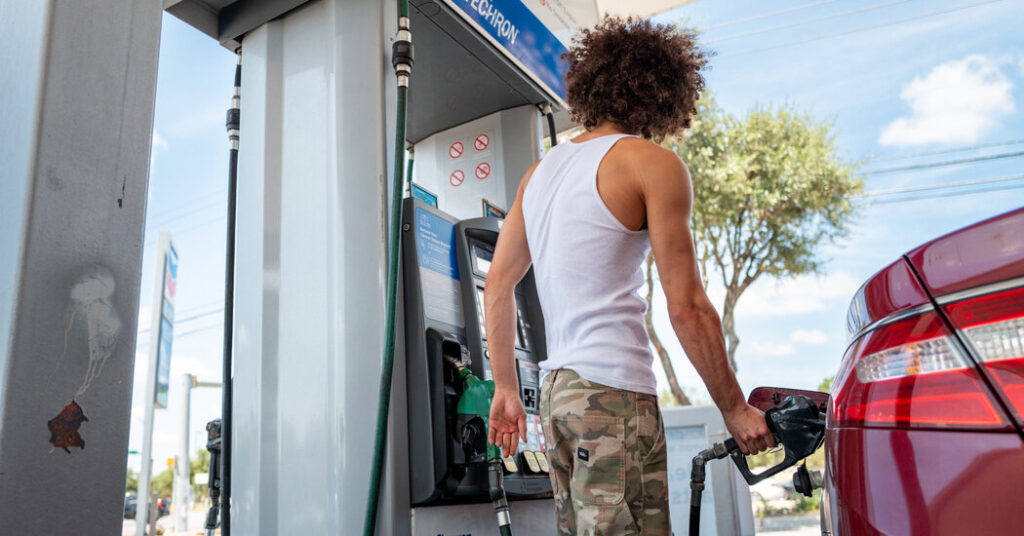
Government data released this week showed that consumer prices rose 3.4 percent in July from a year earlier, outpacing a 3.2 percent increase in hourly earnings over the same period. That means that, for the fourth month in a row, Americans’ real wages — how many sandwiches, haircuts and gallons of gas they can buy with an hour’s pay — actually fell.
Such declines are unusual. In the years before the coronavirus pandemic, real wage growth sped up and slowed down with the ebbs and flows of the economy. But pay never fell outright for more than a month or two at a time.
Then came the pandemic and the ensuing surge in prices, which led to the sharpest decline in inflation-adjusted wages since the 1980s. From February 2021 to June 2022, the buying power of the average American’s paycheck fell more than 4 percent.
The latest shock, driven by the jump in energy prices tied to the war with Iran, hasn’t been nearly as severe. But coming on the heels of the earlier decline in pay — and at a time when affordability and the cost of living remain top of mind for many voters — it has sent measures of consumer sentiment tumbling.
“The real hourly wage is absolutely the fundamental building block of working Americans’ living standards,” said Jared Bernstein, an economist at the Stanford Institute for Economic Policy Research. “When it’s falling in real terms, that’s a huge problem for folks who are already stressed by affordability concerns.”
Mr. Bernstein should know. He was a top economic adviser to President Joseph R. Biden Jr. when the administration was trying to persuade Americans that the economy was improving despite the shrinking value of their paychecks. Those efforts largely failed.
Now, the Trump administration is making similar arguments, so far with the same result. In political polls, voters give the president poor marks for his handling of the economy, which had been an area of strength for him.
On Friday, the University of Michigan said its long-running measure of consumer sentiment fell in early August, partly reversing modest gains when gas prices eased in June and July. Only 8 percent of people surveyed said they expected their income growth to exceed inflation over the next year, down from 18 percent at the end of last year.
Falling real wages aren’t the only sign that households are struggling to manage higher prices. Personal income after taxes — a broader measure that takes into account other sources of cash such as retirement benefits and rental income — also fell in inflation-adjusted terms in the second quarter. And the savings rate has plummeted as Americans try to maintain their standard of living.
The latest inflation data contained some modest good news for Republicans. It showed prices rising more slowly in July than at the peak of the oil shock in the spring. If that trend continues, wages should start rising faster than prices once again.
History Lessons
But even if wage growth does rebound, Americans’ assessment of the economy may not quickly follow suit. Pay gains consistently outpaced inflation during Mr. Biden’s final two years in office, but measures of consumer sentiment barely recovered.
New research from the Becker Friedman Institute at the University of Chicago may help explain why. Economists used data from ADP, the payroll processing company, to study pay patterns of millions of workers before and during the pandemic-era surge in inflation.
Before the pandemic, they found, most companies gave nearly all their workers a standardized annual pay increase, often about 3 percent. During a period of low, stable inflation of about 2 percent, that was enough for workers to scratch out modest gains in real terms.
When inflation jumped in 2021 and 2022, however, companies offered only slightly better annual pay increases, meaning most workers fell behind. The only way to get a bigger raise, at least for many workers, was to change jobs. Unsurprisingly, workers did so in droves — the number of Americans quitting their jobs hit a record high in 2021 and 2022, when inflation was at its peak.
Some workers managed to win larger raises by merely threatening to leave, or by getting promotions. But among employees who stayed with the same company from 2021 to 2024, more than two in five, 43 percent, saw their wages decline in real terms, by an average of roughly 9 percent.
“These are big numbers,” said Erik Hurst, an economist at the University of Chicago who is one of the paper’s authors.
Economists often think about inflation as having relatively small consequences for a large group of people, unlike job losses, which have large consequences for a relatively small group of people. But if inflation results in large, persistent wage declines for a significant share of employees, Mr. Hurst said, “the cost of inflation to workers is just orders of magnitude more than any of our macro models say.”
Older workers, who have a harder time moving between jobs, were hit especially hard. More than half of workers ages 50 and up lost ground to inflation between 2021 and 2024. Even when they did change jobs, they typically got smaller raises than their younger peers.
Younger workers were more likely to get raises that kept up with inflation. But they had to hustle for them — jumping between jobs or seeking out competing offers — and, even then, their pay typically lagged behind where it would have been had prepandemic trends in pay continued.
“During periods of inflation, wage adjustments are not free,” said Christina Patterson, a University of Chicago economist and another author of the paper. Ms. Patterson was also an author of an earlier paper showing the toll that such fights over pay take on employees. “In order for workers to recover their wages, they had to start fighting for it.”
Less Leverage
Now real wages are falling again just as some workers were starting to make up for lost ground. And while inflation isn’t as high as it was four years ago, the labor market is weaker, making it harder for workers to move between jobs in search of better pay. Wage growth has slowed in recent months even before accounting for inflation, a sign of workers’ reduced bargaining power.
A measure of employee sentiment from the job site Glassdoor hit a record low last month, as workers worried about the shrinking value of their paychecks and about the threat posed by artificial intelligence and other forces.
“Workers have less power now — the pendulum has swung from employees back toward employers,” said Daniel Zhao, chief economist at Glassdoor. “There’s less incentive for employers to proactively offer a raise or benefits to offset higher prices.”
The recent declines in pay could pose a problem for Republican candidates in this fall’s midterm elections. Research from economists at Georgetown University and the University of California, Berkeley, recently found that, in the 2024 election, Mr. Trump and other Republicans made their largest gains in the parts of the country where real wage growth was weakest. Now, the same trend could work against them.
“President Trump gained from drops in real wages,” said Francesco Trebbi, an economist at the University of California, Berkeley, who was one of the study’s authors. “Voters punished incumbents for the reduction of the purchasing power of their income.”
But, Mr. Trebbi continued, “the problem is now he is the incumbent.”
The post As Inflation Eats Up Pay Gains, Workers Fall Behind appeared first on New York Times.