The Trump administration asked the Supreme Court on Friday to clear the way for it to complete the White House ballroom, escalating the months-long legal fight over the president’s controversial project.
U.S. Solicitor General D. John Sauer told the justices in an emergency filing that suspending work on the project, which is being challenged by a historic preservation group, threatens national security and the safety of President Donald Trump, his family and executive branch staff. Work on the project is scheduled to stop on Aug. 21 unless the Supreme Court intervenes.
Sauer also argued that it is too late for any court to halt construction on the project.
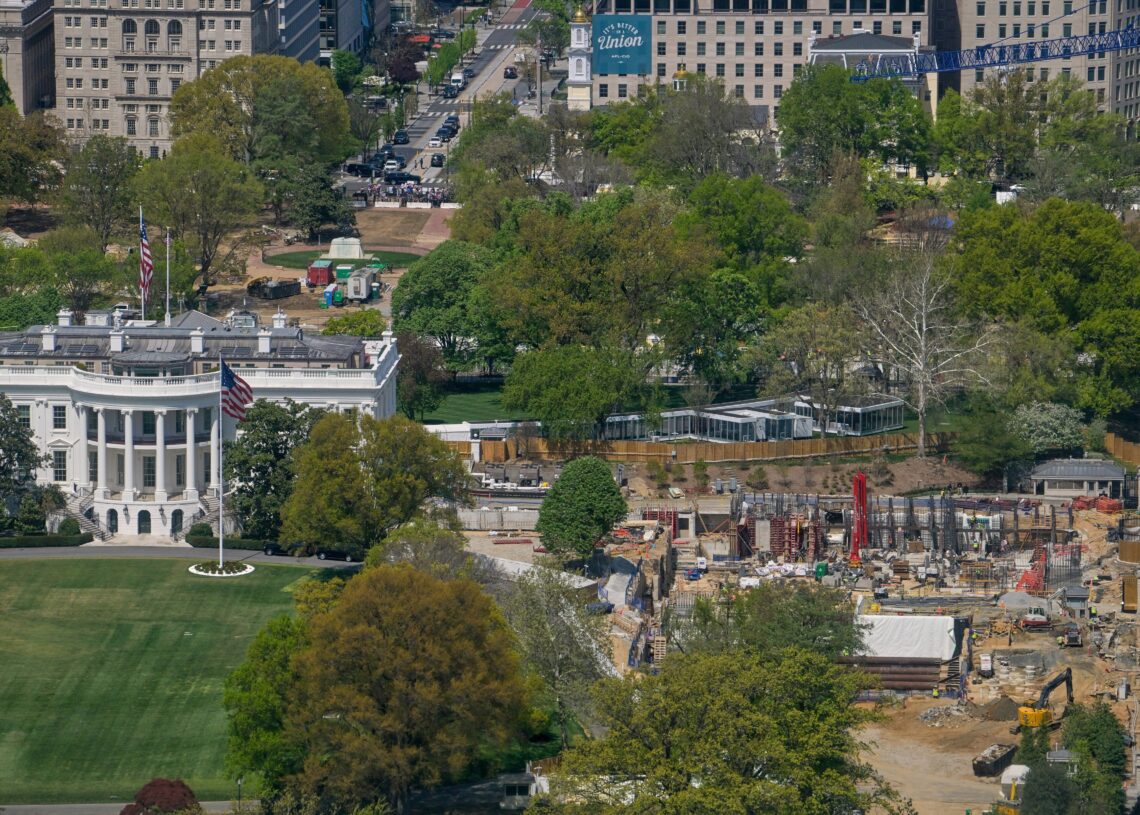
“That line has long since been crossed,” Sauer wrote in his filing, saying that the project was “65% complete” and that about 250 workers are working 20 hours per day, seven days a week to quickly finish it. He asked the high court to allow the administration to continue its work while the legal battle plays out.
The project includes the ballroom to host large events, as well as an underground bunker that the administration says is needed for security. It is already 70 feet above ground in some places, Sauer wrote.
The Justice Department also submitted new renderings of the ballroom — including images that show it affixed with golden seals — and close-up photos of the construction site. The administration also shared affidavits from Secretary of State Marco Rubio, FBI Director Kash Patel and other senior administration officials who listed threats against the president and claimed that completing the ballroom was necessary to protect him.
Allowing the project to remain halted “would freeze the White House complex in a state of needless vulnerability,” Stephen Miller, Trump’s homeland security adviser, wrote in a filing.
The National Trust for Historic Preservation, which sued to halt the project, has dismissed officials’ claims that the ballroom must be finished for national security reasons. Several judges, including U.S. District Judge Richard Leon — who first blocked work on the ballroom earlier this year — have also been skeptical of the administration.
“While I take seriously the Government’s concerns regarding the safety and security of the White House grounds and the President himself, the existence of a ‘large hole’ beside the White House is, of course, a problem of the President’s own making,” Leon wrote in March.
Leon said that aboveground work on the planned 90,000-square-foot structure could not continue without congressional approval. A federal appeals panel quickly stayed Leon’s order but on Aug. 7 sided with Leon and ordered another halt to the project.
“We are aware of no instance in American history in which a President unilaterally and using privately collected funds demolished substantial portions of the White House that Congress authorized to be built and American taxpayers paid for. Until now,” the appeals court majority wrote in a 2-1 decision.
The appeals court stayed its order to give the administration time to ask the high court to take up the case. The justices will now decide whether to temporarily allow construction to go forward or block it, while the National Trust’s lawsuit continues to play out. Alternately, the justices might rule the trust has not suffered the real-world harm necessary to meet the legal bar to bring a lawsuit against the construction of the ballroom.
Sauer said the administration would ask the high court to consider the case. In the meantime, he asked the justices to put the lower court ruling on hold.
Trump, who has been fixated on ballroom construction, has been vocally frustrated about the appeals court’s ruling to halt the ballroom.
“The Military and Secret Service are viewing this horrendous, politically motivated, and unlawful ruling as a National Security threat to our Nation in that the entire Complex is being built for the protection of our Country and, additionally, all future Presidents,” the president wrote on Truth Social this month.
Trump had initially characterized the ballroom as necessary for presidents to entertain VIP guests before shifting to the argument that it is a national security priority. Justice Department lawyers have cited several potential threats, including an attempted shooting in April at the White House correspondents’ dinner and the alleged June plot to attack a UFC event at the White House, as evidence of the need for the project.
The project has taken a number of legal twists and turns.
Leon’s first ruling in March largely blocked Trump from continuing with the ballroom without getting approval from Congress, but it still allowed “actions strictly necessary to ensure the safety and security of the White House.”
Trump then claimed that Leon’s exception allowed him to continue work on the ballroom because it included drone-proof roofing materials and blastproof glass that will enhance the overall security of the White House.
Leon soon clarified in April that construction could proceed only on a subterranean portion of the project deemed necessary by the military, not on the 90,000-square-foot aboveground building. But a day later, a three-judge panel of the U.S. Court of Appeals for the D.C. Circuit stayed Leon’s order, allowing work to proceed in the intervening months while it rendered a final verdict.
At a hearing in early June, Justice Department attorneys argued to the panel that the courts cannot stop Trump’s White House ballroom project — only Congress can.
The president also has said the military is building a “massive complex” beneath the proposed ballroom that Trump has said will include a state-of-the-art hospital, bomb shelters and more.
The area was known to hold the Presidential Emergency Operations Center, which was built during World War II to shelter the president and other top officials in case of emergency.
Trump administration officials initially said the bunker and the ballroom work could proceed independently, but more recently claimed the projects were inseparable.
In clarifying his ruling, Leon, an appointee of President George W. Bush, rejected Trump’s interpretation of the work that is necessary for security. He allowed crews to keep doing subterranean work and to secure the construction site to make it safe for people on the White House grounds.
“National security is not a blank check to proceed with otherwise unlawful activity,” Leon wrote.
In December, the trust sued to block the construction of the ballroom, saying the Trump administration had not gone through the legally mandated review process to get the ballroom approved.
The group was skeptical of the claims that pausing the project would create a security risk.
“It is difficult to believe that even Defendants really think the absence of a massive White House ballroom jeopardizes national security,” lawyers for the National Trust wrote in a filing.
The ballroom, which could hold about 1,000 guests, is the largest expansion of the White House in decades. The White House announced the project in July, when administration officials said the privately funded addition would hold 650 guests and cost $200 million. Both figures have grown steadily since: the capacity to about 1,000, the price tag to $400 million or more.
The Washington Post reported in June that the administration had approved a $500 million non-bid contract to construct the ballroom.
Trump has wanted to build a ballroom at the White House since at least 2010, when he offered to do so as a private citizen but was rebuffed by the Obama administration. He has long disparaged the tents that past presidents have erected on the South Lawn to accommodate large-scale events.
The project has been marked by secrecy and shifting plans from the start.
In July, Trump promised the ballroom would not “interfere” with the existing building. But in October, without notifying the public, the administration destroyed the East Wing in three days, razing the annex that for decades had housed the first lady’s offices, a movie theater and the starting point for White House tours. The demolition shocked preservationists and lawmakers. Documents show that Trump had planned to demolish the East Wing at least two months before doing so — and just weeks after announcing the project.
Polls have consistently shown that most Americans oppose the project. A Post poll in July found about 1 in 3 Americans say they feel enthusiastic or satisfied with Trump’s ballroom, Reflecting Pool and triumphal arch projects, while nearly 2 in 3, 65 percent, feel dissatisfied or upset.
Trump has defended the project, saying it’s needed to host large events and that it’s being funded by private donations from companies including Amazon, Apple, Google, Lockheed Martin and Palantir, which collectively have billions of dollars in federal contracts before the administration. (Amazon founder Jeff Bezos owns The Post.) Democrats and government watchdog groups have questioned whether donors were promised access or other perks in exchange for their gifts.
For a year, Trump has promised that no taxpayer money would be used to fund the project. But The Post obtained an estimate put together by a contractor that found the total project cost would be $600 million, with more than half coming from taxpayers.
After starting site work in September, the administration proceeded with months of demolition and underground construction without submitting plans to either of the two federal commissions charged by Congress with reviewing government building projects: the National Capital Planning Commission and the Commission of Fine Arts. Trump has since remade the panels, filling them with allies, such as his 26-year-old executive assistant.
Both commissions have voted to approve the project, but Leon’s March ruling found that Trump needed congressional authorization. He called the administration “brazen” for arguing that a law providing a few million dollars annually for White House maintenance allows the president to unilaterally pursue a $400 million effort to transform one of the most revered symbols of American power and democracy.
Congress has shown little appetite to authorize the project. Republican leaders have largely avoided the issue while Democrats have opened multiple probes into Trump’s use of private donors to fund construction.
The post Trump officials ask Supreme Court to let ballroom construction continue appeared first on Washington Post.