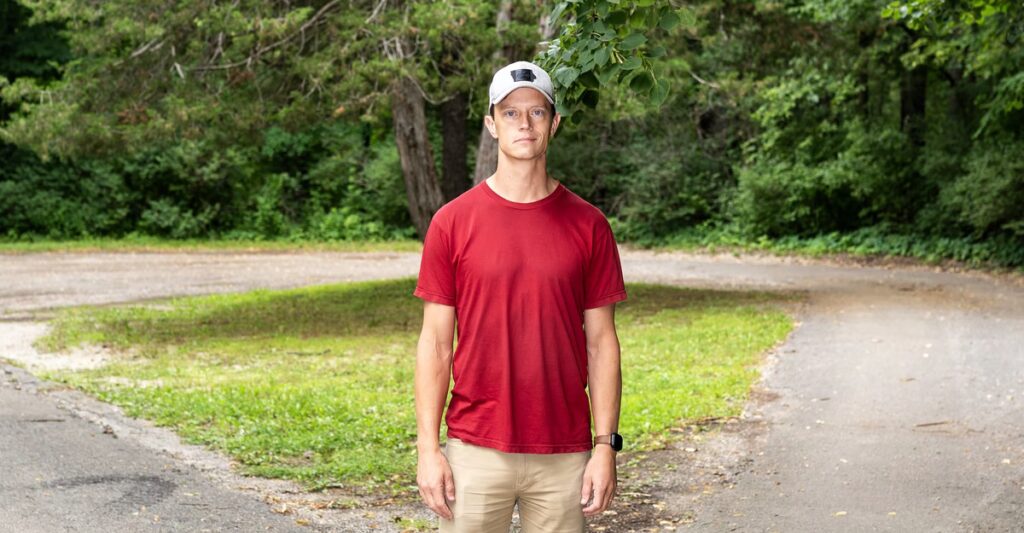
Photographs by KC McGinnis
Somewhere along the county road between Independence and Manchester, I lost Rob Sand.
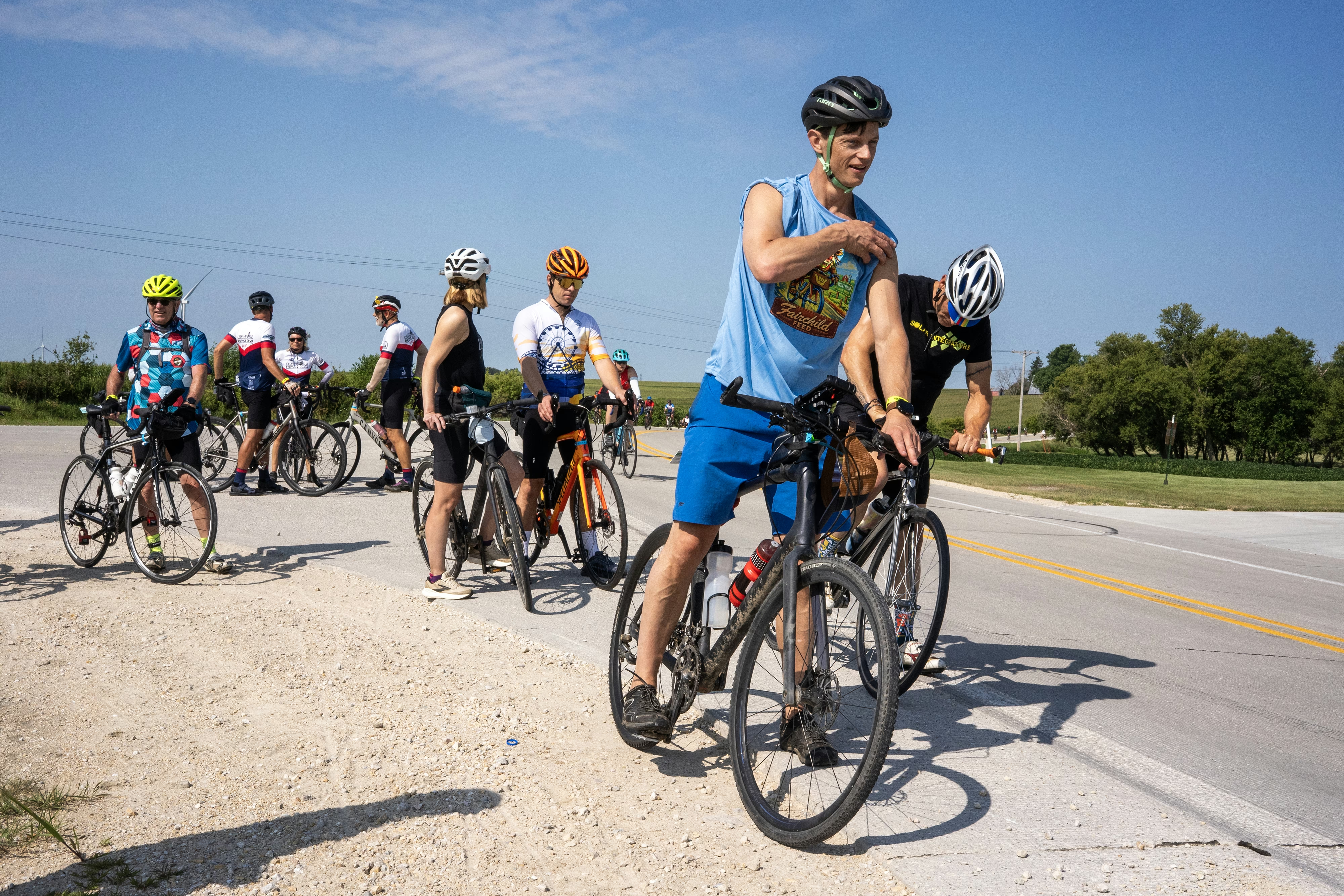
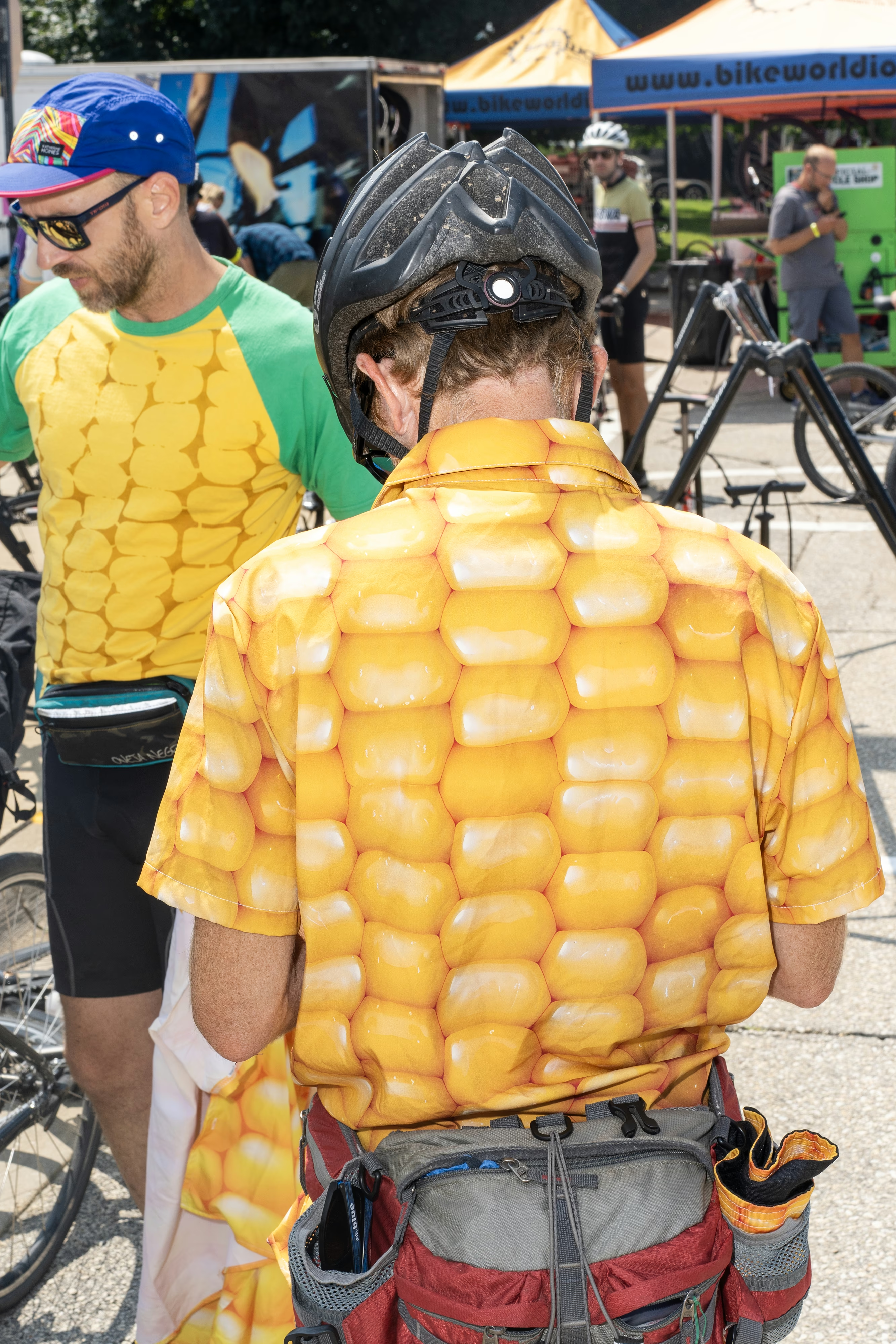
This had been a distinct possibility when I agreed to join the 44-year-old Democratic candidate for governor on a segment of a weeklong bike ride across Iowa. Unlike Sand, I am not a biker—merely a leisurely walker and, like any good Millennial woman, an occasional Pilates-doer. Which is why, on a long, low-grade hill dotted with Queen Anne’s lace, my quads began to burn, my pace slowed, and the subject of my story disappeared into a rainbow river of helmets. A minute later, the sag wagon overtook me. Soon so did a 9-year-old boy.
Thankfully, my humiliation was short-lived. These days in Iowa, one can never truly be without Rob Sand. Even as I panted alone at the back of the peloton, I could hear people chattering about the man who would be governor. “Was that who I think it was?” they said. And, “Oh, I just love him!” At one point, a fit-looking cyclist who turned out to be the former NFL wide receiver Tim Dwight pulled up beside me to lament Iowa’s unfulfilled economic potential. “This is why,” he said, “we need Rob.”
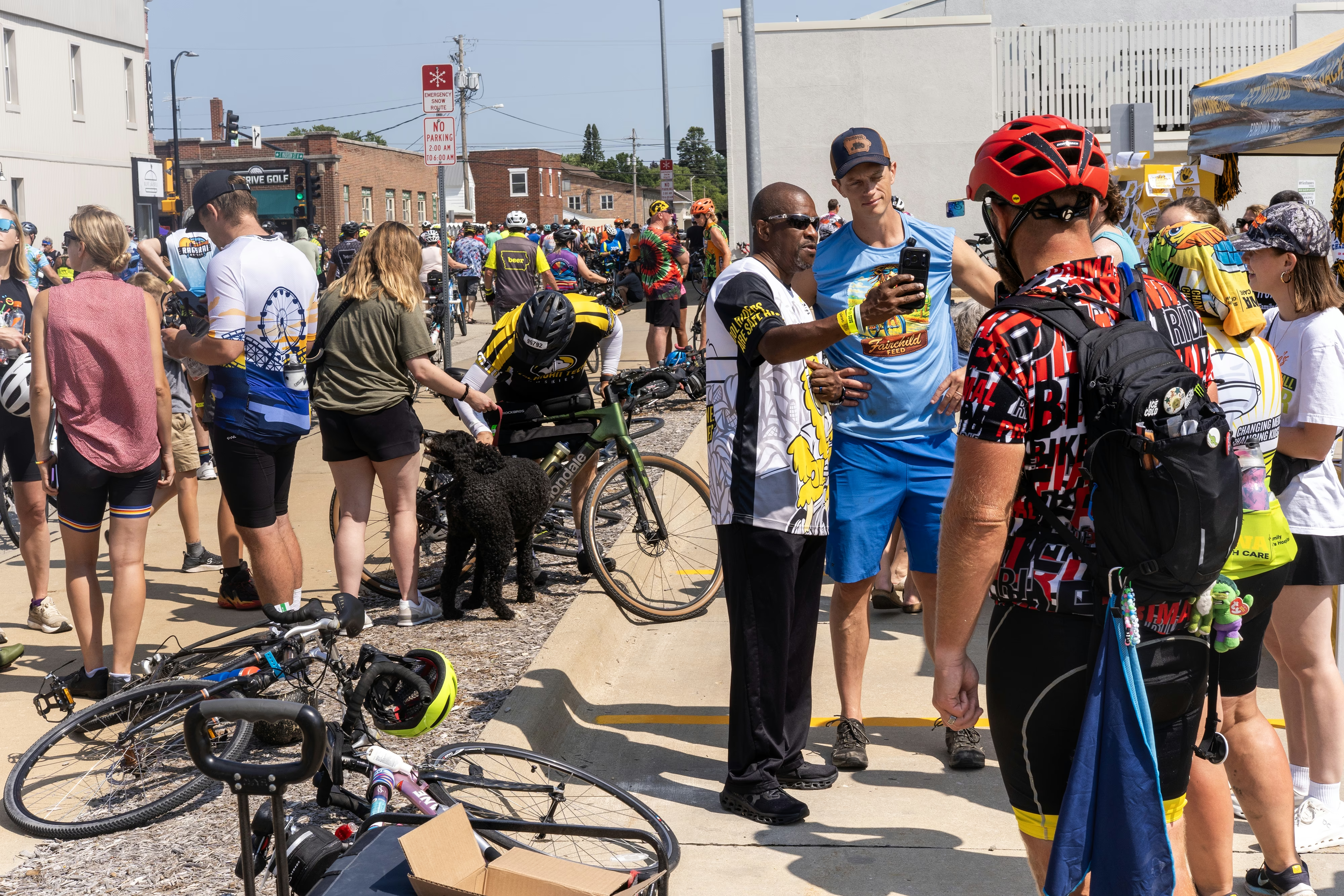
Sand, the state auditor, is ubiquitous in Iowa. On any given day, one might encounter him in a TV ad, promising jail time for corrupt politicians; on Instagram, talking through a mouthful of Casey’s breakfast pizza; and at a town hall singing “America the Beautiful” with a bipartisan crowd of gray hairs. Sand is something rarely found in nature: a successful Iowa Democrat. Which is perhaps why his presence generates such mania. Biking with him across the state felt a little like showing up to a middle-school slumber party with Taylor Swift—or riding shotgun in the popemobile. Despite Sand’s bike helmet and lack of signage, hundreds of people recognized him and begged for selfies. “I nearly killed Iowa’s next governor!” yelled a man in Winthrop who bumped into Sand’s bike. People often used both his first and last name, running them together into a single word. “I lent my bike pump to Robsand!” another man declared in Independence.
Sand’s party has struggled to gain purchase in Iowa since the dawn of the Trump era, and a Democrat hasn’t been elected governor since 2006. The funny thing is, Sand is not a particularly proud Democrat. He tends to refer to the party as “the lesser of two evils” and made a face when I asked whether he enjoyed being in it. “I can’t imagine saying I like being in any political party,” he told me. “I love being a dad.” Before addressing a crowd in Des Moines County last year, Sand’s staff asked for party insignia to be removed from the walls to make the space more inclusive.
The auditor obviously wants to steer clear of the national party’s noxious fumes. But whereas his progressive contemporaries distance themselves by railing against the establishment, Sand’s campaign approach has been different: Quietly, and with an easygoing optimism that Fred Rogers would envy, Sand questions the concept of partisanship itself. “Our political system is broken, and it’s broken mostly because it’s run by two private clubs” that make voters “feel trapped” into making a binary choice, he told a crowd last month in Newton. “The good news is that Iowa is a place where we have typically said we are going to make politics work for ordinary people.”
National Democrats like what they see—even if they find it tough to describe. Sand “is doing the opposite of what almost every other politician is doing,” the strategist and former Pete Buttigieg adviser Lis Smith told me. He isn’t a loud progressive, but he also doesn’t sound like a corporate moderate, Adam Carlson, a pollster, agreed. “Sand is doing a third thing.”
In November, Sand will be up against a potentially strong GOP candidate. But his most daunting adversary will be the math: Registered Republicans outnumber Democrats by almost 200,000 in Iowa. Which means that Sand plans to spend the next 11 weeks telling Iowans that he can be trusted, in spite of the D behind his name. Will enough of them believe it?
Sand had been annoyed the last time I wrote about him. I’d included all of the relevant background details in my story: that he grew up in Decorah, a town near the Minnesota border, which explains his long vowels (Sand pronounces it “Dee-corah”); that he went to Brown University and worked a few modeling jobs in Europe before attending law school and working for seven years as a prosecutor. I’d explained that, like any good red-state Democrat, Sand loves to hunt and spends Sunday morning in church—and that his wife’s brothers called him “Baby Jesus” for his tendency toward self-righteousness.
But Sand was concerned about something else: that I had not fully captured his frustration with America’s two-party political system. “I was hoping you’d get more into election reform,” he texted me—a sentence that, I am confident, no one has ever said before or since. At the time, I did not imagine that many readers were pining to hear a state auditor’s thoughts on the decline of bipartisanship. But here we are, three summers later, and Sand is still talking about the same ideas: moving to an open-primary system and implementing “approval voting,” which would allow Iowans to support more than one candidate. More remarkable, voters are listening.
Sand is a Democrat because “Jesus is for the little guy, and the Democratic Party, at its best, is for the little guy.” But his more inclusive vision wouldn’t require party affiliation. The scramble to replace Graham Platner in Maine, for example, wouldn’t have happened under Sand’s system, he said. Or, “if a really old candidate, hypothetically, had a bad debate experience, and everyone was like, Um, maybe this person is too old to do this, it wouldn’t be a crisis.” The reforms would reward civility, Sand added, and prevent one-party domination of a state.
Republicans have had total control over Iowa for a decade. In that time, they’ve dramatically cut income taxes, redirected hundreds of millions of public dollars toward private schools, and restricted abortion after six weeks. Right now, the state is facing a $1 billion budget shortfall and the second-highest cancer rate in the country.
But Sand does not harp on Republicans. Actually, a Sand political event doesn’t really feel like one: Each town hall begins with a round of applause for the Republicans, independents, and Democrats (for good measure) who showed up, then transitions into a group rendition of “America the Beautiful.” Sand speaks for a while about his policy priorities (corruption, public education, affordability) before opening the floor to questions, some friendly and others confrontational. The event I attended in Newton concluded with a resounding cheer for—you guessed it!—a return to divided government in Iowa.
An observer might fairly describe all of this as just a tad cringe. But one person’s cringe is another’s stirring call for unity. “There’s a movement afoot for change, and he comes along at a good time,” Steve Mullen, a retired teacher, told me in Newton.
It helps that Sand does not behave like most Democrats. He is not, for example, easily drawn into culture-war debates or bandwagon slogans. Early in his campaign when a radio host asked him whether biological males should be allowed to play in women’s sports, Sand answered succinctly, “No.” In January, after federal officers killed Renee Good and Alex Pretti in Minneapolis, Sand did not join in the calls to abolish ICE. “He’s taken some of the cultural issues that dog Democrats in red states off the table,” Adam Jentleson, the founder of the center-left think tank Searchlight, told me.
[Read: ‘Abolish ICE’ is back ]
The progressive left, as you might imagine, is not wild about Sand. Some were disgusted, for example, that the Democrat did not release a statement denouncing ICE after Good’s and Pretti’s deaths. Others see Sand’s comments on trans athletes as a betrayal of the LGBTQ community. Still, most seem to find the state auditor tolerable. “He’s a happy warrior for nonpartisan technocratic efficiency and anti-corruption,” Adam Green, the co-founder of the Progressive Change Campaign Committee, told me. Sand might slap that on a billboard.
Iowa’s state auditor can seem a little naive. Even if he becomes governor, Sand would almost certainly be working with a Republican state legislature that won’t be eager to hand him any wins. But Sand says he isn’t worried. “There’s still a lot of people of good faith in that caucus,” Sand told me at a deli in Manchester after we’d finished our bike ride. State GOP lawmakers know that they’ll need to have something to show for their public service when they “reach the pearly gates.” Had Sand met a politician recently? I thought. When I voiced my doubts out loud, Sand looked stricken. “I am really hopeful,” he said.
Meanwhile, Republicans are busy trying to convince Iowa voters that the auditor is more extreme than his kumbaya suggests. “It’s like The Truman Show,” Zach Lahn, Sand’s GOP opponent, says in one campaign video. “He’s not a moderate.” In another, Lahn pledges to take back Iowa’s public-school curriculum “from the Marxists who hijacked it.”
Lahn, a former Republican operative, seemed to come out of nowhere in June when he defeated incumbent Representative Randy Feenstra for the GOP nomination. More specifically, Lahn came from Kansas. Although he was born and raised in Iowa, he has lived in Wichita, where he founded a private school, for much of the past decade. The Des Moines Register reported that Lahn splits his time between Iowa and his second home in Kansas, where some of his children live, although Lahn reassured Iowans that if he is elected governor, he will be in the state “as much as humanly possible.” (Lahn did not respond to my requests for comment.)
But Lahn’s outsider status might help him. He has no elected-office experience and is not yet a known quantity in Iowa, which means that he does not wear the albatross of incumbency. So far, he’s campaigned on protecting small farms from corporate agriculture, an unusual Republican position in the state. For this, as well as his pledge to ban mRNA vaccines and improve the state’s water quality, Lahn has also received the MAHA stamp of approval. Several conservative Iowans along the bike route told me that they wouldn’t have voted for Feenstra, but they were considering Lahn’s “new ideas.”
Lately, Republicans have accused Sand of doing too much stumping and not enough of his day job; they’ve also drawn attention to the significant campaign donations from his wife and her wealthy family. But Lahn’s main project ahead of November will be to remind Iowans that Sand, regardless of his rhetoric, is running as a Democrat. At Sand’s Newton town hall, a Lahn supporter named Carrie Atkinson asked the auditor to declare the number of weeks at which he would support a ban on abortion. Sand answered that he thought Roe v. Wade was a reasonable decision. “He didn’t answer my question!” Atkinson told me later. At another event, a local Republican activist named Gary Loeffler asked Sand to justify his support for abortion as a Christian. There are “many verses in the Bible that say life begins at breath,” Sand said, an answer that enraged some religious conservatives.

Republicans believe, or say they believe, that Sand, a wealthy guy with an Ivy League education, is far more liberal than he lets on. Loeffler offered a disturbing visual: Like an infested cob of sweet corn, Sand might look normal on the outside, but inside, he’s “full of worms.”
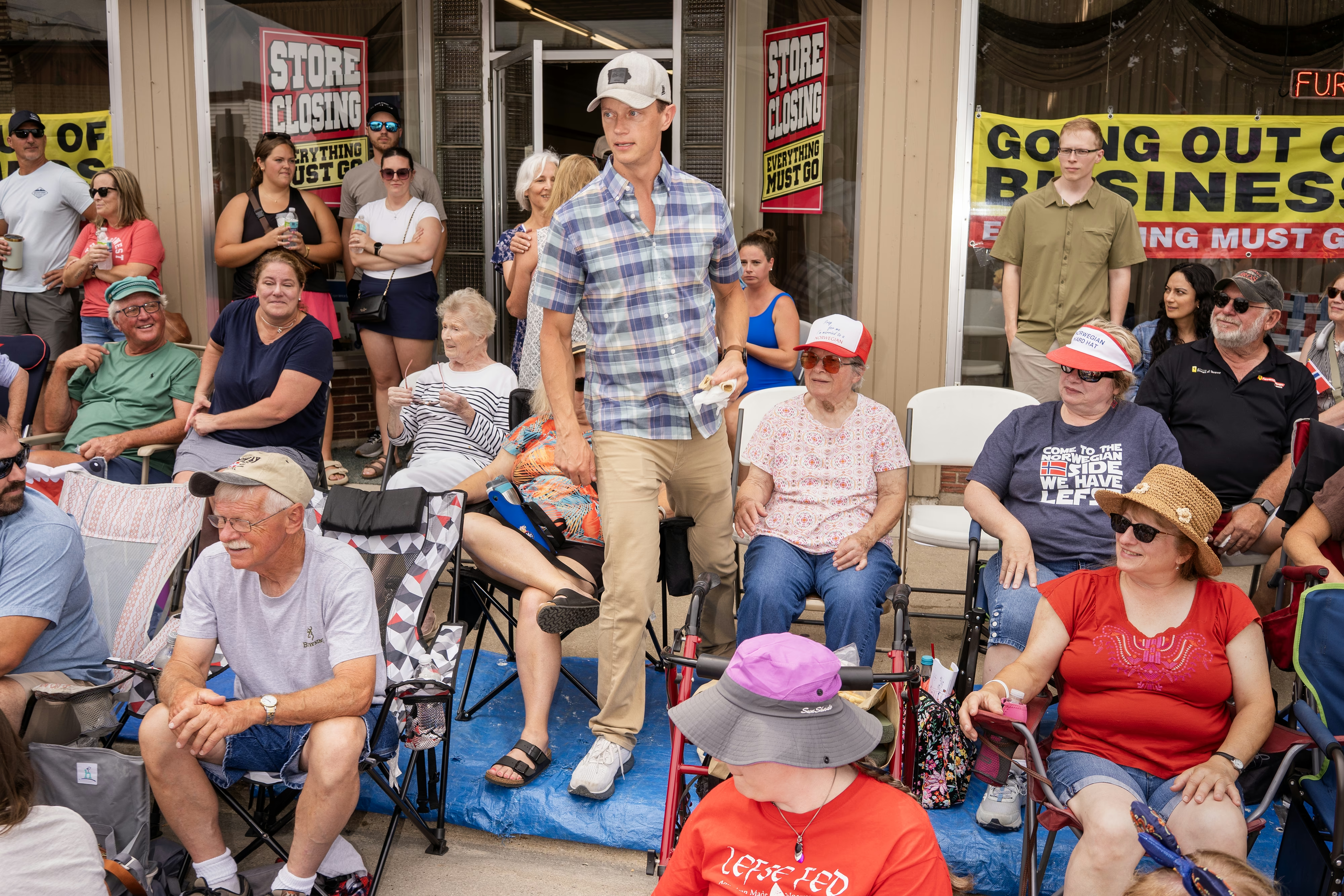
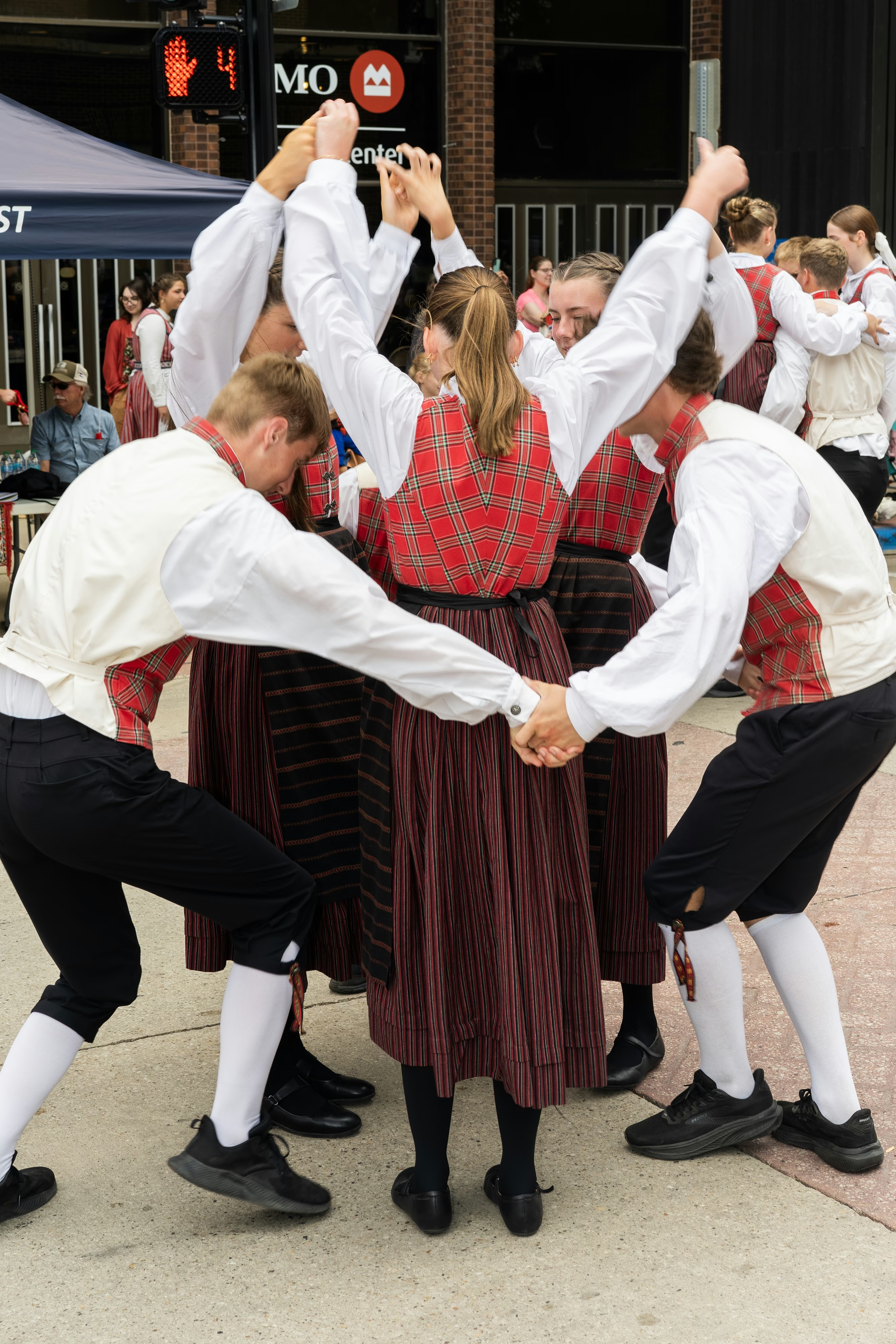
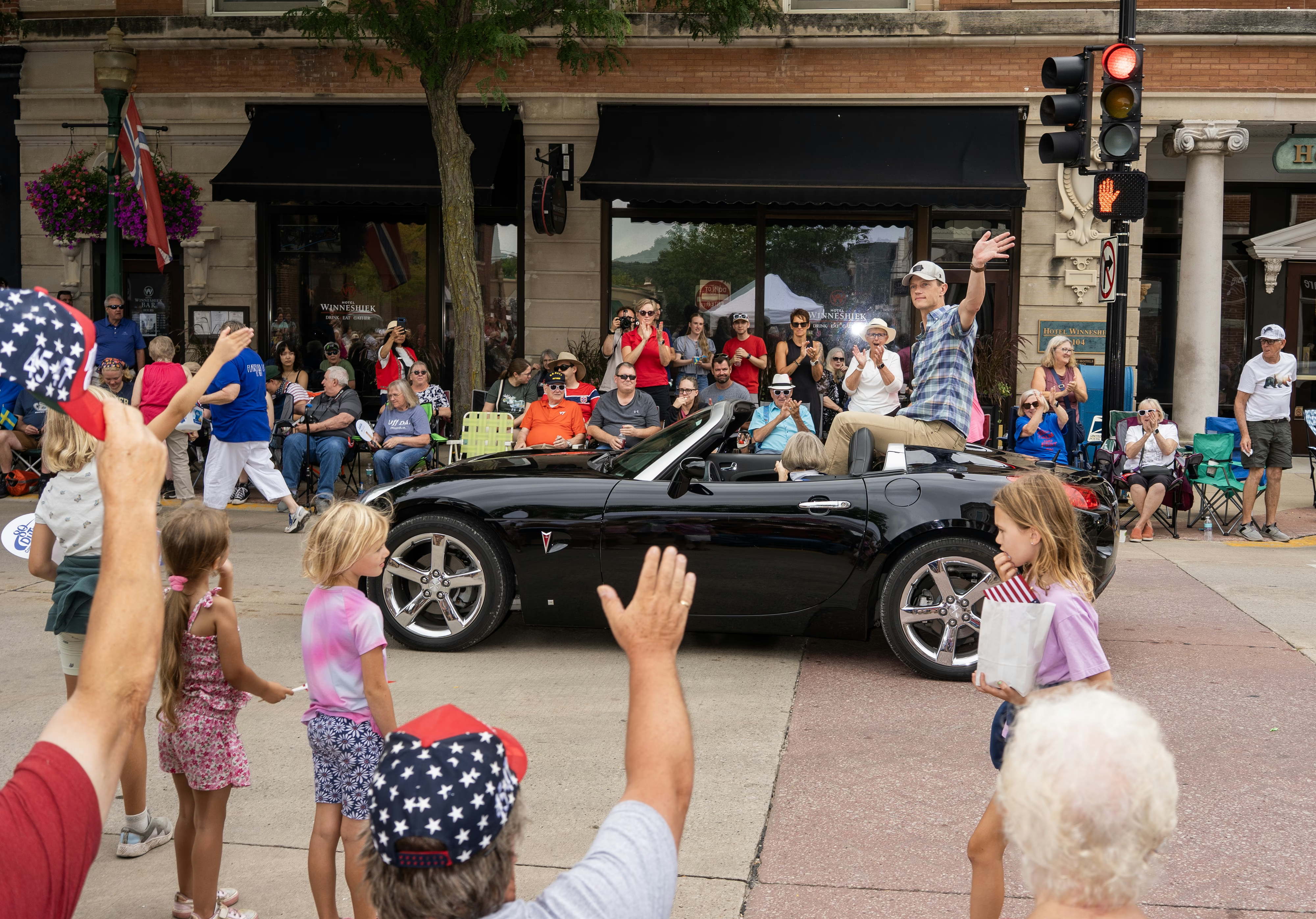
Luckily, I was able to test Loeffler’s hypothesis—by traveling to Sand’s hometown and peering into the proverbial husk. In Decorah, along the Upper Iowa River, I attended Nordic Fest, a celebration of Scandinavian heritage that included Viking battle reenactments, Nordic dancers, and a parade featuring Sand in the back of a convertible. It felt a little like visiting Bedford Falls with George Bailey. “This is Rob Sand; he’s a good friend of my eldest son!” the announcer said as the auditor drove by. Sand’s aunt, who ran the lefse stand, trotted into the street to give him a package of fresh Norwegian flatbread. Sand’s father asked me in Norwegian if I spoke the language of my ancestors. (I do not.)
After the parade, Sand offered a wry tour of his hometown. Walking down the main drag, he pointed out the old teen center. “Can you guess how many times we went?” Near a statue of a long-snouted woodland creature, he explained: “Trolls are out in the world and can be dangerous.” Quickly, we were overwhelmed by friends and well-wishers. Among them was Andy Rasmussen, Sand’s best friend from high school. Sand was always smart and ambitious, Rasmussen, who does autobody work in Decorah, told me later. He liked to skateboard and bowhunt. He didn’t drink, but he’d give friends rides to parties. “The running joke was that someday Rob’s gonna be president,” Rasmussen said. But what were Sand’s politics back then? I wanted to know. Is he a Trojan horse of socialist corn worms? Rasmussen basically shrugged. “He will generally talk to and listen to anybody that’s out there.”
Others who knew Sand during college and law school similarly described a man committed to listening. At Brown in the early 2000s, Sand frequently criticized the Bush administration in his column in the school paper. Still, he recruited Stephen Beale, a conservative columnist at the paper, to start a new class on conservative thought, featuring readings from Edmund Burke, Barry Goldwater, and Pat Buchanan. Sand is still “being his authentic self,” Beale, who now works as a freelance writer, told me. “He really does care about hearing the other side.”
I thought about Sand’s cheering section at the Nordic Fest parade. “Light ’em up, Rob!” one man had shouted. But Sand had waved him off. “No, no, no,” he’d said.
The next two months may not be so friendly. So far, Sand has outraised Lahn, but Republicans are pouring millions into the state, partly thanks to a high-profile Senate bid from Democrat Josh Turek and three surprisingly competitive House races. Expect ads from both parties to be vicious—and pervasive. On Thursday, screaming activists for Turning Point Action chased Sand around the Iowa State Fair.
[Read: Democrats might actually win Iowa]
Right now, Sand looks reasonably well positioned for victory. The Cook Political Report has changed its analysis of the race from “lean Republican” to “toss up,” and new polling shows Sand leading Lahn by five points. If he succeeds, Democrats might finally be able to say out loud what many have believed for years: that Iowa still defies partisan categorization.
Many Iowans are only now starting to pay attention. Before I lost Sand on the bike ride, a middle-aged man named Ethan Vaas had rolled up next to us. “Are you who I think you are?” he asked Sand, sounding more suspicious than excited. The two chatted for a moment, but Vaas soon pedaled away, looking unimpressed. An hour later, though, he was back, this time to talk with Sand about his job and his kids. Vaas wasn’t sure how he’d vote this year, he told me later. He typically “leans right.” But there was something different about Sand.
The post A Democrat in Name Only appeared first on The Atlantic.