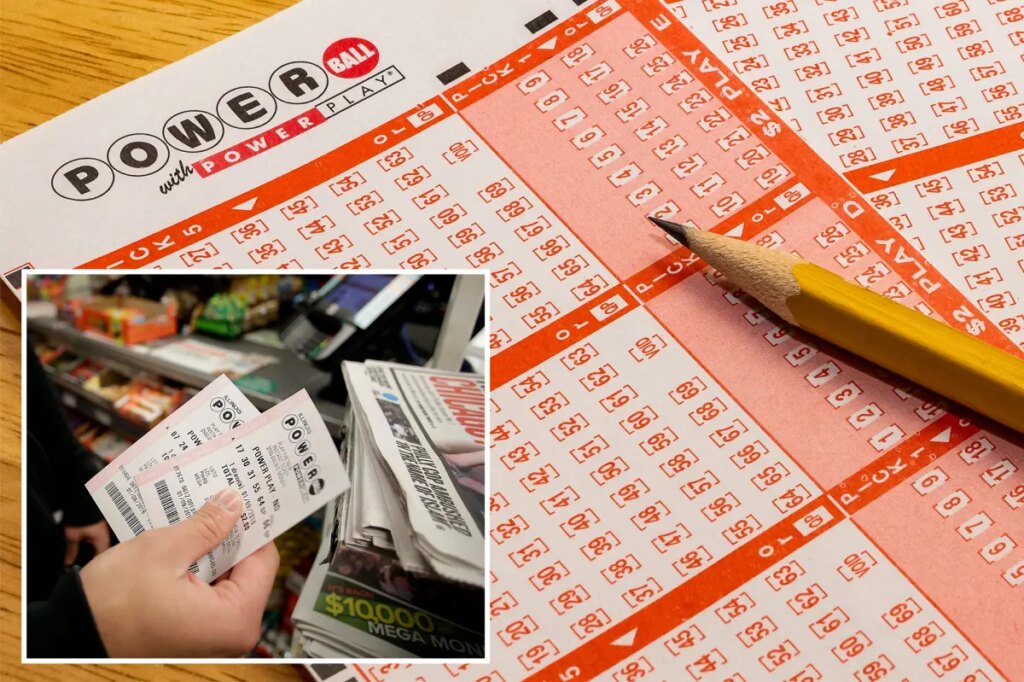
The Illinois Powerball ticket holder who hit a $1.04 billion jackpot may be able to keep their identity under wraps thanks to a state law – but their take-home prize could be a fraction of that amount.
The lucky gambler defied the one in 292.2 million odds to hit the top prize – the eighth-largest in the game’s history – but must decide whether to receive their prize in one lump sum or in 30 graduated installments over 29 years.
The winner must claim the prize by October 11 — within 60 days of Wednesday’s drawing — if they choose the one-time prize worth an estimated cash value of $450.5 million, according to the Illinois Lottery.
But they will see considerable deductions if they go down this route.
If they take the lump sum, an automatic 24 percent federal withholding tax will cut their prize to $342.4 million. Then an additional 13 percent in federal taxes will further cut the amount to $283.8 million.
The state of Illinois will withhold $22.3 million due to its 4.95 percent tax applied to winnings.
But if the player is content to receive the annuity, they can wait until Aug. 12, 2027 before having to come forward.
Illinois lottery ticket holders who win prizes over $250,000 can enjoy anonymity, but they must file a request to keep their identity under wraps.

Players can request to keep their name and location confidential when filing a claim form.
If they don’t submit the request, then a player’s name, home city, and the amount won will be disclosed.
Illinois lottery bosses do not publish winners’ addresses or cell phone numbers.
Twenty-three states allow players either full anonymity or a degree of anonymity, according to the World Population Review.
All winners in Delaware, Kansas, Mississippi, Missouri, Montana, South Carolina and Wyoming can enjoy full anonymity.
New Jersey lotto winners must choose to remain anonymous, as do players in North Dakota.
In Virginia, permanent anonymity is only granted to lottery winners who win $10 million or more. The threshold in Texas and West Virginia is $1 million or more.
Colorado, Florida and Michigan are the states that offer partial anonymity.
Florida winners can stay anonymous if they collect their prize as part of a trust. But for those who win more than $250,000, the player will be unmasked 90 days after they collect their prize.
Once the 90 days pass, the winner’s full legal name and city of residence become part of the public record and can be released to anyone who files a public records request.
This rule applies to the gambler who won the $800 million Mega Millions jackpot – which was the game’s 10th-largest jackpot.
Wednesday’s winning ticket, which was bought at a Hy-Vee Gas Fresh & Fast convenience store in Quincy, snapped a 44-drawing dry spell. The jackpot has now reset to $20 million ahead of Saturday’s drawing.
It was the first jackpot win since Powerball began being soldin the UK.
The largest Powerball jackpot remains the $2.04 billion prize won by Californian player Edwin Castro in November 2022.
The post Why Illinois Powerball player who hit $1.04B jackpot may never be known — and how much they’d take home after taxes appeared first on New York Post.