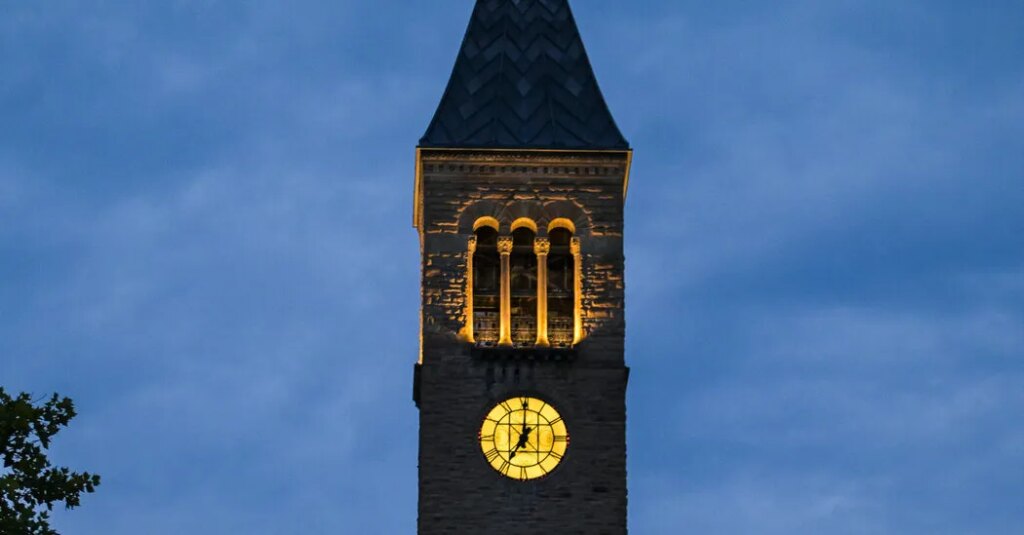
Last week on the rolling campus of Cornell University, students were asking questions about their education that none hoped ever to raise. Did they want to be at a school where a woman said she was sexually assaulted by several men at a 2024 fraternity party, and none of the men faced criminal charges?
And after they had worked so hard just to get in, and paid the tuition of $73,946 a year, would they lose the cachet of Cornell’s storied name on their resumes? Many students declined to be interviewed for this article, for fear of being associated with the scandal.
“Cornell is now known for this,” said Lewis Holland, a senior, his voice shaking.
He had cherished so much about the school: the idyllic campus in Ithaca, N.Y., with trees turning red and orange in the fall, the work ethic of the students who spend late nights in the libraries, his own research on 2-D materials.
Now, the idyll is gone, he said.
In its place is a mess they did not bargain for, and which most did not create. There is a high-profile criminal investigation, made more prominent by the school’s Ivy League status, and renewed scrutiny of the campus’s long-criticized fraternity culture, where the drug ketamine seems to be an accepted social lubricant at some houses.
Like other campuses, Cornell has been riven by pro-Palestinian demonstrations and charges of antisemitism, including an incident in which the university president bumped a student with his car. And like other Ivies, Cornell was already in the cross hairs of the Trump administration.
Last week, students and faculty were trying to find their way through the miasma. And they were doing so under the glare of global digital media, both formal and informal.
Many expressed sympathy for or outrage on behalf of the woman who said she was assaulted; others defended the men and put the blame on the woman.
Some of the most severe criticism fell on the local prosecutor and campus police for their handling of the rape accusations.
Donors have organized campaigns to curb gifts to the university. Gov. Kathy Hochul last week denounced the local prosecutor and campus police force and appointed the state attorney general, Letitia James, to investigate the woman’s rape allegations. And some students are calling for the creation of a program that would allow survivors of sexual assault at Cornell to transfer to another Ivy League university.
For professionals treating the trauma of sexual assault, the case was a reminder of the grim statistic that, nationally, one in five female college students say they were assaulted during their years on campus — and most of these assaults go unreported, some for fear of exactly what has happened at Cornell. The university’s own survey last year found that 35 percent of undergraduate women reported having nonconsensual sexual experiences during their time there.
The seven men accused in the 2024 Cornell case have denied the allegations, while the university, the fraternity and prosecutors have said they responded appropriately given the information they had at the time.
For the university and its 27,000 students, the attention on the school “is going to cause a lot of damage,” said Jeff Hunt, a crisis consultant who worked with Penn State University after an assistant football coach was convicted in 2012 of sexually abusing 10 boys.
Mr. Hunt said the damage to schools involved in scandals could not be measured in donations or applications for admission, which tend to recover fairly quickly. “It just kind of lingers,” Mr. Hunt said, coloring the way students and faculty think about the institution they are part of.
“It’s a reopened wound,” he said, referring to the renewed attention on the allegations, two years after the event. “And it just does a lot of reputational damage and will do so for as long as the wound remains open. And the question now is, what closes the wound?”
He pointed to two scandals that universities handled differently.
At Penn State, the university brought in Louis Freeh, a former director of the F.B.I., who investigated the case and produced a detailed report, which the school then made public. At Baylor University, where 15 women said they were sexually assaulted by football players between 2012 and 2016 and accused the school of protecting the athletes, the administration hired an outside law firm to investigate the allegations. But the university released only a condensed summary of the firm’s report.
“That just makes people think that there must have been a lot of there there,” Mr. Hunt said. “So I think that the principles of independence and transparency are critical in the moment.”
Cornell was already trying to heal from the convulsions that have roiled many universities since 2023, and political pressure that toppled the presidents of several Ivies.
At least 15 students had been suspended for participating in pro-Palestinian demonstrations, some for as long as three years. The protests, and the university’s handling of them, led the Trump administration to launch a civil rights investigation into allegations of antisemitism and to freeze $1 billion in grants. After the university agreed to pay $30 million to the federal government and invest another $30 million in agricultural research, the administration restored the grants.
Then last April, after a debate about the conflict between Israel and Hamas, demonstrators surrounded the black Cadillac S.U.V. of Michael Kotlikoff, the university’s newly appointed president. Dr. Kotlikoff was captured on video backing the car into one of the demonstrators and was accused of running over another student’s foot. That student, who received his degree in May, was subsequently banned from campus for a year for his role in the confrontation.
Dr. Kotlikoff, who had spoken at the event, later described himself as the victim of the incident, saying he had experienced “harassment and intimidation” that was aimed at “silencing speech.”
Some students and recent alumni last week said they saw a discrepancy between the university’s punishment of demonstrators and the seven students accused of sexual assault.
Caro Achar, a 2018 graduate, said that she felt “a mind-boggling level of dissonance” watching her alma mater “expel students for engaging in protest” two years ago — while allowing some students accused of sexual assault to remain on campus.
“It’s so hard to want to continue to engage as a lifelong Cornellian with an institution that I feel is behaving in such an incredibly hypocritical way,” she said.
The seven accused men received punishments of varying severity from the university, including expulsion.
On Saturday, Dr. Kotlikoff appeared in a video in which he addressed the outrage on campus and among alumni. “This is a defining moment in Cornell’s history,” he said. “We owe it to Jane Doe and to survivors of assault to get this right, and we must keep each other safe.”
At least one of the accused men was still on campus last week. The accuser, who is identified in her lawsuit as Jane Doe, is not at the school. None of the accused men has been charged with a crime, and all have denied wrongdoing. Four said that they had consensual sexual contact with the woman at the party, and the others denied participating.
Rue Wiser, 19, a freshman in the School of Industrial and Labor Relations, said that Cornell was their first choice of schools and that they had been extremely excited to get to campus in September. Now some of that excitement has turned into anger.
“This has harmed Cornell’s reputation, but rightfully so,” said Mx. Wiser, who identifies as nonbinary. “When a university handles a situation like this so badly, that it has protected the rapists more than the survivor, reputational damage is deserved. I’m much more concerned about whether Cornell learns anything than whether their reputation is hurt.”
They added, “I’m still extremely proud to be a labor relations student here.”
This kind of anger will not be easy to assuage, said Simon Barker, the managing partner at Blue Moon Consulting Group, a higher-ed crisis consultancy. The boilerplate response at many institutions in crises — announcing a blue-ribbon committee to investigate and recommend changes — is not likely to satisfy anyone except the people organizing it.
“The faster any school can get to that recognition that this is not about defending what we did but recognizing what we failed to do, the better off they’re going to be and the quicker they’re going to be able to restore trust in the institution,” Mr. Barker said. “I don’t think we’ve seen that yet, that pivot from defensiveness to, ‘OK, we’ve actually got to do things differently. We’ve got to look at ourselves.’”
Liam Casey, a freshman, concurred. “Everybody is disgusted,” he said. “People are generally sick of the university releasing statements and making task forces. It’s less about what they need to say, and more about what they need to do.”
Mr. Barker said that universities ultimately recover from these crises, but not before some higher structural changes. At Baylor, the university president, football coach and athletic director resigned or were fired.
Yet universities often underestimate the damage or the measures needed to repair it, he said.
“Cornell has a stellar reputation,” he continued. “It’s what I call too big to fail in terms of reputation. People are still going to want to go there. The challenge is around the edges. We typically see the institution carries on, but the leadership team goes.”
The repercussions now extend beyond the university, filling countless social media feeds.
Last week, after Michael Tracey, a political commentator, urged his followers to publish the name of the Cornell accuser, thousands of social media users posted “I am Jane Doe” or “Jane Doe is me,” to confuse internet searches for her name. The New York Times has seen her name in university documents but is withholding it.
But the reality of the 2024 night remains palpable on campus. Last week, a widely viewed video on Instagram showed a woman approaching Gillio Lopes, one of the seven accused men, in a hallway on campus and telling him, “I just wanted to let you know personally that I’m ashamed to be on the same campus as you.”
Such interactions have caused Mr. Lopes, a senior, to consider leaving the school, his lawyer Andrew Miltenberg told The Times. “I told him and his parents to expect this story’s not going to end any time soon.”
Troy Closson, Cole Louison and Christopher Maag contributed reporting.
The post A Campus Reckoning: ‘Cornell Is Now Known for This’ appeared first on New York Times.