The recliner really is made in Vietnam. The plant, just north of Ho Chi Minh City, is legit — it’s got thousands of workers making real furniture. The motor inside the recliner is another story.
The motor arrives from China finished, branded and boxed, shipped by the container load from a factory in the same corporate family as the furniture maker. Workers unbox it and bolt it into the recliner. Within 90 days the recliner sails from Vung Tau and lands at Norfolk, Va., where the Chinese mechanism is declared as Vietnamese. If the paperwork holds, that “Made in Vietnam” claim erases 25 percentage points of American tariff that would otherwise be levied.
It is not an isolated case. On Thursday, the White House is releasing a report documenting the great transshipment scam: a shadow network of more than 40 countries enabling sleight of hand to deceive American consumers and customs officials about where their exports really originate. In the process, these countries are robbing the United States of tens of billions of dollars a year and countless manufacturing jobs.
Transshipment is driven by tariff arbitrage: When a product from one country faces a higher U.S. tariff than it would from another country, the difference becomes a profit opportunity, and even a business model in its own right.
Ship $1 billion of Chinese goods straight to an American port and the duty can run to several hundred million dollars. Send the identical goods through Vietnam, Malaysia or Thailand and most of that bill disappears. Send them through Mexico wearing U.S.-Mexico-Canada Agreement paperwork that they have not earned, and the bill can disappear entirely.
Five independent analyses — two government, three private — have estimated the scale of illegal transshipments from China. Goldman Sachs puts it near $40 billion a year. The White House Council of Economic Advisers estimate lands around $60 billion; the Commerce Department, measuring the extent to which imports of products previously listed as coming from China have been replaced by imports of the same products from other countries, says $67 billion; the software company Exiger, working from shipment-level data, estimates $75 billion; and Altana, a company that tracks global supply chains, measuring total exposure, puts the figure at $303 billion.
These analyses use different data, screens and definitions, but they all point to huge losses for U.S. manufacturers as well as huge losses for the U.S. Treasury. The human toll is even more stark.
A Chinese motor that leaves the Guanajuato-Querétaro corridor labeled as Mexican is a motor not built in Detroit, Grand Rapids or Indianapolis. A Chinese switch that leaves Ho Chi Minh City as Vietnamese is a switch not made in Chicago, Milwaukee or Rockford. A Chinese pump that leaves Pune as Indian is a pump not machined in Cincinnati, Dayton or Columbus. And all the jobs making those products in all those other countries represent missed livelihoods for workers across the United States.
Motors, switches, pumps, transformers and the minerals behind them may not sound as important as the latest digital technology, but wait until a pandemic breaks a supply chain, a war interrupts shipping or a foreign government turns commercial dependence into strategic leverage.
That’s why our newest trade agreements go beyond the traditional country-of-origin question. The agreements prevent a country that wins lower tariffs from the United States from renting that advantage out to a third country’s exports. And unlike some prior agreements, the new ones are backed with real muscle.
A recent executive order from President Trump targets the weaknesses transshippers exploit: shell companies with no U.S. assets, opaque ownership structures, importers that post too little collateral to cover tariffs, and repeat violators that dissolve and reopen under a new name.
In addition, Customs and Border Protection is establishing a new artificial intelligence-enabled inspection system, called Detective Border, that will soon be able to assess transshipment risk in every ship leaving every port carrying cargo bound for the United States.
The message to higher-tariff countries is straightforward: Do not conceal a product’s nation of origin or create a fraudulent paper trail through a lower-tariff country. The way to pay lower tariffs is to fix the conduct that earned you high tariffs in the first place — reduce the trade barriers you have erected against U.S. products; stop dumping your state-subsidized excess manufacturing capacity on our shores; respect intellectual property; and move toward reciprocity.
The message to lower-tariff countries is equally clear: Preferential access to the American market is not a license to launder somebody else’s exports.
Unscrupulous foreign exporters are always going to try to evade high tariffs, if detection is slow and penalties are manageable. The calculus changes, however, when shipments are risk-scored at machine speed, when importers have real assets and bonds on the line, when repeat offenders can lose access to the market, and when stronger rules of origin close the back door.
And so does the benefit to domestic producers, which have suffered through decades of their foreign competitors’ deceptive practices.
A country that cannot make essential industrial components has not merely lost factories; it has handed foreign suppliers leverage over its economy and its defense industrial base. It’s time to end the transshipment dodge and to start the next chapter of American manufacturing.
Peter Navarro is an assistant to President Trump and senior counselor for trade and manufacturing.
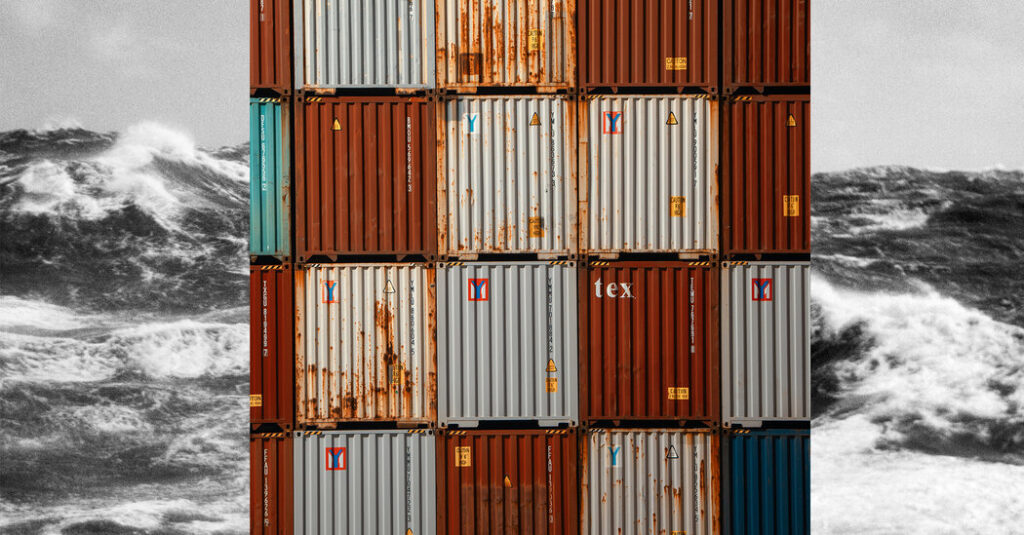
Source photographs by Kaya & Blank for The New York Times and H. Armstrong Roberts/Getty Images.
The Times is committed to publishing a diversity of letters to the editor. We’d like to hear what you think about this or any of our articles. Here are some tips. And here’s our email: [email protected].
Follow the New York Times Opinion section on Facebook, Instagram, TikTok, Bluesky, WhatsApp and Threads.
The post The Great Scam on the High Seas appeared first on New York Times.