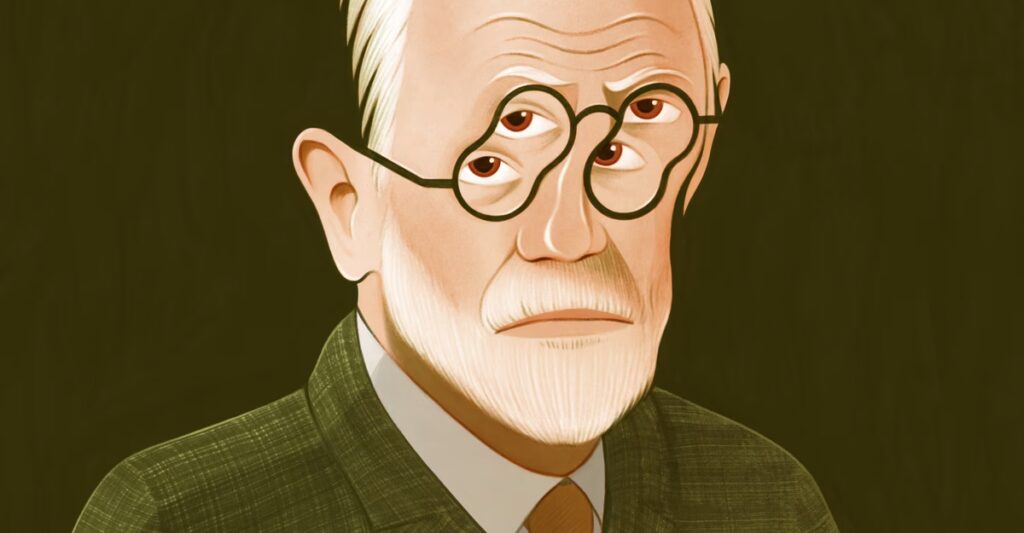
To announce that you are embarking on a course of psychoanalytic training today is tantamount, in many quarters, to admitting that you plan to treat your patients using astrology or by parsing the entrails of a goat. To say that you are undergoing psychoanalysis as a patient is to reveal that you are entrusting your mental health to a witch doctor. So if I were to tell you that a respected neuroscientist has undertaken to exhume Sigmund Freud and make a case for both his theory of mind and his psychoanalytic method as the best—indeed, the only—approach that can cure emotional disorders, you would likely rate that a quixotic project, and its author perhaps a candidate for serious therapy himself.
Freud’s cultural and scientific influence crested some 70 years ago, and much of psychiatry’s history since then has consisted of a renunciation of the man, his concepts, and his therapeutic techniques so comprehensive as to have an edge of savagery, even vengeance, to it. He has been deemed a sexist, a misogynist, a bully, a narcissist, a homophobe, a pervert, an addict, an opportunist, a plagiarist, a fabulist, and a scientific fraud, as well as a disloyal friend and a credit-stealing protégé. Not to mention a bungling, incompetent therapist—“a dogmatist who browbeat his patients and consistently failed to mark the crucial difference between their fantasies and his own.” (So sums up the flap copy on a collection of Freud-filleting essays by 18 psychiatrists, philosophers, historians, and others compiled in 1998 by Frederick Crews, a literary critic and onetime devout Freudian turned virulent heretic.)
If coroners were to pin an actual time of death on Freudianism, they might specify 1963. That year, the philosopher of science Karl Popper held up psychoanalytic theory as the archetypal instance of what he called “pseudoscience”: Worse than mere bad science, psychoanalysis was, in being untestable, simply not science. Based in large part on the highly speculative interpretation of imperfectly recalled dreams, of all things, psychoanalytic theory was impervious to real scientific inquiry. In presuming to explain everything, Popper pronounced, psychoanalysis explained nothing at all.
So who today would dare attempt a rehabilitation of Freud? And why? To take the second question first, here’s one reason: What has followed Freudianism has not been, by many reckonings, any better. In the 1970s, the mental-health profession fled from such squishy psychological concepts as transference and countertransference, the death drive, and seduction theory—as well as more outlandish ones like penis envy, castration anxiety, and the Oedipal complex—and leaned instead into “biological psychiatry,” which had emerged from the drug discoveries of the 1950s and ’60s.
Physiological notions took hold, such as the “catecholamine hypothesis of affective disorders,” which attributed anxiety and depression to deficits of the neurotransmitters norepinephrine and dopamine. Three decades later, in the 1990s, the “chemical-imbalance theory of depression” arrived, tying depression and other mood disorders to dysregulation of another neurotransmitter, serotonin. Psychoanalysts’ highly subjective assessments gave way to the ostensibly more objective measurements provided by neuroscientific instruments that can capture brain activity, such as EEGs, PET scans, and fMRIs. Doctors turned to genetic testing to help identify various temperament types and emotional predispositions, and relied on standardized questionnaires assessed for their validity in diagnosing mental illness.
In repudiating Freudianism and touting the field’s proper medical grounding, science-based psychiatry confidently predicted that measurable success was soon to come. That’s not what happened. Biological psychiatry “overreached, overpromised, overdiagnosed, overmedicated,” as the Harvard medical historian Anne Harrington put it in 2019. Which raises the question of whether psychiatry has simply exchanged one form of witchcraft for another.
The champions of so-called anti-psychiatry and critical psychiatry—now emboldened by Secretary of Health and Human Services Robert F. Kennedy Jr. and the MAHA movement—certainly think so. So do some leading figures in biological psychiatry. As the head of the National Institute of Mental Health from 2002 to 2015, Thomas Insel tried to root America’s approach to mental-health care more firmly in brain physiology and the emerging understanding of genetics than in the nebulous concepts of Freudianism. But in 2017, when he looked back on the $20 billion he’d spent on the endeavor, his verdict was bleak: “I don’t think we moved the needle in reducing suicide, reducing hospitalizations, improving recovery for the tens of millions of people who have mental illness.”
What biological psychiatry once promised seemed revolutionary; from the suffering patient’s perspective, what it’s delivered has been marginal. Still, reverting to the nostrums of a disgraced Victorian quack seems a little like saying This modern medical technique isn’t working so well—let’s go back to using leeches. Well, as it happens, leeches have become an important part of the modern reconstructive surgeon’s tool kit, for use in skin grafts after surgeries, among other things. Might Freudianism be psychiatry’s leech, resurrected for the astonishing health benefits it contained all along?
The Platonic ideal of the person who might dare to make this case would look a lot like Mark Solms, the author of the new book The Only Cure: Freud and the Neuroscience of Mental Healing. He is a South African neuroscientist armored with a sturdy résumé and hundreds of articles in scientific journals, along with half a dozen books and counting. His lab discovered the specific pathway in the forebrain responsible for stimulating dreams, and he disproved the notion that dreaming is dependent on REM sleep. He’s also done extensive research into the science of consciousness.
Solms is a practicing psychoanalyst as well; he treats neurological disorders (stroke, Parkinson’s, dementia) in addition to psychiatric disorders (anxiety, depression, psychosis). He’s coined a term, neuropsychoanalysis, to describe his clinical work, because he buttresses traditional psychoanalytic techniques—free association and dream interpretation, among other methods of probing the unconscious—with the more recent findings of neuroscience. Much of his research has involved trying to use modern technology to demonstrate the scientific underpinning of certain Freudian concepts and theories. For instance, Solms says that the pleasure-seeking drive (the source of Freud’s “pleasure principle”) is located in the brain networks that communicate via dopamine, and he has mapped the superego onto a region of the prefrontal cortex involved in emotional regulation.
A neuroscientist who is also a practicing psychoanalyst is a rare bird. But Solms is rarer still, having spent the past 29 years completing a revised translation of the complete works of Freud. Twenty-four volumes were published in 2024, and an additional four, consisting of his writings on neuroscience (including some that have never previously been published in English), are due out in 2028. Making available previously overlooked writing has given Solms a chance to correct the misimpression that Freud was homophobic. In a letter to a woman who had asked him to “cure” her son’s homosexuality, Freud writes that being gay “is nothing to be ashamed of, no vice, no degradation; it cannot be classified as an illness.” (This last bit is ironic in light of the American Psychiatric Association’s official classification of homosexuality as a “sociopathic personality disturbance” or “sexual deviation” until 1973.) Freud goes on to note that some of the most accomplished figures in history—Plato, Michelangelo, Leonardo da Vinci—were gay, and ends by saying that although psychoanalysis can help her son become happier, less neurotic, and more productive, none of that will have anything to do with his sexual orientation. I suspect more than a few Freud detractors will be surprised to read this.
By Solms’s own estimation, there might be “nobody alive who has spent more time with Freud than I have.” But Solms is no doctrinaire acolyte, as guardians of the Freudian flame have tended to be. Ernest Jones, an influential early director of the International Psychoanalytical Association, believed his role was to create a secret committee “like the Paladins of Charlemagne” to protect Freudian theory against heresy. Solms, in contrast, embraces some major criticisms of Freud, calling the death drive, for example, “an egregious error.” As for Freud’s rather “idiosyncratic” theories about sex, Solms writes, “I don’t think there’s any getting around the conclusion that Freud had this stuff seriously muddled.”
Part of Solms’s premise in this book is implicit and inarguable: Despite the attempts to purge Freudianism from psychiatry, its tropes, terms, and concepts—the unconscious; the id, ego, and superego; sublimation; defense mechanisms; the obsession with sex; the importance of early-childhood experiences—have seeped so deeply into our cultural limbic system that they live on in the shared metaphors and terminology we use to discuss personality and mental health: Frank is “anal”; Mary is “repressed”; Donald Trump is a “narcissist” and an “egomaniac”; Jill Biden was “in denial.” When Freud died, in 1939, W. H. Auden wrote that he had become “a whole climate of opinion / under whom we conduct our different lives.”
[From the January/February 2014 issue: Scott Stossel on surviving anxiety]
But the two explicit arguments Solms makes on Freud’s behalf in The Only Cure are astonishingly ambitious—and contentious. The first is that Freud deserves credit for neuroscientific prescience. A recent history of neuroscience states baldly that “Freud had nothing novel or insightful to say about how the brain worked.” On the contrary, according to Solms: Many prevailing theories about how the brain functions were first worked out by Freud. For instance, Solms writes, Freud effectively identified the way that short-term memories get consolidated into long-term ones, and did so more than half a century before the neurochemical mechanism for this was discovered. (To bolster his case here, Solms marshals the very man who identified that particular mechanism, Eric Kandel, who won the Nobel Prize in Physiology or Medicine for doing so, and who agrees with Solms that psychoanalysis is “the most coherent and intellectually satisfying view of the mind” we have, and that neuroscience is the “new intellectual framework” that can reinvigorate psychiatry.)
Or consider Freudianism’s key concept, the unconscious. Freud argued that our personalities and behaviors are governed by a maelstrom of hidden drives and motivations mostly unknown to our conscious selves. What we experience as our “conscious life” is in fact only a post hoc rationalization of things we are doing for other reasons, a devastating blow against not just human rationality but even free will.
For years, evidence of the unconscious seemed inaccessible to objective science. How can you prove the existence of something that none of us, by definition, can be subjectively aware of ? But technologies unavailable to Freud have demonstrated that much of what happens in the brain is in fact unconscious. Studies using fMRI machines have revealed that when frightening images or angry faces are shown to people too fast for them to consciously perceive them, their brains nevertheless register the fear stimuli: The machines detect a flare of activity in the amygdala, which is followed by a surge in heart rate, blood pressure, and stress hormones, among other responses. The feeling of fear in the body then breaks into consciousness, and the brain makes decisions in response to that. It has become hard to deny that, at least in basic outline, Freud was right about the unconscious.
Solms’s second explicit claim is, if anything, even more provocative. There is abundant evidence, he writes, that psychoanalysis and its offshoots “are astoundingly effective”—in some cases, he argues, “as dependable as, say, insulin is at managing type 1 diabetes, or as the HPV vaccine is at preventing cervical cancer. These treatments are so well proven that it would strike most doctors as—to use a technical term—crazy not to deploy them by default.”
Solms’s unqualified endorsement of psychoanalysis is startling after decades of criticism. In support, Solms cites a number of studies and papers from the past 40 years to show that psychoanalytic-style talk therapy is more effective than antidepressants or electroconvulsive therapy for depression, or than antipsychotics for schizophrenia. He also cites research demonstrating that psychoanalysis has a robust “sleeper effect”—that is, symptoms continue to improve long after the treatment has ended.
These results are so striking that I decided to look at the underlying studies, and some other relevant ones. I found that Solms is highly selective in what he cites, and elides a lot of nuance (and sometimes directly contradictory evidence) in service of his case for psychoanalytic-style therapy and against other forms of therapy, especially pharmacotherapy. Cherry-picking is not unusual (especially when dealing with studies that are hard to compare), but the conclusions that flow from it are usually accompanied by a degree of circumspection.
Solms’s verdicts are categorically blunt: “Nearly every psychiatric disorder listed and defined in the standard diagnostic manuals is best understood and treated, not pharmacologically, but psychologically.” And: “There are, as things stand, no physiological cures in psychiatry.” And perhaps most bracing: “The mainstay of modern psychiatry—psychopharmacology—is for the most part a defence against facing the facts about what our patients really need. It is a way of suppressing symptoms instead of asking what they mean and fixing that.”
Solms’s position aligns him, probably unintentionally, with the public pronouncements that RFK Jr. has issued about SSRI antidepressants in his role as HHS secretary, which made the American Psychiatric Association convention in May jangly with tension. Antidepressants are useless, Kennedy has said at various times; they are more addictive than heroin, result in “brain damage,” and could be partly responsible for school shootings. None of this is true. But one reason demagoguing against medication has been easy is that the biological model of psychiatry—although filling the coffers of pharmaceutical companies—has delivered no panaceas, instead fueling cycles of disenchanted overreaction. (Today, one in six Americans takes an antidepressant; no wonder APA attendees were on edge.)
[Read: Panic attacks and the meaning of life]
Solms does concede that while no physiological cures exist in psychiatry, physiological treatments can remediate symptoms. That Advil doesn’t “cure” pain doesn’t stop people from taking the drug to alleviate it. Still, his broadside against pharmacology seems overbroad: Although it is surely true that many of those who take SSRI antidepressants do not need, and should not be on, them, it is also true that many others would be debilitated, if not dead, without them.
Before Freud became a psychiatrist, he himself was a neuroanatomist. Some of his early research was on the gonads of eels and the nervous systems of crayfish. But given the tools available to him in the 1890s, he kept bumping up against the limits of what the physical brain could reveal about the functioning of the mind. Frustrated and in need of money, he put aside the microscope, opened a private practice, and began focusing instead on clinical observation of patients, and of his own mind. Studying consciousness—and the unconscious brain that lay beneath it—from the inside was how Freud constructed psychoanalytic theory. He sometimes expressed embarrassment at this approach. “It still strikes me myself as strange that the case histories I write should read like short stories and that, as one might say, they lack the serious stamp of science,” he reflected in his foundational Studies on Hysteria in 1895.
Freud never abandoned his quest to link physiology and psychology. “We must recollect that all our provisional ideas in psychology will presumably some day be based on an organic substructure,” he wrote in 1914. In 1938, not long before his death, Freud was still at it: “The future may teach us to exercise a direct influence, by means of particular chemical substances, on the amounts of energy and their distribution in the mental apparatus.”
Solms has picked up the baton, but he is adamant that we have not reached the future that Freud was forecasting. Rather, his view is that we need to go back to Freud’s true aim: to treat the soul, not by ministering to the brain, as modern biological psychiatry does, but “by accepting that the ‘soul’—construed as the experiencing, active, living ‘I’—is a part of nature.” And he has company, even among clinicians who came of age during the rise of biological psychiatry: Patients with psychosis are “too fascinating and complex to be reduced to the blockade of dopamine receptors,” the psychiatrist Pesach Lichtenberg wrote in the 2023 book Psychopharmacology Reconsidered. So what kind of map does Solms provide?
You know Chekhov’s famous stipulation that if you introduce a gun in the first act, it must be fired in the third? Well, here’s a corollary: If you introduce a penis on the first page of a book about psychoanalysis, it will go off, or fail to, or both, very soon. In his second paragraph, Solms ushers in a depressed physician named Teddy P, who gets dumped by his girlfriend after struggling with both premature ejaculation and erectile dysfunction (perhaps a bit on the nose for a book about Sigmund Freud).
When Teddy’s case becomes acute—in addition to depression and sexual dysfunction, he develops insomnia, headaches, brain fog, seizures, and evidence of possible dementia—Solms takes him on as a patient. He determines that Teddy’s underlying disease is psychological, not neurological (the seizures had made that an open question), and attributes much of what ails Teddy to the cascading effects of drugs and treatments he’s being given for his depression, anxiety, insomnia, and pain. Solms weans him off his medications and embarks with him on a course of psychoanalysis. Then he puts Teddy aside, leaving the reader in suspense for 258 pages before resuming the account of his fate.
For all his extensive neuromedical training, Solms makes a point of describing the work of psychoanalysis as “less like science and more like a practical trade. Long experience leads to familiarity with many different kinds of glitch and suggests many different kinds of fix.” Some people—and by some people, I might mean me—derive a certain solace from understanding their anxiety and depression as, in effect, mechanical failures, not moral ones: a snag in the temperamental wiring here, an unfortunate genetic variant there, a dysregulation of neurotransmitters not unlike the problems with insulin regulation in a diabetic’s pancreas.
[From the November 1962 issue: Jung on Freud]
But Solms’s contention, drawing from Freud, is that those mechanical problems can be fixed only as part of a wholesale realignment of unconscious drives and emotional needs. That worked for Solms: He had been plagued by a severe death anxiety since he was a little boy, when his older brother suffered brain damage in a freak accident, but was cured by a course of analysis on the couch of Clifford Yorke, a British World War II veteran who had helped care for survivors after the liberation of Bergen-Belsen.
Teddy recovers. (This is no spoiler; readers could hardly have been expecting otherwise.) After four years of arduous work with Solms, revisiting early-childhood experiences and his relationship with his mother, his depression and anxiety lift, his sexual and romantic-attachment issues abate, his growing conscious awareness frees him from damaging unconscious compulsions. He becomes an outstanding doctor.
The treatment involves all kinds of unexpected twists and turns, and Solms deploys a lot of Freudian tools—dream analysis, free association, breaking down defense mechanisms, recovering buried memories, transference and countertransference, and elaborate (too elaborate, if you ask me) feats of interpretation by the analyst. To someone with my firmly materialist leanings, it all seems a bit much.
But I was struck by two things Solms writes in different places earlier in the book. One is that the aim of psychotherapy, at its core, is simply “to help our patients find better ways of meeting their emotional needs.” Whatever you think of the whole complicated Freudian edifice, who could take issue with that? The other is: “Psychoanalysis is a cure wrought by loving your neighbor as yourself.” Solms has set out to complete the Freudian project by giving it a neuroscientific basis—but maybe the more important accomplishment is to have restored to psychiatry its humanity.
This article appears in the September 2026 print edition with the headline “What if Freud Was Right?”
The post What if Freud Was Right? appeared first on The Atlantic.