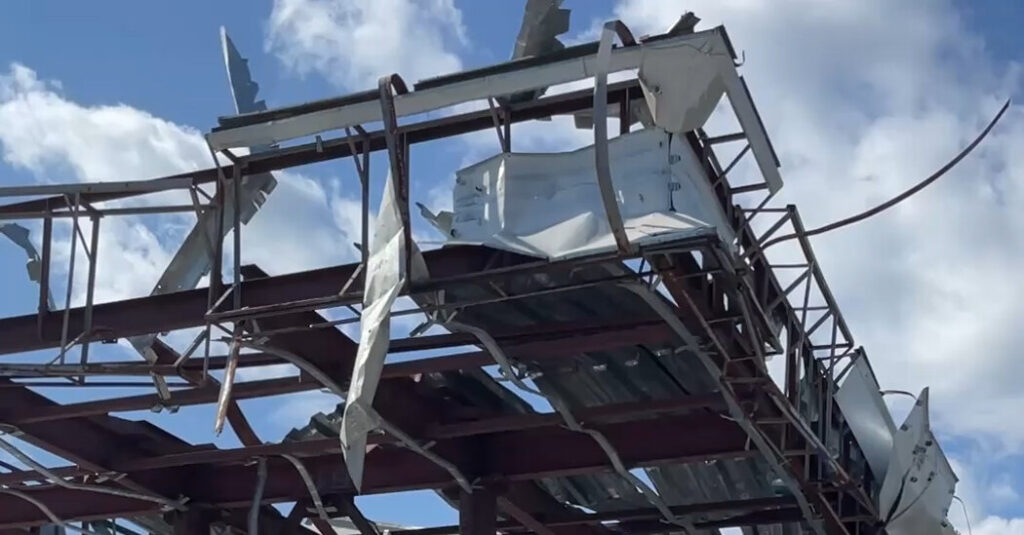
Most have sandbags at the entrance. Many have shrapnel scars and scorch marks, or have been reduced to burned-out husks. All across Ukraine, gas stations tell the tale of a lethal new front in the war with Russia.
Russian forces have attacked nearly 250 Ukrainian gas stations in recent months, in what officials, analysts and operators say is a systematic and deadly campaign of retaliation for Ukraine’s strikes on Russian refineries. The stations, a beloved and quirky fixture of Ukrainian life, have become objects of anxiety and fear.
Ukraine says its long-range strikes on Russian refineries aim to choke off the revenues that fund Russia’s war machine and pressure the Kremlin to stop the fighting. Russian state news media say the strikes on Ukrainian gas stations are similarly aimed at disrupting “transport logistics” for Kyiv’s forces.
But Ukrainians note that unlike Russian refineries, the gas stations being targeted draw a daily procession of ordinary civilians as customers. Many of the Russian refineries are state-owned or belong to big companies, while many of the gas stations in Ukraine are independent retail businesses.
Though Ukrainian soldiers sometimes frequent the stations, they are not military installations. Striking civilian gas stations has no real impact on military fuel supplies, said Serhii Beskrestnov, a former adviser to Ukraine’s defense minister. “Therefore, the sole purpose of these attacks is to terrorize the civilian population,” he said.
Russia’s Defense Ministry has started reporting on gas station strikes in its daily bulletins. It has shared video footage of drone attacks on stations, which it said were “in active use” by Ukrainian troops. Rybar, a Russian pro-war Telegram channel believed to be close to the military, recently wrote that the campaign was “gaining momentum.”
While Ukraine’s strikes on refineries have caused fuel shortages in Russia, for now the gas station attacks have dented the Ukrainian psyche more than the fuel supply.
Ukraine’s gas stations have long been about far more than just fuel. They are social hubs known for hot dogs and spotless bathrooms, way stations for civilians crisscrossing a country whose airspace has been closed for four years. Near the front lines, they offer refuge to soldiers fresh from battle, a place to mingle over a latte with comrades, support staff and civilians.
But now some drivers minimize station stops, avoiding bathroom breaks and carrying extra fuel cans in their cars. When they do stop, they might start the gas pump and then scurry away from the station, skipping the minimart, to wait while their tanks fill. People tend not to linger if they can help it. Some employees now take cigarette breaks at a distance from the stations.
Roads throughout Ukraine are signposted with the destruction of the Russian campaign. Driving between Dnipro and Zaporizhzhia in southern Ukraine, nearly every other gas station is a charred shell. A station can be open one night, then gone the next.
A gas station along that highway was empty one recent evening, save for soldiers filling up a truck. Not even the station workers were present. They had moved about 500 yards up the road, to watch from a distance.
On the highway leaving Kharkiv in northeastern Ukraine, two gas stations directly across from each other were shredded, with fragments of Shahed drones scattered around twin craters. Ribbons of twisted metal hung above the pumps, creaking in the wind.
Just 10 minutes down the road, another gas station was burned down to the studs. At another, a blackened gas pump was blown backward; peeking out of the rubble of the wrecked station building were tissue packs and a surprisingly intact mug that said in English, “Coffee gets me started, Jesus gets me going.”
One gas station in Kharkiv with signs of strike damage had white cylindrical sandbags piled high at its entrance, along with a fresh-looking poster that declared in Ukrainian, “DURING AN AIR RAID ALERT THE GAS STATION CLOSES.”
It also read: “Personnel leave the gas station and stay in a shelter until the end of the alert.”
Another station had boarded up its windows but business carried on, uninterrupted, as an air-raid alarm started to wail.
The strikes have killed a number of people, including Maksym Oseredchuk, who had worked for The New York Times as a driver before being drafted into the Ukrainian military. He died in June in an attack on a station in the southern city of Kherson.
One attack on a station in Zaporizhzhia killed two people on July 6, another killed a man in Izium on July 5, and one in the Dnipropetrovsk region on July 1 claimed the life of a gas station operator.
While Russia has hit Ukraine’s energy infrastructure since its full-scale invasion in 2022, analysts say there was a clear shift beginning in April, soon after Kyiv ramped up its long-range strikes within Russia. Gas station after station in Ukraine started coming under attack by Russian drones.
There have been at least 246 strikes on gas stations since the beginning of April, including 194 between the start of June through July 27 alone, according to Armed Conflict Location & Event Data, a nonprofit that tracks global conflict.
The Russian attacks seem to come in clusters. Four stations in Poltava hit between July 24 and 25. Three in Odesa hit overnight between July 7 and 8. Stations in Sumy, Chernihiv, Poltava and Kharkiv all came under attack on July 3. Two days earlier, five were hit in the Dnipropetrovsk region alone.
Most strikes have occurred in regions near the front lines, though places further from the battlefield have not been immune, according to ACLED and the Kyiv-based A-95 consulting group. A-95 also reported that fuel-truck drivers were increasingly refusing to go to the most dangerous areas.
As drivers and customers make their own risk recalculations, Ukrainian officials and station operators have also made adjustments.
The authorities set up mobile fueling points for residents of Trostianets, in the Sumy region, after strikes destroyed every gas station in the area. Some gas stations in the Donetsk region of eastern Ukraine have installed anti-drone netting.
One leading chain, WOG, acknowledged that its stations had “suffered some of the heaviest losses among fuel-market operators.”
WOG has advised against leaving cars near gas stations and introduced special operating procedures this month for areas near the front lines. It ordered its stations to close between 9 p.m. and 7 a.m., to switch off outside lights at night and suspend all fueling during air-raid alerts.
Ukraine’s Ministry of Economy did not respond to requests for comment about the economic impact of the gas-station strikes. The Oil and Gas Association of Ukraine, which called the campaign an attempt to “exert psychological pressure on society,” said there were no price spikes at the pump or fuel shortages like those that have afflicted Russians in recent months.
“At first glance, it resembles the situation in Russia, but the result is radically different,” Andrei Pivovarsky, the chief executive of WOG, wrote in a Facebook post. “In Russia, after the strikes, there are queues at gas stations, a shortage of fuel in individual regions and interruptions with supply.”
But in Ukraine these days, it’s the opposite. People gas up as quickly as possible at largely empty stations, then speed away.
Michael Schwirtz, Nataliya Vasilyeva, Nataliia Novosolova, Adam Coll and Tyler Hicks contributed reporting.
The post Russia Turns Ukraine’s Gas Stations From Social Hubs Into Deadly Targets appeared first on New York Times.