I served as the chief information officer of the athletic apparel company Lululemon for eight years. Deploying new technologies, artificial intelligence included, was part of the job. But when I left, my successor was handed a new title: chief A.I. and technology officer.
I winced — not about the person but about the pattern. Companies these days are quick to stick “A.I.” in news releases, in earnings calls, in product names, in job postings and in titles at the top of their organizations. The real question is what strategy sits behind the abbreviation. A title costs nothing, but it doesn’t produce anything, either.
And that’s a problem. When companies mistake an announcement for a strategy, they spend real money — and sometimes cut real jobs — chasing a future that isn’t actually being built. And in doing so, they’re persuading Americans to reject a powerful innovation that could do so much good for all of us.
I have spent 30 years in technology, and like many of my peers, I used the newest tools to solve hard problems. In the internet era, my colleagues and I built a tool that let every customer check the inventory in each of Nordstrom’s stores. It increased sales significantly. When I was at Lululemon, we found a way to use A.I. to help executives better predict which products would sell in which stores. It took time, lots of people and big budgets.
Then ChatGPT arrived. This new technology was easy to understand for most nontechnologists — a chief executive, board member or investor — a healthy portion of whom began demanding their organizations immediately embed the technology throughout their operations. A.I. companies started popping up like food trucks at a street fair.
These A.I. companies arrived armed with demonstrations, and the demos were amazing. Talented technologists promised to crack business problems that were too complicated and expensive to solve before. Leaders across departments cleared their calendars to listen to the parades at their doorsteps.
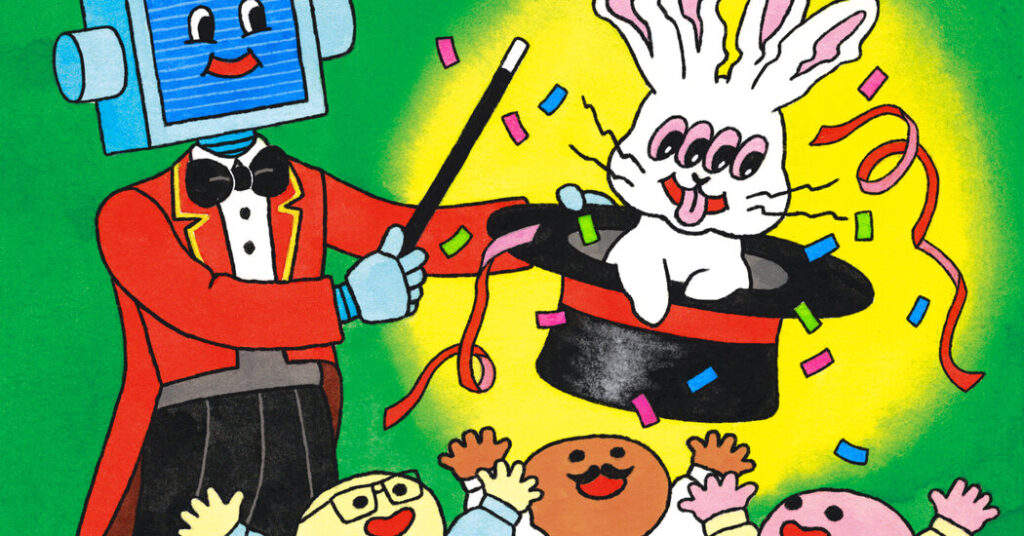
This was the beginning of what I call A.I. wishing: the belief by company leaders that A.I. is magic, that you can wave its wand toward a hard problem and skip the work of solving it. It is sincere, and that is what makes it dangerous. I continued to meet with the stream of A.I. vendors, all promising their tools would be game changers. Collectively, the hordes introduced chaos into teams already stretched thin.
A few years ago an executive brought me an A.I. product and asked me to fast-track it. A board member had recommended it. The promises were bold: It could answer any question about the company. It could predict years and years of sales, tell which advertising was working and suggest what would work better, find and fix waste in how products were made and moved, and more.
I was skeptical. I know that even A.I. cannot tackle an issue it has never been taught to understand or accurately advise a business it knows nothing about. When we met with the company, it didn’t ask us a single question — not about our data, our systems or how we worked. We eventually said no, but it took longer than it should have. Even a room full of people who knew better wanted its promises to be true.
In the meantime, we continued to run pilots — small test versions of tools inside the business before committing to it. I wanted them to work as much as the next person, but the results were the same almost every time. The demo looked like magic. But the tool wanted clean, connected data and decisions made in consistent, repeatable ways. Ours lived in a dozen systems that did not agree, layered with decades of exceptions and workarounds.
This is not just my story. When I compare notes with other chief information officers, the details change, but the ending rarely does. One runs an insurer, another an airline, another a manufacturer. Each tried tools that dazzled in the demo and stalled the moment they hit the mess of a real, decades-old business. Last year a report from M.I.T.’s Project NANDA put a number on it, finding that 95 percent of enterprise generative A.I. pilots never delivered real results.
We are getting smarter from each round of pilots. The tools keep improving, and the gap keeps narrowing. But better A.I. tools are never going to close it on their own. What’s left is the part that was always ours: the slow, expensive work of cleaning up the messy data, complex human decisions and tangled systems.
This is how the A.I. revolution is actually going, at company after company.
Don’t mistake any of this for doubt about A.I.’s potential. It is the most powerful technology I’ve seen, and entire industries are already being remade by it. Pharmaceutical companies are rebuilding drug discovery around it. Banks run fraud and risk detection on it. Governments are treating the chips behind it as a matter of national security. This kind of work doesn’t happen in a quarter, and believing that it can is the trap.
This brings me to A.I. washing. The insidious cousin of A.I. wishing, it is when a company — under pressure to immediately show results — claims to be doing more with A.I. than it actually is.
The board wants to see progress. A leader who can’t show something starts to look like the problem. Seventy-five percent of executives admitted their A.I. strategy is “more for show,” according to a recent global survey by the A.I. company Writer and the research firm Workplace Intelligence. So a chatbot becomes the first step in an A.I. “transformation,” and a demo becomes proof of what’s coming. It isn’t lying, exactly. It’s describing what you hope will happen as if it already had taken place.
Perhaps the best-known version of A.I. washing is the most tragic one: the A.I. layoff. A company proclaims it needs fewer people because A.I. made its operations more efficient. Often the efficiency doesn’t exist yet. The cut is really about freeing up cash, sometimes to spend more on A.I.
In May, U.S. employers announced 97,000 job cuts, and according to one research firm, companies blamed 40 percent of them on A.I. A separate survey found that around one-third of hiring managers who had cut a role because of A.I. had already rehired for the same or a similar one.
Of course they did. They eliminated positions before redesigning the work, so the work shifted onto the people who remained. Then companies quietly hired back some of the capability they claimed A.I. had replaced. That cycle burns money and loses the talent and experience that was pushed out the door (not to mention the trust of the people asked to stay).
And there’s another cost. Behind all of those cuts are human beings who might have been falsely told a machine could do their jobs. Some had the demoralizing task of training the very tools meant to replace them. I know a few such individuals. One gave two decades to a company that told her, in a short meeting, that software could now do what she did. Truth was that it couldn’t, not really. She wasn’t a cost to be optimized. She was the person who knew why the numbers looked the way they did, the very context no tool could see. The ones who stayed absorbed her work and quietly wondered if they were next.
Every inflated announcement, every time a company blames A.I. for layoffs teaches people to distrust the technology itself. Distrust builds resistance. The Writer and Workplace Intelligence report found that 44 percent of Gen Z workers and roughly a third of the broader work force said they were actively sabotaging their company’s A.I. rollout. The fear is real, and it is spreading.
The way out of this is not more hype. It’s honesty. A vocal minority of people genuinely believe superintelligence is nearly here, ready to either remake the world or end it. Who knows if they’ll be proved right? I’m skeptical because the humans are still in charge and we have a habit of moving slower than the hype. But most companies aren’t living in that debate. In my experience, the useful truth is the plainer one in between: A.I. is a genuinely powerful technology that still needs people, and putting it to use is slow, human work. The sooner we are honest about that with our boards, our employees, our investors and the public, the sooner we can stop performing A.I. and start building something with it.
Julie Averill is a former chief information officer of Lululemon and the author of “Chief Impact Officer: Real Transformation Comes From Human — Not Just Artificial — Intelligence.”
The Times is committed to publishing a diversity of letters to the editor. We’d like to hear what you think about this or any of our articles. Here are some tips. And here’s our email: [email protected].
Follow the New York Times Opinion section on Facebook, Instagram, TikTok, Bluesky, WhatsApp and Threads.
The post I Helped Run Lululemon. Companies Need to Stop Kidding Themselves About A.I. appeared first on New York Times.