For the past few months, fans of a very funny content creator named Elyse Myers — you might have seen her viral post about a Taco Bell first date — noticed that she appeared to be getting thinner and thinner, pounds dropping from her already petite frame. Over the weekend, as these followers were starting to express concerns, Myers put out a video. She explained that for several years, she’d been dealing with severe reproductive issues that caused regular hemorrhaging and pain. She’d finally had a surgical procedure to address the problem, and her body was now rebalancing itself after years of medical trauma.
These details were humiliating to talk about in public, Myers confessed. She is a comedian; hemorrhagingis not part of her brand. But the public was prying into her weight, so here she was in a narrower body, reluctantly explaining what was never anybody’s business.
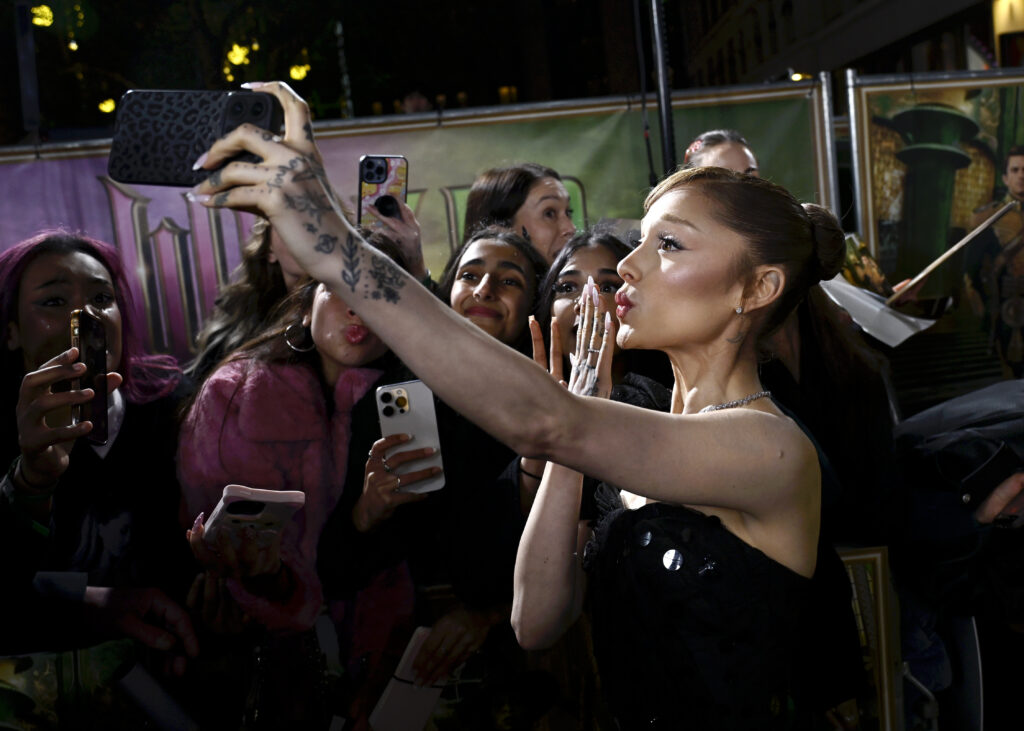
Which brings us, not quite but almost, to Ariana Grande, whom we are now about to discuss. The singer-actress, 33, has been noticeably slender for a long time; her appearance during press tours for the two “Wicked” movies prompted concerns about her health. But in a music video released Friday, she looked emaciated.
“Petal” began with a content warning — the video features a starlet taking bloody revenge on casting directors — but online commenters wondered if the warning should have applied to Grande’s body itself. Here, I’m aware of the fine line between and disgust and inspiration for people with eating disorders, so please proceed with caution:
Grande’s cheeks appeared to be sunken. Her clavicles and upper rib cage protruded. Her arms seemed to be entirely lacking fat or muscle and instead to be sinew on bone. Her legs, what we could see of them, were spindly. Online, a dietitian I follow posted a hesitant video explaining that while she generally refrains from publicly commenting on other people’s bodies, she was going to use Grande’s video to educate viewers on the signs she looks for when diagnosing malnutrition at an anorexia/bulimia treatment program. The dietitian then dispassionately pointed out that Grande’s body, at least the parts that were visible, fit nearly every criteria.
We have absolutely no idea what’s going on with Ariana Grande, and, like that friendly neighborhood dietitian suggested, it’s generally best to assume that people’s bodies are their own business. As exemplified by the humiliated Elyse Myers, sometimes we’re getting it wrong even when we’re sure we’re right.
But while Grande’s body is her own business, how it affects us and how we react to it is ours. Grande is not an Internet-famous comedian, she is a superstar with worldwide name recognition, a highly paid fashion plate and a role model to a young audience. The way you see her body may impact the way you think about your own body, and so there’s a push and pull between leave Ariana alone and what in God’s name is going on here?
If she is ill, then should we communicate that this is not a healthy body; this is a body born of deprivation disguised as glamour? If she is healthy, then should we support her right to look as she pleases, even while explaining to our children that most women’s bodies will not naturally look like this unless something is very wrong? Does she owe us an explanation either way?
Interestingly, the music video in question is a meta-commentary on this whole discussion. In “Petal,” Grande’s character begins as a hopeful ingenue, showing up to auditions with roomfuls of other hopeful ingenues, only to be told in the casting rooms that she’s not good enough. Every time she’s critiqued, she bounces back a little less easily, her smile takes on a more permanent hurt.
At the same time, the lyrics of “Petal” acknowledge the strangeness of her position as a wealthy, famous celebrity. “I’m not a victim … I’m practically drowning in my blessings,” she sings at one point. Another lyric offers the commentary, “As long as she keeps getting it right, heartbreak won’t bite here in paradise,” which, whether intended or not, might also make you think: eating disorder.
Anorexia, after all, is a disease fueled by a desire for perfection.
After Grande’s character in the video takes a chainsaw to the judgmental casting directors, she emerges, blood-spattered, to the waiting room where other auditioners — themselves beaten down from rejection — erupt in grateful cheers.
The message is supposed to be feminist. Here is Grande, declaring that commentary is off-limits and it’s the haters who have a problem. One casting director had asked to see “the old you,” and she wants to make it clear that the old her is never coming back.
The message would feel feminist, if the song had been performed by, I don’t know, Chappell Roan or Billie Eilish or some other singer whose brand is rejecting traditional beauty standards. But when Grande, a woman who has defined beauty standards, offers this message from an incredibly frail-seeming body, the message does not seem to be “You’re all perfect as you are,” the message seems to be: “Leave me alone so I can wreck myself without judgment.”
I sincerely hope that Ariana Grande never reads this, or any commentary like it. Because she is in an impossible situation. She owes us, a bunch of strangers she’ll never meet, absolutely nothing. She owes us, the fans who gave her a career, at least something.
And what if the career we gave her was also the pressure cooker that caused pounds to drop off of her petite frame, whether because of illness, stress or societal pressure? And what if hearing discussions of her physique in the public sphere is further deleterious to her health? And what if those discussions save someone else’s life?
She exists in a stratosphere of fame most of us cannot even imagine, and that comes with pressures most of us would never wish for, and she does that in a body that, for years, has been publicly consumed.
After “Petal” began causing public consternation, a London theater company announced that Grande had pulled out of her planned run in a 2027 stage production of “Sunday in the Park With George.” Grande’s representatives told People magazine that she would be “taking a step back from visibility” after she completes her current tour. That she needed a break from “endless, ongoing public scrutiny.”
The woman must be exhausted. For any number of reasons, none of which we are privy to, she must be exhausted. Her body does not look like it could afford to lose even another pound. And yet somehow I’m sure that if she gained back five or 10, commenters would find a way to call her fat.
As I’m writing this, I’m thinking of former models who have come out to share that when they were called the most beautiful, they were at their most sick. Ballerinas who fuel their bodies for peak performance but are then baselessly accused of barfing it all up in the bathroom. Ballerinas who actually do that. People who lose weight on GLP-1s and feel fantastic. People who lose weigh on GLP-1s and wonder why it took that to find love. Protein cookies. Carnivore diets. The fact that BMI is a terrible measurement. The fact that I don’t know a better one.
Being a woman and having a body is inherently conflicting, and so the only thing I know about Ariana Grande is that she must be exhausted.
As I’m writing this I’m also thinking about how a few months ago I decided to lose the last five pounds of baby weight gained for a baby who is now going into kindergarten. And how I now imagine myself having all sorts of conversations with my daughter, wanting her to understand that all bodies are good bodies, that food is just food, that dessert isn’t a moral failing. That Mommy will love her just the same whether she weighs 100 or 400 pounds, but for some reason it was apparently very important to Mommy that she lose an incredibly arbitrary and meaningless five.
For … health? For yoga pants?
I do not want my daughter to watch Ariana Grande’s new video. I do not want to have a conversation where I tell her what to think of Ariana Grande’s body, or explain that we live in a world where we think about her body at all.
Because none of this is really about Ariana Grande.
After six years of writing about gender and a year of writing about our relationship to screens, and after more than four decades as a woman — after all that, what I’m left with is that I still have no idea how to talk about Ariana Grande.
That’s what it’s about. We still have no idea how to talk about any of this. And maybe we never will.
The post Ariana Grande is extremely thin. Is it any of our business? appeared first on Washington Post.