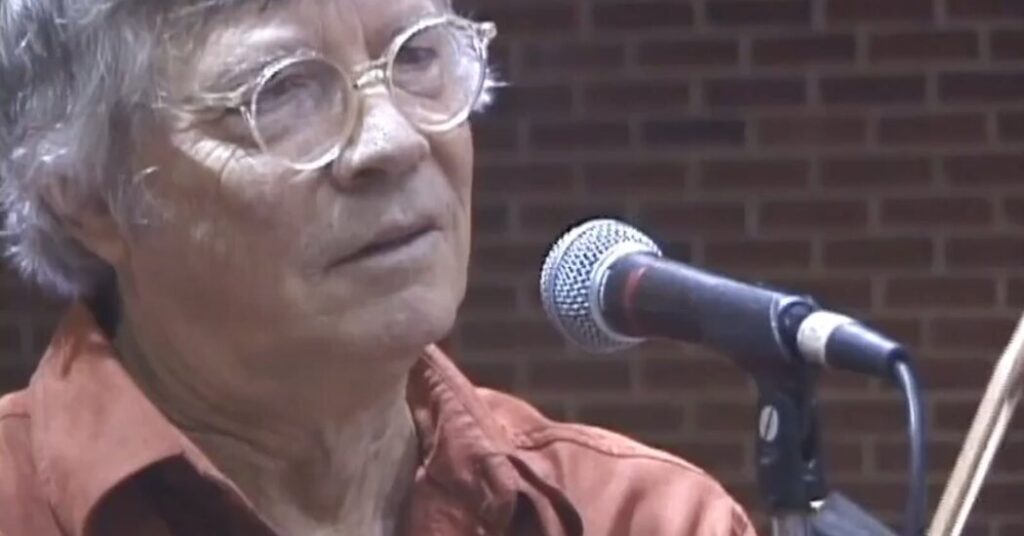
Dudley Laufman, a charismatic farmer, poet and musician who in the 1960s and ’70s led a revival of traditional New England folk dancing, drawing old-timers and hippies to raucous late-night shindigs in grange halls and basements across the region, died on July 13 at the cabin he built by hand 67 years ago in Canterbury, N.H. He was 95.
His daughter Heidi Eide confirmed the death.
Mr. Laufman was best known for calling contra dances, a style similar to square dances in which partners line up across from each other. The caller, backed by a band playing fiddles, accordions and other instruments, dictates the dancers’ movements, in keeping with the music.
Contra dancing has its roots in Europe and arrived in the United States in the late 18th century, taking hold in farming communities. But by the 1950s, when Mr. Laufman began calling, it was close to extinct.
Mr. Laufman brought a looser, more inviting energy to contra, one that appealed to the back-to-the-land counterculture of the ’50s, a precursor to the hippies of the ’60s. With his sturdy frame forged from years of working on dairy farms, and long hair that flowed over his woolen turtleneck sweaters, he cut a Romantic figure onstage, not unlike that of his hero the Scottish poet Robert Burns.
His breakout came when he brought a group of musicians and dancers to the Newport Folk Festival in 1965, the same year that Bob Dylan scandalized traditionalists there by going electric. Some 16,000 people watched Mr. Laufman and his ensemble perform. Word spread about this new, yet very old, form of dancing.
He was soon in constant demand around New England, and he had the stamina to match, often calling about 300 dances a year. He assembled a group of musicians to accompany him, the Canterbury Country Dance Orchestra.
“Dudley is the single most important individual in creating nationwide interest in contra dancing,” David Millstone, a dance caller who made a documentary about Mr. Laufman, “The Other Way Back” (2007), said in an interview. “He was the central charismatic figure in this extremely vibrant dance scene.”
Mr. Laufman also began to attract a younger crowd, including college students and hippies who found something authentic and earthy in contra — and particularly in the flowing, relaxed way that Mr. Laufman called it.
Teenagers who grew up with contra dancing brought it with them to college, and college students who became hooked took it with them after graduating. By the mid-1970s, contra dancing, once the province of rural New England, had a nationwide following.
“The kids that were coming to the dances, the barefoot hippies, you know, they were tired of doing rock ’n’ roll, where you didn’t touch your partner, and they found here was something where they could touch their partner, and it was connected to the rural area, back to the land,” Mr. Laufman said in an interview with the National Endowment for the Arts, which named him a National Heritage Fellow in 2009.
“And they thought that was pretty neat,” he added. “That’s what they wanted, and I was the guy that was doing it.”
William Dudley Laufman was born on Feb. 7, 1931, in Newton, Mass., and grew up in nearby Arlington. His father, M. Miller Laufman, was in business, and his mother, Marjorie (Dick) Laufman, was a civil rights activist.
As a child, he bridled against his comfortable suburban life, and began working summers on a dairy farm. After a long day of milking cows, he would join the farmers in putting together a dance, drawing in the local community.
“And we’d dance, and there was the smell of the wood smoke, and the firelight gleaming on the girls’ hair, and the rosiny sound of the fiddle, and I was hooked,” he told the N.E.A. “I just knew that I wanted it to be a central part of my life.”
He received an associate degree in agriculture from the Stockbridge School of Agriculture at the University of Massachusetts Amherst. During the winter, he played hockey, until one warm year the ice failed to form and he was too poor to drive to an indoor rink. To fill his time — and, he said, his need for attention — he took up fiddling and dance calling.
A Quaker, he received conscientious objector status from the military and went to work as an occupational therapist in Brattleboro, Vt., from 1952 to 1955. He then spent several years working at New Hampshire State Hospital, a psychiatric facility in Concord.
In 1959, Mr. Laufman bought a 1.75-acre plot in nearby Canterbury. The cabin he built there did not have electricity or running water. He grew most of his food. He called his home the Wind in the Timothy, a reference to a species of perennial grass native to Europe.
Mr. Laufman’s marriages to Cynthia Dunbar, Patty Windus and Jacqueline Gilman ended in divorce.
Along with Ms. Eide, a daughter from his first marriage, he is survived by his partner, Nanci Aguiar; three other children from his first marriage, Bronwen Hairston, Nathaniel Laufman and Singwen Gobillot; a daughter from his second marriage, Windelyn Laufman; six grandchildren; nine step-grandchildren; and three sisters, Ann Mason, Abigail Martin and Johanna Walsh.
Mr. Laufman worked as a proofreading clerk for a typesetter in Concord in the late 1960s, but by the turn of 1970s he was able to support his family with his music. He also published several books of poetry, including “An Orchard and a Garden” (1974).
Eventually the demand for contra music became too big for Mr. Laufman to handle alone. Bands began to emerge, taking some of his work but also offering a faster, more energetic style of contra.
Mr. Laufman rejected this new style, but he also began playing and calling different forms of folk dance, including square, barn and Morris, a traditional English style. His wife Jacqueline often joined him, under the name the Two Fiddles.
He did not seem to mind watching his followers move on.
“I am not a missionary,” he told Yankee magazine in 1995. “I just happen to like a certain kind of music.”
The post Dudley Laufman, Eminent Folk Dance Caller, Dies at 95 appeared first on New York Times.