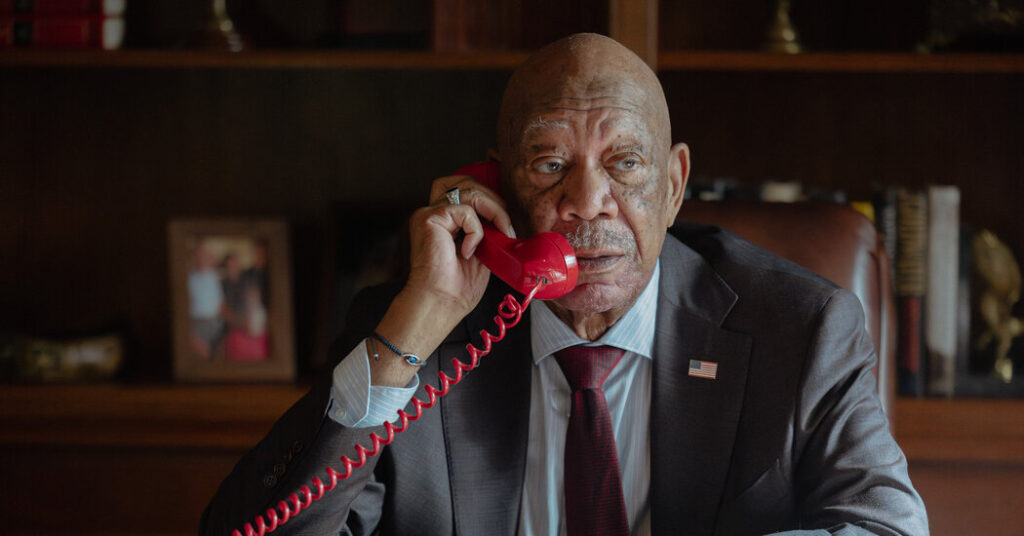
Morgan Freeman insists he still does not understand the fuss over his voice. The 89-year-old Oscar-winning actor has voiced God and presidents, and he is the go-to narrator for your favorite documentarian. He still brushes aside the impact of his immediately recognizable, resonant baritone.
Freeman, whose career did not take off until later in life, is nearly a nonagenarian, but is still going strong. He is reprising his role as Edwin Mullins, the U.S. secretary of state, in the third season of Taylor Sheridan’s espionage thriller “Lioness” on Paramount+, which also stars Zoe Saldaña and Nicole Kidman. Freeman also feels a duty to preserve blues music; he is a founder of a live blues club in Clarksdale, Miss., and he produced and narrated a blues record due out in August.
He recently spoke to The New York Times about his work in the Sheridan-verse, that voice and how he chooses projects. This interview has been edited and condensed for clarity.
Taylor Sheridan has attracted a long list of movie stars to his shows. What is it about his writing that makes his shows attractive?
His writing has to do more with the human experience, what people are actually going through, emotionally, in a lot of cases. You saw that a lot in “Yellowstone,” and you actually see it a lot in any of his writings. And here, in “Lioness,” in Joe’s [Saldaña’s character] case, for instance, he is dealing with a woman whose life is on the line very often. She has kids and a husband. She makes decisions and she has to consider these. It takes courage to write about stuff like that, and Taylor seems to have an awful lot of it.
You didn’t used to see many movie stars joining episodic television series. Why are so many joining in this moment?
There’s more work in episodic TV streaming than there is actually in movies that are going to the theaters. If people can sit at home and watch something extraordinary, then that’s what they’ll do. So, that’s why Warner Bros., Paramount and Hulu, all of them have these streaming stations.
In the show, you play a government official at a time when there is so much geopolitical unrest in real life. Do you feel a responsibility in that role when real life often mirrors art?
We are really not trying to deal with contemporary geopolitical issues at all. We know that people are going to come away with something that shows what their own ideas about what they saw and what it means, but as we present it, it has nothing to do with current situations at all.
The show is action-filled, but your scenes take place in a situation room. How do you build up the tension when you only have the room as a stage and your voice as an instrument?
We don’t have to build up the tension. It’s the dialogue that builds up the tension of whenever there is that kind of tension. You’re dealing with life and death situations with the teams that are out there in the field. So, just as that, you take what you’ve got in terms of script and internalize.
At what point did you realize that your voice was such a unique instrument?
I still haven’t. I’m just being told that.
At what age were you first told that?
I don’t know — 80, 75.
That’s hard to believe.
Don’t find it hard to believe. My career didn’t even get started when I was 50.
What goes through your head when people say that you have a profound voice and cadence?
“Gee whiz,” is what goes through my head. “Really? Thank you very much.” That’s it. What else are you going to do with it?
Is there anything specific that you’ve done to hone it through the years?
No. Just try to speak clearly. That’s all. What’s there is there.
You have dived into blues music. Why is that important to you?
Blues music is, No. 1, America’s bottom-line heritage, and that bottom-line heritage belongs to the Black population of this country. We created it. We nursed it along — this is blues and gospel — because there are a lot of our gospel singers that came out doing the blues after. Money in blues is better than money gospel song. And the two are inextricably married. I didn’t really sit down and decide that this is something I have to do. It was sort of pressed on me.
I was in Clarksdale one day, and a couple of backpackers were walking the streets and they were trying to find some place that they could listen to the blues in Clarksdale and there was no place. My partner and I, we just decided that’s a no-go. We’ve got to do something about that. So, I can’t really sit here and say to you that’s been a passion of mine all my life. The necessity for doing it was pressed upon me.
Is there a key element to a script that makes you say yes to it?
If somebody offers you a job, it’s very nice if they’re offering you also an exciting script, but in reality, two or three things come into play. What are they going to pay you? If they’re going to pay you enough, then you overlook some of the glitches in the script that happen to be there. Sometimes you can mention things that are in the script that don’t quite work out for you and by and large, that gets worked out.
Is there a role left that you haven’t played that you still want to?
No. I’m pushing 90 now. So, the roles that I wished I had been able to play, Denzel Washington will play.
What is it that keeps driving you to make art?
I’m like Clint Eastwood on that: Don’t let the old man in. So, keep working. If you can get out of bed and don’t fall down when you do it, then you just count your blessings and keep moving. So, I’ll work as long as I can — as long as somebody says, Do you want to do this part?
The post Morgan Freeman Is Pushing 90, With No Plans to Stop appeared first on New York Times.