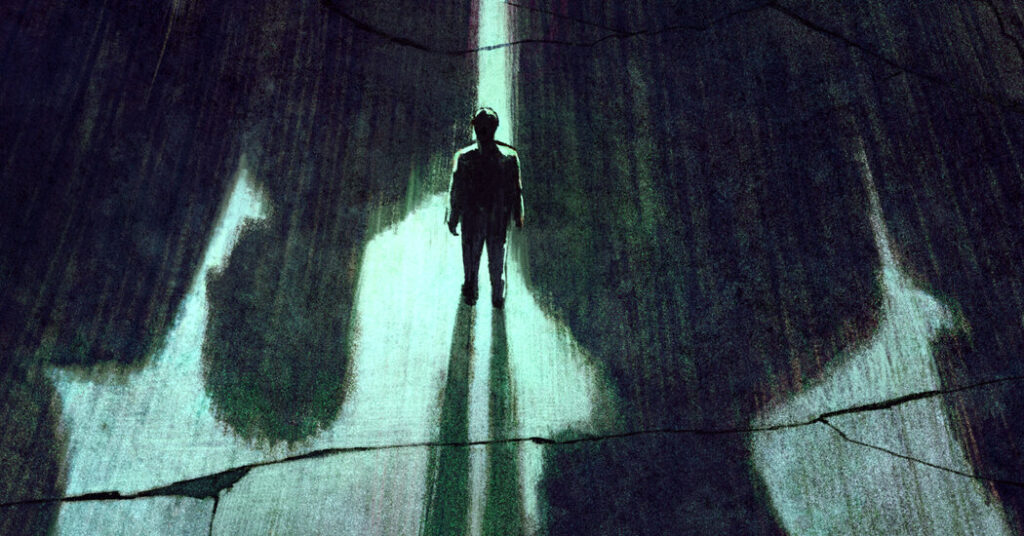
On Dec. 23, 1978, weeks before revolutionaries toppled the Iranian monarchy, armed assailants carried out two coordinated attacks in Ahvaz, the operational hub of Iran’s petroleum industry, killing an Iranian oil official and an American oil executive in separate ambushes.
The victims were my father, Malek-Mohammad Boroujerdi, and his colleague, Paul E. Grimm.
I read about the attack the next day on the front page of this newspaper. I had arrived in America to study only four months before. For most readers, it was another dispatch from a faraway country descending into revolutionary turmoil. For me, it was the moment that I learned my father had been murdered.
Some of the men who helped orchestrate his killing later became architects of the Islamic republic, and now sit at the heart of the government that Washington faces in its on-and-off-again war. For decades, American policymakers have viewed the Islamic republic primarily through the prism of its clerical leadership. Yet understanding Iran’s resilience and its capacity for defiance requires looking beyond the religious establishment to this lay revolutionary generation that helped build the regime — the men who emerged from militant organizations and who now occupy the commanding heights of the Islamic republic’s power structure.
This generation of men was born in the mid-1950s, came of age during the upheavals of the 1970s and entered adulthood amid the 1979 revolution. The years leading up to the revolution were a time of clandestine activism and revolutionary struggle. These men built the institutions of the post-revolutionary order, fought the Iran-Iraq war and weathered successive waves of domestic unrest, international isolation, economic sanctions and military confrontation.
Whatever judgment one makes of their record, they are neither political novices nor leaders easily cowed by external pressure. Their longevity has endowed them with a deep institutional memory, a strong instinct for regime survival and a pragmatic understanding of the uses — and limits — of both coercion and compromise. As the Trump administration looks to extract itself from its war with Tehran, it must grapple with these realities. Neither war nor peace with the Islamic republic will come easily, regardless of who occupies the White House.
My father was a secular nationalist. He was neither drawn to the religiously inspired revolutionary message of Ayatollah Ruhollah Khomeini nor particularly supportive of Shah Mohammed Reza Pahlavi, whose rule, in his view, owed much to the C.I.A.-assisted coup of 1953. Despite his misgivings about both camps, he remained committed to his job. When oil workers across the country went on strike to cripple the shah’s government, my father continued reporting to work in his capacity as a senior official of the Oil Service Company of Iran, which supported the National Iranian Oil Company’s petroleum operations.
That decision ultimately made him a target. In the weeks before his death, my father started to receive threats from Mansouroun — “the Victorious Ones” — a militant Islamist guerrilla organization that viewed those who continued working in the oil industry as enemies of the revolutionary cause. In the foggy predawn hours of Dec. 23, 1978, just a few feet from our home, they ambushed my father as he drove to work, shooting him once in his chest and once in his hand. At the same time, several miles away, members of a closely allied Islamist guerrilla organization unleashed a hail of gunfire on the car of Mr. Grimm. Both men were killed.
The twin assassinations were a turning point for Iran. Mr. Grimm, the acting managing director of the Oil Service Company, was the only American killed during the revolutionary upheaval of 1978 and 1979. His murder triggered the evacuation of most foreign personnel employed in Iran’s oil industry, dealing a severe blow to production. According to figures from the U.S. Department of Energy, within three days of the murders, oil output plummeted from 3.2 million barrels per day to under 700,000. The economic paralysis of the shah’s regime was no longer a looming possibility. It was a fast-unfolding reality, hastened by a campaign of intimidation and violence waged by Islamist militants.
Stunned and disoriented, I returned to Iran to be with my family. Unlike my father, I had been sympathetic to the revolutionary cause as a teenager, even if I, too, was uneasy with its overtly religious overtones and symbolism. Now the revolution had just claimed my father’s life, leaving me to grapple with a tangle of grief, anger, sympathy and uncertainty. The modern world had not yet witnessed a successful theocratic revolution, and what was unfolding before my eyes was bewildering. One day I would visit my father’s grave; the next, I would stand among crowds observing revolutionary demonstrations in the streets.
Eventually, I left Iran to go back to my studies in the United States. On the flight, I made a promise to myself: I would abandon my plan to become a petroleum engineer and would study politics, hoping to better understand the ideas, forces and events that had so profoundly altered the course of my life.
I have devoted my academic life to examining the ideological foundations of the 1979 revolution and the architecture of power in the Islamic republic and have undertaken what I believe to be the largest empirical study of Iran’s political elite to date. As part of this work, I traced the careers of the truculent members of Mansouroun, many of whom rose to the highest ranks of the Islamic republic’s military and security establishment.
Among the most prominent members was Mohsen Rezaei, who helped protect Ayatollah Khomeini upon his return to Iran in February 1979. In September 1981, Ayatollah Khomeini appointed Mr. Rezaei, then 27 years old, as the commander in chief of the Islamic Revolutionary Guards Corps. Mr. Rezaei went on to become the longest-serving commander in the Guards’ history, holding the post for 16 years while overseeing the corps’s transformation from a revolutionary militia into a sophisticated military organization with dedicated ground, naval and aerospace forces. Today, after mounting four unsuccessful presidential campaigns, Mr. Rezaei serves as a senior military adviser to the supreme leader, Mojtaba Khamenei, who fought in the Iran-Iraq war as a teenager while Mr. Rezaei was the Guards’ top commander.
Other alumni of Mansouroun who helped oversee my father’s death and other extrajudicial killings before the revolution also rose to the highest ranks of the Iranian military-security establishment. Among them was Ali Shamkhani, who served as the minister of the Guards, the minister of defense and, for a decade, the secretary of the Supreme National Security Council. He was a top security adviser to Ayatollah Ali Khamenei before being killed in the U.S.-Israeli bombardment this past February targeting the supreme leader’s compound.
Another was Mohammad Baqer Zolqadr, who served first as the chief of the Guards’ Joint Staff and subsequently as the deputy commander in chief of the organization. In March, Brigadier General Zolqadr was appointed secretary of the Supreme National Security Council, placing him at the center of Iran’s national security decision-making. Both the United States and the United Nations have imposed sanctions on him; General Zolqadr has denounced President Trump as “the deluded American president” who threatened all Iranians.
Other Mansouroun veterans also went on to play important roles in the projection of Iranian influence abroad, including helping to establish Shiite militant organizations in Iraq and Lebanon, serving as military attachés in Syria and occupying some of the highest offices of the Islamic republic, including first vice president and acting president.
For nearly half a century, I have spoken out rarely about what happened to my family. The story was too personal, too painful and, for many years, too dangerous for members of my family to tell. It also meant withholding parts of that history from my own children while they were growing up.
But recently, as Washington finds itself negotiating, directly or indirectly, with men such as Mohsen Rezaei and Mohammad Baqer Zolqadr, I changed my mind. To most Americans, these names are little more than items on briefing papers. To me, they belong to a revolutionary generation that has not only shaped my own life since I was 16 years old, but whom I understand better, perhaps, than most.
The death of Ayatollah Khamenei, one of the Middle East’s longest-serving autocrats, together with the demands of a war against two formidable adversaries, has produced a new political reality: Revolutionary Guards-turned-politicians have emerged as the country’s decisive power brokers. Both the injured supreme leader and the enfeebled clerical establishment understand that their survival — and the survival of the Islamic republic itself — depends on the power of the Guards. While these military strongmen will continue to pay lip service to Mojtaba as the supreme leader, they are unlikely to hesitate to shape his agenda or override decisions that conflict with their institutional interests. Such is the perfidious architecture of political authority in postwar Iran.
The United States and Israel have yet to learn that the Iranian regime is not made of papier-mâché, and the Islamic republic’s confrontational ideology is unlikely to dissipate anytime soon. The men in uniform showed no hesitation in killing thousands of their own compatriots in January — a national trauma that Iranian society has yet to fully process. They will continue to practice a politics of performance for domestic audiences even as they recognize that the regime’s social contract is both morally bankrupt and fiscally unsustainable.
In 1978, members of Mansouroun gunned down my father on a road in Ahvaz. I could never have imagined that many of the men who helped oversee his killing — or their surviving comrades — would, nearly half a century later, become the principal adversaries and interlocutors of my adopted homeland.
Like everyone else, I don’t know how this war is going to end. But after a lifetime of observing these men, I do know this: Expecting meekness or diplomatic finesse from them is a dangerous illusion. Their combustible mix of vanity and mendacity has trapped Iran in debilitating crises, both at home and abroad. The accumulation of economic, social and environmental failures has left the country increasingly vulnerable and made governance ever more costly.
Yet the regime endures. The formidable architecture of Iran’s “deep state,” the relative cohesion of its ruling elite and decades of institutional experience in managing crises continue to provide it with remarkable resilience. The result is an uneasy equilibrium: Internal discontent and external pressure steadily intensify, but the state’s capacity for survival remains largely intact. That is the paradox of Iran today — a system under relentless strain, yet still far from collapse.
Mehrzad Boroujerdi is the dean of the College of Arts, Sciences and Education at Missouri University of Science and Technology.
The Times is committed to publishing a diversity of letters to the editor. We’d like to hear what you think about this or any of our articles. Here are some tips. And here’s our email: [email protected].
Follow the New York Times Opinion section on Facebook, Instagram, TikTok, Bluesky, WhatsApp and Threads.
The post This Is What My Father’s Assassination Taught Me About the War in Iran appeared first on New York Times.