In 1972, the Rainbow Sign, a Black cultural center in Berkeley, Calif., put on a group show that featured a small work by Betye Saar, an artist from Los Angeles. Though not even a foot tall, “The Liberation of Aunt Jemima” (1972), her box assemblage that featured a mammy doll wielding a rifle and a grenade, landed with a seismic jolt. Its message of Black power and autonomy made her into a central figure of the Black Arts Movement and ultimately helped catapult her to fame.
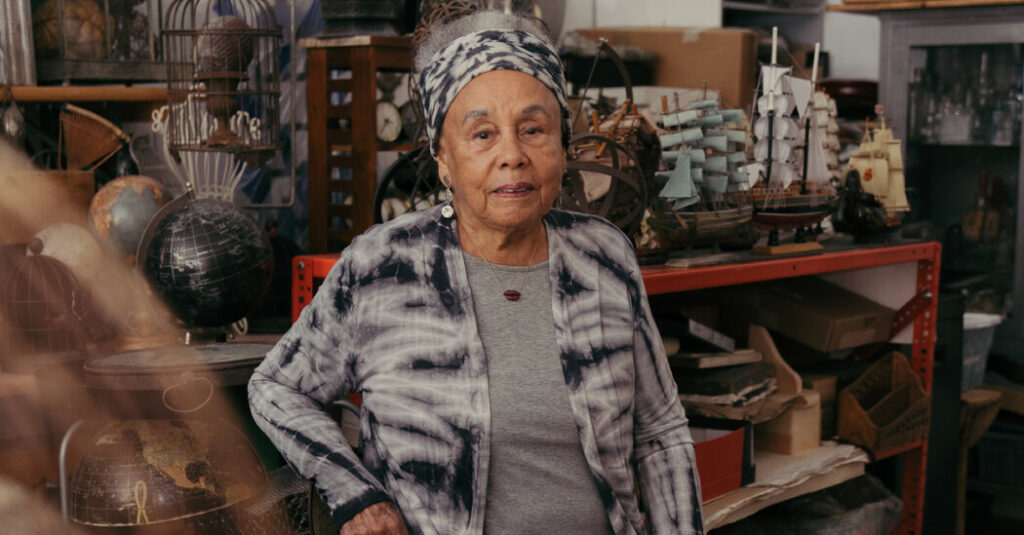
Saar died on Sunday at 99. She leaves an influential legacy built over more than six decades: assemblages that give new life to found objects — even those rooted in bigotry — as well as more ethereal, personal works imbued with a profound spirituality.
‘Anticipation’ (1961)
Saar studied design, but a chance encounter with printmaking in the late 1950s led her to become an artist. This early screen print foretells the ways in which Saar’s work would continually counter the dehumanization of Black people: It shows the artist, pregnant with her third child, looking placid as she holds a small bouquet of flowers.
‘Black Girl’s Window’ (1969)
This pivotal piece — fabricated from a discarded window — marks Saar’s transition from printmaking to assemblage. It also serves as a literal window on her life at a time when her marriage to the ceramist Richard Saar had come undone. Among its elements are the lion, representing Leo (her astrological sign) and an eagle with the word “LOVE” emblazoned on its chest. “It comes and goes,” she later explained of the bird. “It flies away. It stays.”
‘The Liberation of Aunt Jemima’ (1972)
After encountering the assemblages of Joseph Cornell at a museum exhibition, Saar began to use shadow boxes in her work. The racial tumult of the era — including the 1965 Watts uprising and the assassinations of civil rights leaders — inspired their content. “Liberation” features a raised Black fist hanging from the skirts of the armed mammy, which takes a derogatory depiction of a Black woman and transforms her into a revolutionary. Saar used racist knickknacks in withering ways throughout her career.
‘Mti’ (1973)
In the 1970s the artist became increasingly intrigued by West African and Afro Caribbean spiritual practices and took a trip to Haiti spurred by her interest in vodou. She began building shrines like “Mti” (Swahili for “tree”), which contains protective eyes drawn onto its surface and an interior painted haint blue, a shade, according to the lore of the Gullah Geechee, that protects a home from ghosts. For Saar, these assemblages were not just about aesthetics, but also about finding ways to channel the latent power of objects. When displaying “Mti,” she encouraged visitors to leave offerings at its base.
‘A Loss of Innocence’ (1998)
Saar’s assemblages grew in scale and complexity. “Innocence” features a vintage child’s nightgown stitched with clothing labels imprinted with terms like “Tar Baby” and “Picknaninny” — epithets that the critic Hilton Als once wrote, “not only besmirch innocence but remove the very possibility of it.” The garment, suspended from above, can move with small gusts of air, giving the installation the uncanny feel of being haunted.
‘The Destiny of Latitude and Longitude’ (2010)
Cages are a recurrent theme in Saar’s work, evoking the legacies of slavery. Particularly striking is this one, with a pair of sailing ships, one of which rests on a bed of partly braided gray hair that reminded the artist of her grandmother. At the top of the cage sits a lone crow, a symbol for Jim Crow.
‘Drifting Towards Twilight’ (2023)
Even late in her career, Saar produced ambitious installations that featured boats, often hovering over the ground. “Drifting,” a key work in this vein, is on long-term view at the Huntington, near her hometown, Pasadena. In the work, a vintage canoe appears to glide along a river of desiccated branches. “Even in death,” Saar said of the plants, “things can be really beautiful.”
The post 7 of Betye Saar’s Most Important Works appeared first on New York Times.