Over the past 40 years, the emergence of digital technology led to a surge in automation, amplifying inequality even as it increased productivity. Economic growth continued, but it enriched only some groups while punishing many others. This not only precipitated a collapse of shared prosperity; it also exacerbated the crisis of liberal democracy that’s upending much of the developed world.
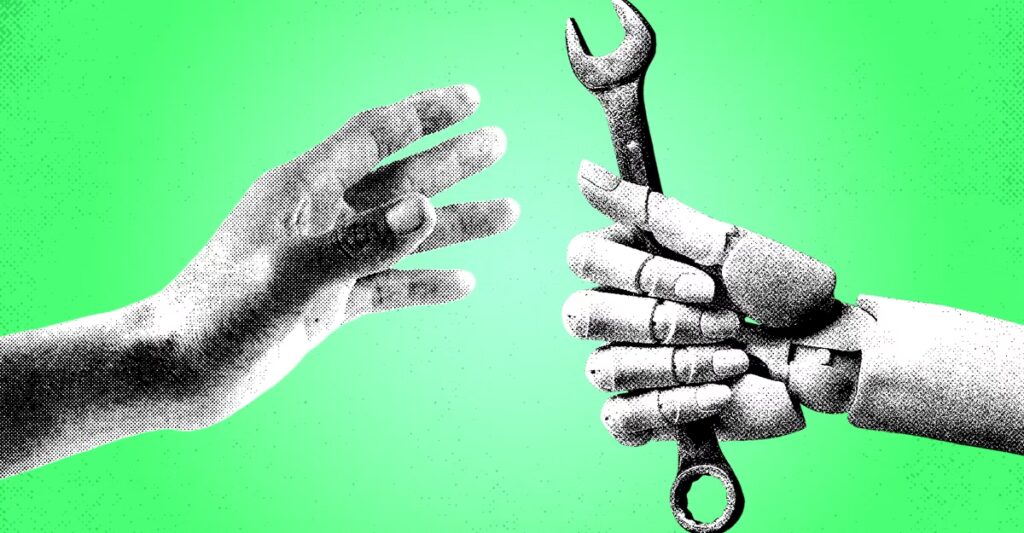
Now generative AI is poised to supercharge the inequities of the past four decades. But this isn’t inevitable. A society-wide effort will be required to avoid the mistakes that were made during the advent of digital technology. That will mean redirecting AI development so that it benefits workers instead of replacing them. I call this “pro-worker AI”: models that expand the capabilities of workers, give them new tasks, and make them more productive.
From a technological perspective, it’s entirely feasible—and in some cases already proven. Such a transformation won’t happen on its own, and it won’t be simple. But there are ways to jump-start it.

We’ve known for some time that AI can enhance workers’ skills instead of rendering them useless. The computer scientist J. C. R. Licklider saw this back in 1960, when he predicted that computers would one day augment human cognition by providing workers with highly processed, context-sensitive information. For the next six decades, digital technology was not up to that task. The internet represented a breakthrough in collecting and storing information, but retrieving it remained a challenge. Although search engines could quickly yield countless results, humans were the ones who had to process them, sequentially and slowly.
[From the July 1945 issue: As we may think]
Now generative AI has fulfilled Licklider’s prophecy. It can find the most relevant answers to a query and summarize them almost instantaneously, in digestible form. It can process technical information and furnish precise guidance for complicated tasks performed under specific conditions. This kind of information retrieval and provision forms the basis of pro-worker AI. If widely adopted, it could increase wages, employment, and productivity all at the same time, restoring the link between productivity growth and good jobs that the past four decades have severed.
Pro-worker AI would serve far more people than just knowledge workers who need to draft slide decks or emails. Consider electricians, who are in high demand across many industries. You don’t need a large language model that can write sonnets to be able to troubleshoot electrical equipment; you need specialized models trained on niche, high-quality data. These are the hallmarks of pro-worker AI. Facing ever more sophisticated equipment and grids, electricians could benefit from an AI tool that draws on a targeted knowledge base, past use cases, and site-specific inputs—sensor data, photographs, written reports—to help them identify problems with machinery or circuitry. Indeed, a global company is already developing a set of products like this for a range of field technicians.
Pro-worker AI could boost productivity across other service industries, too. In education, a model trained on relevant curricular material might allow teachers to spot patterns in test results and tailor lesson plans for particular groups of students who tend to make the same mistakes. This is one of many ways that AI could make education more cost-effective and personalized, which could drive up demand for teachers and bolster their wages.
Perhaps most important, pro-worker AI could create good service jobs for workers who aren’t college educated, and thus begin to uproot the inequality that has been entrenched in the postindustrial economy. In the health-care industry, for example, specially trained models could enable lower-skilled laborers to perform a broader range of tasks, particularly those that rely more on physical exertion and social interaction than on medical expertise.
The promises of pro-worker AI won’t be realized, however, unless it receives more attention and investment. This will require a dramatic shift in how all parts of society—governments, corporations, investors, workers—think about AI.
In Silicon Valley today, most funding chases automation. This isn’t entirely surprising. Automation can be lucrative for both managers and shareholders because it reduces payroll and decreases dependence on organized labor. More broadly, AI models that act and sound like us—instead of those that support us—attract a disproportionate amount of hype. “Reaching human parity” has become a key metric of success in Silicon Valley.
At the same time, the global race for AI supremacy largely centers on artificial general intelligence, which would in theory be able to take over human labor across all sectors, including white-collar cognitive work and the nonroutine tasks that skilled blue-collar and craft workers perform. Even models that don’t meet the AGI threshold could eliminate an untold number of jobs. The few people lucky enough to claim the remaining tasks in the economy would lose substantial wages.
[From the March 2026 issue: America isn’t ready for what AI will do to jobs]
Several policies could begin to shift Silicon Valley’s attention toward pro-worker AI. Starting at the international level, the United States and Europe should create AI agencies that can generate incentives—such as grant programs or public competitions—for technologists to develop models that are designed to expand workers’ capabilities.
A simpler fix involves the tax code. Tax laws in many industrialized economies encourage far too much automation. In the United States, for example, labor income is taxed significantly more than capital income. If a business pays a worker $100, it will have to hand over as much as $30 in tax and spending obligations. But paying $100 for automation equipment leads to a tax burden of less than $5, a number that has dropped as companies have been allowed to write off more spending on digital infrastructure. For the most part, this tax asymmetry triggers only mediocre productivity gains. In fact, even when automated labor is less productive than human workers, a company may well make money by automating.
To a certain extent, employers’ preference for automation is unavoidable. For one thing, companies need to cover health insurance for humans and not for machines. But removing these distortions in the tax system would create a more level playing field for workers, as well as for the development of pro-worker AI models.
Part of the promise of pro-worker AI is to create new tasks, which in many cases will demand that laborers learn new skills. As such, society will need to invest in worker training. By “training” here, I’m not referring to the unrealistic goal of turning coal miners into computer programmers. Rather, training should aim to allow workers, including manual and craft workers, to boost their existing expertise. The introduction of AI to the workforce may continuously change which skills are in demand, so training will have to be adaptive and emphasize flexibility. Pro-worker AI itself could play a role, helping update training programs just as it can help teachers revise lesson plans.
Redirecting technological change toward pro-worker AI will also involve even more herculean undertakings. Chief among them is reducing the dominance of technology monopolies, which have an outsize effect on AI development. They’re using it not only to push the technology toward automation and AGI, but also to discourage innovation by forcing out new companies that have unorthodox, and potentially disruptive, ideas. Creating a more competitive environment would open greater space for pro-worker AI. This can be achieved by enforcing existing antitrust laws, which have rarely been applied in tech. It may also require limiting Silicon Valley’s considerable power of persuasion, for example by fostering more and better-funded independent media.
A stronger labor movement would help too. Rather than resist AI, unions should become advocates of a pro-worker AI agenda. Merely bargaining for higher wages won’t be enough: Most companies will respond to demands for higher wages by simply choosing more automation. Instead, unions will have to build the case that corporate investments in pro-worker AI can benefit both labor and management, making the former more productive and the latter more profitable.
At stake is a core tenet of the liberal economic order: that jobs and wage growth remain available to workers of different skills and backgrounds. The past 40 years have jeopardized this promise. But they have also produced new, capable technologies—most important AI—that can help workers rather than sideline them. First we have to decide that automation won’t be the north star of the AI age.
This essay has been adapted from Daron Acemoglu’s new book, What Happened to Liberal Democracy?
The post How to Make AI Work for Workers appeared first on The Atlantic.