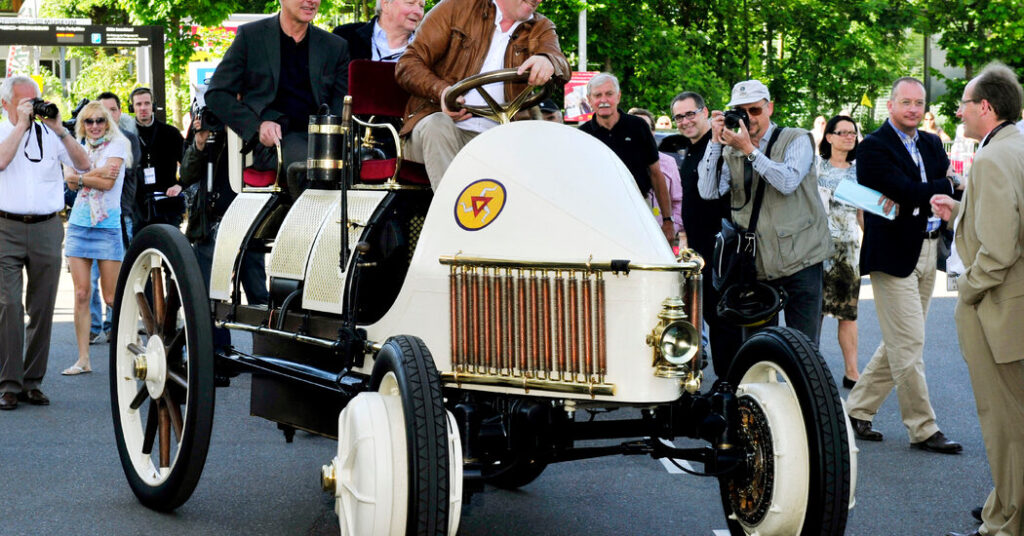
Before there were super-hybrids, before plug-in versions, before even the vaunted Prius — the hybrid that set the modern standard — there was the 1900 Lohner-Porsche Semper Vivus.
Created by Ferdinand Porsche nearly 100 years before the first Prius ever turned a wheel, the Semper Vivus, which means “always alive,” used electric power but didn’t suffer the severe range limitation that plagued early electrics, which relied solely on lead-acid batteries.
Indeed, we must back up a bit. Porsche was a prolific automotive inventor and engineer long before the company that would bear his name was formed, and he was just 25 years old when he built the world’s first hybrid automobile.
His early technical experience was in electrical energy, working for Béla Ebber & Company, a producer of electrical components in Vienna. In the last years of the 19th century, he left Béla Ebber and went to work for Jakob Lohner & Company, a well-known coach builder.
There he created a battery-powered vehicle known as the System Lohner-Porsche. It wasn’t the world’s first battery-powered vehicle, but it was significant in that it was driven by wheel-hub motors, and Porsche’s work in creating that drivetrain system would soon lead him to develop a hybrid car.
Although a wheel-hub motor for railroad cars had been awarded a U.S. patent in the 1880s, Porsche’s hub motor was an engineering breakthrough. By incorporating motors in the wheel hubs of a battery-powered electric car, drivetrain components were eliminated and mechanical systems were simplified. There are inherent drawbacks, but in 1900, the advantages of hub motors far outweighed any problems the technology introduced. Hub motors are still used today, primarily in bicycles, although they are also sometimes used when conventional vehicles are converted to electric power.
The System Lohner Porsche’s introduction at the 1900 Paris World Fair — the Exposition Universelle — resulted in this report in The Berliner Zeitung: “The vehicle’s epochal innovation is the full removal of the intermediate transmission,” the newspaper said, and added “through the integration of the electric motors, the Porsche system, into the hubs of the front wheels.”
This E.V. was capable of approximately 20 miles an hour, competitive performance for the time, but given the limitations and weight of lead-acid batteries, it could be driven only about 30 miles on each full battery charge and was reportedly reduced to a crawl when ascending hills.
So Porsche looked for a boost: internal combustion engines. Two single-cylinder De Dion engines drove two generators that powered the wheel-hub motors while charging a much smaller and lighter battery pack. In essence, it was what we now call a series hybrid. The car could be initially, albeit briefly, operated on battery power alone. As in today’s mild hybrids, the generators also served as motors to start the gasoline engines.
After testing, the Lohner-Porsche Semper Vivus was deemed successful, and a production version was developed, the Lohner-Porsche Mixte. This design further simplified the hybrid powertrain with a Daimler four-cylinder engine spinning a single generator that both powered the hub motors and charged a compact battery pack. The hub motors functioned as generators on deceleration, thus providing some measure of regenerative braking, but four-wheel brakes were fitted as well.
This Mixte was built on a wooden frame, atop of which rode a phaeton body. The car was expensive, and not many were sold to the public. One account cites just 12 sales of the first Mixte version in all. But variations on the theme were subsequently produced for fleet use, including some with four motors and all-wheel drive.
Total production of Lohner-Porsche hybrids is said to have totaled approximately 300. The last example of any version is believed to have been destroyed during World War II.
The Lohner-Porsche hybrids were serial hybrids. The gasoline engine of this type of hybrid serves only to power a generator, which provides electric current to charge the batteries and, in some cases, power the motors. Almost all modern hybrids are parallel hybrids that combine electric power with the gasoline engine’s output to turn the wheels. But there are a few modern serial hybrids, most notably the Ram 1500 Ramcharger, which uses a V-6 engine to turn a generator, and Nissan’s e-Power hybrid models.
While Porsche doesn’t currently produce a serial hybrid, the company is heavily into parallel hybrids, including the Panamera 4 E-Hybrid, which combines the power of a combustion engine and an electric motor to generate 463 horsepower — enough to achieve a top speed of 173 m.p.h. Like the Lohner-Porsche, it’s not inexpensive, with a starting price of $127,200.
Porsche A.G., now part of the Volkswagen Group, is quick to play up the pioneering efforts of its founder. In 2007, Porsche Engineering and Drescher Karosseriebau, a coach builder, constructed a replica of the Semper Vivus hybrid prototype, using photographs, an engineering drawing and some informed guesswork. That replica even made a splash at the 2011 New York auto show, where a gas-engine version of the Panamera was introduced.
In an interesting footnote to Ferdinand Porsche’s hybrid adventures, the Mixte, the first production hybrid, is said to have been funded largely by a German automotive entrepreneur named Emil Jellinik — a name students of Daimler history will recognize. Jellinik was a marketer of Daimler automobiles, which, at his insistence, would soon thereafter be known as Mercedes automobiles, in honor of his daughter, Mercédès Jellinik. Had her father been so inclined, the first Porsche electric might have been a Mercedes.
The post How the Prius Traces Its Lineage to a 1900 Car From Ferdinand Porsche appeared first on New York Times.