Photographs by Klaus Galiano
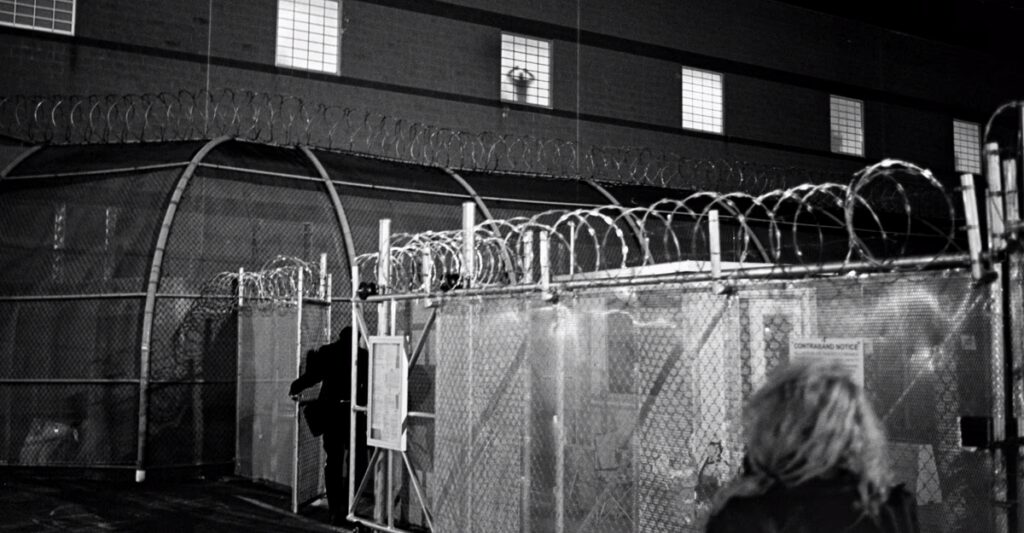
It was probably inevitable that the Delaney Hall immigration detention center in Newark, New Jersey, would become a battleground in the broader fight over President Trump’s mass-deportation campaign. The privately run jail reopened last year as the only sizable facility of its kind in the New York City metro area, with capacity for 1,000 ICE detainees. Trump officials have been threatening for months to intensify ICE enforcement in New York, making Delaney Hall essential to their plans. It’s also smack-dab in a blue sea of state and local governments dominated by Democrats whose constituents are furious at ICE.
Protesters have rallied outside Delaney Hall since May to denounce poor conditions inside the facility, operated by the GEO Group on a $1 billion, 15-year contract. Trump officials say that complaints about the facility are overblown and that protesters’ true goal is to drive out ICE.
New Jersey Governor Mikie Sherrill and other prominent Democrats have joined calls for Delaney Hall to be shut down, and they’re suing the Trump administration to block ICE plans for a larger jail in another part of the state.
In recent years, blocking or limiting ICE jails has generally been an effective tactic for immigration activists because it constrains the government’s ability to arrest and hold large numbers of immigrants. It also drives up costs by forcing ICE to relocate detainees. Squeezing ICE’s capacity has worked in tandem with so-called sanctuary policies adopted by state and local jurisdictions that try to limit or prohibit cooperation with federal immigration enforcement. The result is a geographic imbalance in ICE infrastructure: There are relatively few detention centers close to northern and coastal cities with large immigrant populations, while a disproportionate number of the agency’s jails are concentrated in Texas and Louisiana.
But the keep-ICE-out approach has downsides that Democrats rarely acknowledge. And now that ICE is swimming in cash, a strategy that relies on starving ICE of resources might turn out to be not just futile, but counterproductive.
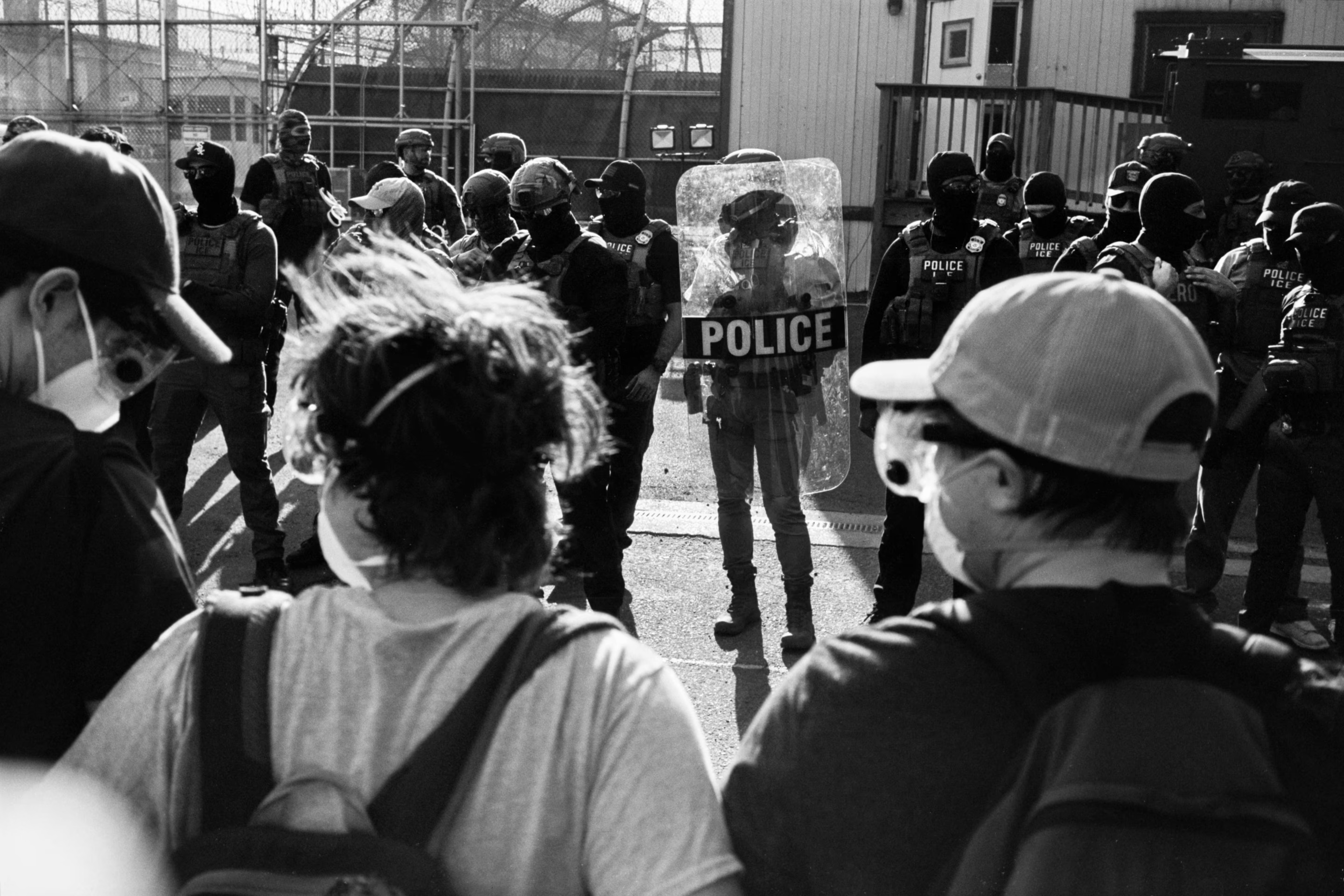
Since Trump returned to office, Republicans have used the budget-reconciliation process to channel more than $100 billion in additional funding to ICE, 10 times the agency’s annual budget. ICE opponents can make it harder to open new immigration jails in blue cities and states, but the administration now has all the money it needs to ship detainees to southern states, where detention costs are generally lower. When Tom Homan, Trump’s “border czar,” traveled to New Jersey last month to defend conditions inside Delaney Hall and meet with Democratic officials, he said protesters’ calls to close the jail would backfire.
John Gihon, a former ICE attorney in Florida who is a board member of the American Immigration Lawyers Association, told me that when ICE facilities shut down in Democratic-run states and cities, it’s “a small-time win” for activists but it leaves detainees worse off.
“ICE is going to find the bed space,” Gihon said. “A lot of time, it’s going to be farther away from a blue state, and farther away from friendly federal courts, in a place with terrible conditions.” In addition to being more distant from family members, immigration courts in Texas and Louisiana have judges who reject asylum claims at some of the highest rates in the country, federal data show. And sanctuary cities such as New York and Chicago generally have more legal-aid organizations that can help ICE detainees get out of custody and fight deportation. “When I have a detention center near me that I can drive to, I never have to worry about my client missing a phone call,” Gihon told me.
That’s not to say that advocates have no reason to fight for better conditions, or to get immigrants out of ICE custody. At least 52 detainees have died while detained by ICE since Trump returned to office, two and a half times the rate of fatalities from his first term, according to a report published last month by Human Rights Watch.
But Democrats calling for Delaney Hall to close should be careful what they wish for, Gihon told me. “If you shut that place down, everybody gets sent to Louisiana,” he said. “And most of them are not going to get out.”
ICE relies on a patchwork of jail facilities and immigration detention centers, many of which are privately run, to hold the immigrants it arrests and seeks to deport. The agency currently has about 65,000 detainees in custody nationwide, down slightly from January but still close to record levels. Trump officials say they need to boost detention capacity to 100,000 to hit their goal of 1 million deportations a year.
Opponents of Trump’s immigration crackdown have scored some victories lately in their battle to stop the expansion of ICE detention centers. The “Alligator Alcatraz” camp in the swamps of south Florida has been closed. In Maryland, a federal judge has blocked ICE’s attempt to open the state’s first large immigration detention facility. And Trump officials have scaled back plans to create a national network of ICE megajails out of converted warehouses, and are instead preparing to sell or repurpose several properties purchased during a billion-dollar spending spree last winter.
The backlash to ICE has picked up momentum around the country as more Democrats condemn the agency and endorse calls to eliminate it. A YouGov poll conducted in March found that three-quarters of Democrats and more than half of independents favor abolishing ICE. The survey was conducted after the killing of two U.S. citizens protesting the ICE crackdown in Minneapolis.
[Read: ‘Abolish ICE’ is back ]
Homan, who used to run ICE, has waged a counter-messaging campaign in defense of his former agency and its legal authorities. He met with Newark Mayor Ras Baraka to ask for more support from city police, and ate a meal in the Delaney Hall cafeteria, pronouncing the spaghetti “good.” And he leveled a warning last month to Sherrill and other Democrats calling for the jail’s closure. “You want to shut down the facility?” Homan said. “Then every illegal alien we arrest in that state, we’ll fly to Texas. We’ll fly to Arizona, detain them there, because we’re going to keep arresting people. We’re going to keep detaining people. We’re going to keep removing people.”
Detainees picked up by ICE in the New York City area and held at Delaney Hall remain close to their families. (One of the demands of recent protests was increased visitation hours.) If the facility is shut down, Homan said, immigrant families will see their loved ones shipped out of state. “How does that benefit the migrant community?” he asked.
Attorneys and immigrant advocates I’ve spoken with deplore Homan’s threats, but acknowledge that ICE’s funding surge has put them in a bind. They’re not giving up calls to shut down immigration jails and stop ICE from opening new ones. Yet for detainees who are already in ICE custody, they concede, that approach is likely to make outcomes worse. The rates at which immigration judges grant protection to immigrants seeking asylum vary widely, for instance; New York City courts have some of the highest approval rates, while courts in Houston have among the lowest.
The advocates I spoke with said ICE opponents, by and large, have not yet reckoned with the implications of ICE’s new financial resources, and remain committed to tactics that try to limit arrests and deportations by making it as difficult as possible for the agency to operate in their communities.
Claire Trickler-McNulty, an attorney who oversaw ICE policy and planning under Joe Biden and who now advises advocacy organizations, told me the agency’s geographic imbalance developed partly because detention facilities in southern states were lower cost and logistically convenient for deportation flights or bus transfers to Mexico. Trickler-McNulty said activists who want to fight Trump’s crackdown should call for safe, humane detention and, more important, fewer detainees. “My view is you want to be very clear on who needs to be detained and for how long, and manage those cases very closely, so that people aren’t spending too long in detention,” Trickler-McNulty said. “If we accept the premise that we are going to have immigration detention for a certain segment of the population, then that is what you would want.”
ICE officers arrested nearly 40,000 people last month nationwide, the highest one-month total since Trump reentered office, according to the agency’s most recent data. Thanks to a hiring surge last fall, ICE has added about 8,000 officers, doubling the size of its workforce. Homan has threatened to marshal those forces to surge operations in New York City and other sanctuary jurisdictions, where immigrants generally face lower risk of arrest and deportation.

[Read: The truth about ICE’s recruiting push ]
Last January, soon after Trump took office, I was invited on a ride-along with William Joyce, the second-highest-ranking official in New York City for ICE’s Enforcement and Removal Operations division, which handles deportations. Joyce told me he had fewer than 100 detention beds available, leased from a jail about 60 miles north of the city, in Orange County, New York. When space ran out there, he had to send detainees to jails in Pennsylvania, Virginia, or farther south. The lack of ICE-jail capacity in the New York City metro area has led to overcrowding at the agency’s processing center inside 26 Federal Plaza in Lower Manhattan. (A suspect was arrested there Monday after a failed arson attack at the building’s entrance that did not result in serious injuries.) Joyce, like a lot of ICE officials in sanctuary jurisdictions, had a limited budget to work with, and prioritized using the available jail space for detainees with serious criminal histories over those whose only violations were immigration-related.
Such trade-offs are no longer necessary. Nearly 40 percent of immigrants taken into custody have no criminal records, according to Homan. “We’re arresting everybody we find,” he said Tuesday on a podcast hosted by Katie Miller, the wife of the Trump aide Stephen Miller.
The ICE detainee population has also soared because the Trump administration has made it harder for judges to issue bonds that would allow immigrants fighting deportation to be released and continue working while they await their next court appearance. And the Laken Riley Act, signed by Trump nine days after taking office, has expanded the range of criminal charges that render someone ineligible for release, to include shoplifting and theft.
Last fall, then–Department of Homeland Security Secretary Kristi Noem oversaw the purchase of at least 11 large warehouse properties around the country at a cost totaling more than $1 billion. The acquisitions were part of a $38 billion ICE plan to build a national network of megajails with capacity for as many as 10,000 detainees. But the agency faced intense opposition to the plan, including in Republican-led states, and ICE officials found themselves facing a red-tape labyrinth as they sought permits from local governments for their sewer and water upgrades. The warehouse purchases, which were directed by Noem and her de facto chief of staff, Corey Lewandowski, are now under internal investigation by DHS’s inspector general.
DHS Secretary Markwayne Mullin, who replaced Noem in March, has said the department is scaling back and reevaluating the ICE-warehouse plan. Department officials say they may repurpose or sell several of the warehouses, boosting ICE capacity elsewhere by purchasing privately run facilities from ICE contractors and adding space at existing jails.
[Read: The $97 million Utah warehouse ICE bought for $145 million ]
Trump officials are still looking to boost their jail capacity in the Northeast. After the administration bought a large warehouse in Roxbury, New Jersey, for $129 million in February, state officials and the Republican-led town council sued to stop ICE from converting it into a detention center, citing environmental concerns. The government said last month that it was no longer planning to go forward with the conversion, but after Sherrill celebrated the announcement as a “major victory,” Mullin abruptly reversed course, and declared that the department “will NEVER back down.” As of last week, attorneys for the Trump administration told the court they’re still figuring out what to do with the warehouse, and they gave no timeline for the decision.
The post The Problem With Shutting Down ICE in Blue States appeared first on The Atlantic.