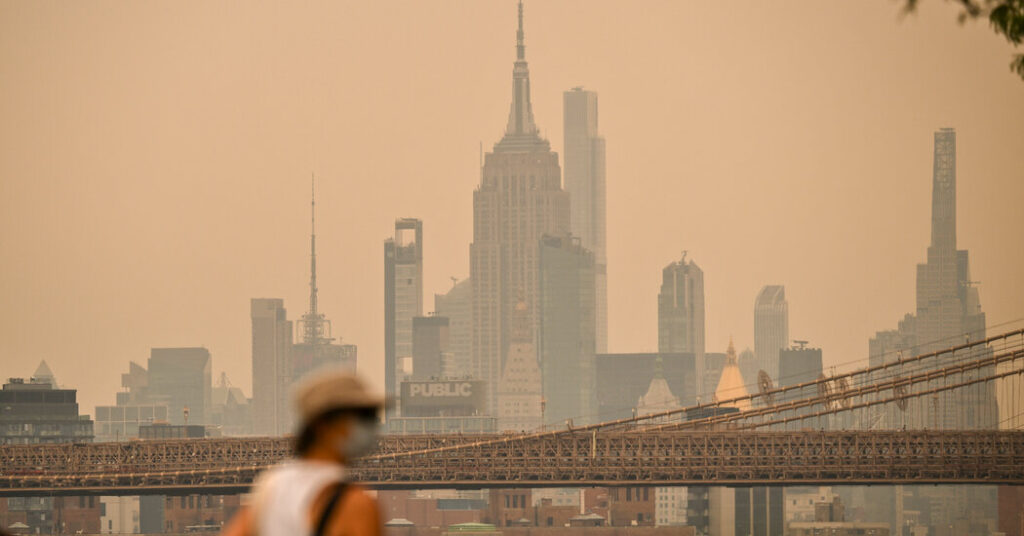
Across North America over the last week, as wildfires raging in Minnesota and Ontario released huge plumes of smoke, air quality readings soared far beyond the rating of above 300 that health experts considered hazardous. They even rose above 1,000 in some places.
It’s not the first time plumes of smoke from wildfires have clogged the air far from where they are burning, and it most likely will not be the last. But an analysis by two air quality experts has found that certain pollution levels in many towns and cities across the Midwest and northeastern United States were the worst on record — even above those measured in 2023, when fires also burned in Canada and acrid air settled over much of the East Coast for days.
Air quality in the United States is measured using the Air Quality Index, created by the Environmental Protection Agency to help people understand the risk of air pollution to their health. Readings fall into six color-coded categories, ranging from green (50 and below) for the cleanest air to maroon (above 300) for air that is most hazardous.
It is a measure of five major air pollutants — ground-level ozone, particulate matter, carbon monoxide, sulfur dioxide and nitrogen dioxide — and how unhealthy they are making the air at a specific setting, as measured by a network of official government-run sensors and less-precise but more widespread community sensors.
At the request of The New York Times, two air quality experts, Marissa Childs, an assistant professor at the University of Washington, and Minghao Qiu, an assistant professor at Stony Brook University, examined one of those pollutants, known as PM 2.5, which are particles that are 2.5 micrometers or smaller in size.
It is a main component of wildfire smoke that can enter the bloodstream and lungs, and long-term exposure can be deadly.
Last week, the researchers found Chicago, Detroit, Milwaukee and Toledo, Ohio, all experienced the highest average readings over a 24-hour period recorded in the last 20 years.
“There are many components to air pollution, but one of the ones that has been studied the most is PM 2.5,” Dr. Childs said. “Historically, wildfire smoke has been associated with big increases in PM 2.5.”
The researchers looked at daily average concentrations of PM 2.5 levels at reporting stations across the Midwest and Northeast to determine when was the worst day for air quality, with records from an E.P.A. archive database going back to 2006. The areas closest to the Great Lakes experienced the highest 24-hour average readings of PM 2.5 last week.
Some daily averages last week across the lower Midwest and the parts of the Northeast farthest from where the fires were burning, including New York, did not top those set in 2023.
Record-setting days with bad air quality are concerning to health experts, who advise people to stay indoors to avoid exposure to hazardous air on these days. While these dramatic spikes in air pollution are notable, experts said sustained exposure over time can cause more harm to respiratory and cardiovascular health and reduce overall life expectancy.
“This acute episode of high air pollution is making headlines, as it should, but it’s the chronic lower-grade burden of the issue in many places around the world that makes air pollution the largest external threat to human health on the planet,” said Christa Hasenkopf, the director of the clean air program at the Energy Policy Institute at the University of Chicago.
The United States is recognized for its above-average air quality in comparison to many other countries and for decades conditions gradually improved.
“The rise in wildfire activity over the last decade has undermined that trend contributing to something of a plateau in air quality nationally, and worsening conditions in some areas locally,” said Robert Rohde, the chief scientist at the research organization Berkeley Earth.
The post Air Pollution From Wildfire Smoke Set Records for Many, Analysis Shows appeared first on New York Times.