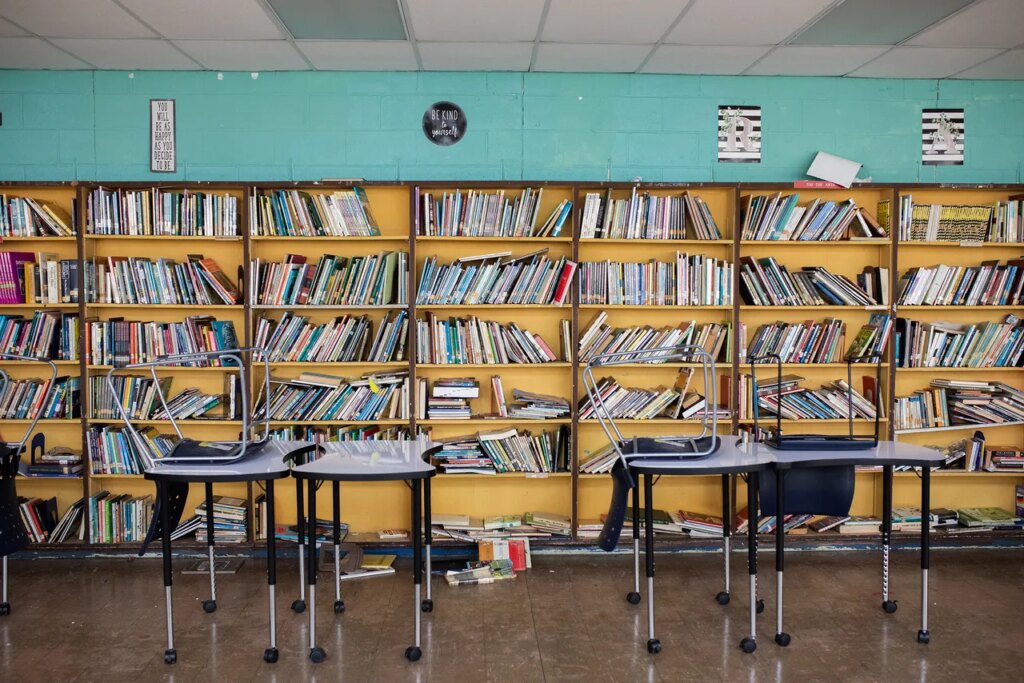
It’s three weeks until Mississippi’s standardized test season begins, and Candace Hamberlin is feeling the pressure.
Evidence of what’s at stake hangs all around Jefferson County Middle School, where Hamberlin is in her first year teaching eighth-grade English. Inside her classroom, a large piece of black polyester with clear pouches labeled “Data Wall” shows the current reading level of each student. The school hallways are lined with posters listing schoolwide scores on an earlier practice test. One prominently displays the grade Mississippi would assign their school if that practice test had been the real thing: 175 out of 700 points, an F.
Jefferson County is one of the smallest in Mississippi; 6,800 people spread across 527 square miles along the Mississippi River. It’s also one of the poorest, with 32 percent of the population living below the poverty line. Fayette, where the only public elementary, middle, and high school are all based, is the only city in the county, home to about a dozen churches but not a single stoplight. The county is 13 percent white, but most of those families send their kids to private or parochial schools; 98 percent of the school district’s students are Black.
Inside Hamberlin’s classroom, it’s time for test-prep drills. This period has 20 eighth graders enrolled, but only 10 are present; six have been pulled out for remedial work with a consultant the district has hired to boost test scores, and the remaining four are absent for unclear reasons. The students in the room each grab a Chromebook and log in, at speeds ranging from feet-dragging to actively resistant. They open the StudySync software program, which shows them each a series of questions tailored to their weaknesses. Their faces look like they’re being marched to the guillotine.
Much of literacy instruction at Jefferson County Middle School now begins and ends with screens. In fact, Hamberlin doesn’t lecture at all on Wednesdays and Thursdays; students spend those class periods with StudySync and i-Ready, another adaptive software program, so each can focus where they need the most help.
The youngs are facing problems that didn’t even exist half a generation ago. They’re handling it better than you think.
Their teacher can’t blame them for being sick of these exercises. The students’ lives, and hers, are dominated by the looming Mississippi Academic Assessment Program (MAAP), the set of annual standardized exams that measure their progress in language arts as well as science and math. Test prep is a year-round activity. Her students must learn how to decode the meaning of unfamiliar words, make inferences, identify the central idea of a passage, analyze tone and point of view. Every Friday brings a practice test.
Before moving to eighth grade, Hamberlin logged 25 years as an elementary school teacher. Eighth grade appealed to her because it’s all about analyzing texts, not just consuming them. That’s her idea of a good time. She remembers reading the first chapter of the first Harry Potter book four times just to make sure she didn’t miss a single detail. As she talks a group of students through a reading passage by Sojourner Truth, her passion is palpable—for the material, but even more for the puzzle-solving that reading comprehension requires.
“A lot of them think they’re studying the story,” she says afterward. “You’re not studying the story, that’s just the sprinkles on top. It’s what was she thinking, why did she say it, how did she convey her message?”
Despite her clear talent and enthusiasm for teaching, though, Hamberlin has thus far failed to convince many of her students to care about reading. Earlier in the year, barely half of the eighth graders scored high enough to pass the all–important exam, and less than 15 percent are scoring “proficient.” If that F on the final schoolwide practice test had been the real thing, it would have been disastrous; Mississippi’s letter grading system comes with steep real-world consequences. Low-performing schools can face state monitoring, while their funding is more likely to come with “accountability” strings attached. State law allows students to attend out-of-district charter schools only when their home district is failing, so low scores can result in a decrease in funding because fewer students are enrolled. Superintendents and principals know that their jobs are tied to increasing scores or at least not allowing them to drop.
Across the country, reading performance has slid for 14 years, and the problem is most extreme in middle and high school. Even in Mississippi, where the improvement in elementary school test scores has become the stuff of legend, older students are struggling. No one can quite agree on why reading scores have dropped so far.
“They’re not reading books for the love of books. They’re reading probably more than they ever have, but it’s snippets.”Kevin Smith, education scholar
And that’s just what the tests measure. Hamberlin’s true fears are more existential. Hamberlin wants her students to pass the exam, but what she really wants is to build them into readers; adults who can interpret a complex set of instructions, power through a confusing block of text, and—hopefully, maybe, at least a few—actually read books. “It’s as simple as understanding a conversation. How many times have you talked to someone and you’re talking about two different things?” she says. “All those skills from reading just transfer to life completely.”
Plenty of her students are smart and capable, but she’s never encountered a group less interested in reading. And neither she nor anyone else seems to have any idea how to fix it.
Panicking over standardized test scores is an American tradition. In 1983, a Department of Education commission published A Nation at Risk, a 36-page report that would become the foundation of education policy discussions for decades. Until then, standardized tests were generally administered locally, with little weight attached to scores. The National Assessment of Educational Progress (NAEP), which has since become “the nation’s report card,” had run trial exams in a small number of schools since 1969, but only for research purposes.
Citing a decline in SAT scores over the preceding two decades, A Nation at Risk’s authors framed their concerns in geo-political terms, warning that countries like Japan and South Korea were poised to overtake the US in global economic rankings if American students didn’t make significant gains. Their language was hyperbolic to the point of scare–mongering: “If an unfriendly foreign power had attempted to impose on America the mediocre educational performance that exists today, we might well have viewed it as an act of war,” the introduction read. “As it stands, we have allowed this to happen to ourselves.” One bullet point reported that one–quarter of Navy recruits could not read at a ninth-grade level, “the minimum needed simply to understand written safety instructions. Without remedial work they cannot even begin, much less complete, the sophisticated training essential in much of the modern military.”
In the four decades since, at least one of the authors of A Nation at Risk has backed away from its findings, saying the commission cherry-picked the data that best served their preexisting thesis that American schools were failing. They did accomplish their goals, though: The report called for the adoption of “more rigorous and measurable standards” in schools, and throughout the ’90s, states designed their own standardized tests to be administered across all school districts.
The march toward high-stakes testing crescendoed with President George W. Bush’s signature education reform program, No Child Left Behind, signed into law in 2002, which required standards-based exams in reading and math for every public school student in the country. Schools that didn’t meet standards risked state takeovers.
Detractors have long questioned the validity of test scores, pointing to built-in bias among other issues. Even so, state testing has become the most important measure of reading skills by a huge margin. NAEP reading scores did rise, modestly, in the first part of the 21st century (at least among elementary and middle schoolers; high school scores stayed largely flat). Scores for 13-year-olds moved from 259 to 263 on a 500-point scale between 1999 and 2012; 9-year-olds improved from 212 to 221. The narrative that American schools were failing faded from conventional wisdom.
Then reading performance began to drop again. Among 13-year-olds, scores fell to 260 by 2020, nearly erasing the previous gains. The pandemic made things worse. By 2025, 13-year-old scores had plunged to 256, just a point above where they were in 1971. (Math scores have seen a similar decline.) Scores ticked up slightly among 9-year-olds in 2026 and remained at the prior year’s levels among 13-year-olds. One-third of 13-year-olds score “below basic” on standardized reading tests, meaning they can’t identify the main idea in a passage.
Panic roared back. Secretary of education Linda McMahon said the national results in 2024 “confirm a devastating trend”; The Atlantic said the country was “sliding toward illiteracy”; New York magazine labeled the drift “The Big Fail.” Much of the uproar sounded straight out of A Nation at Risk: “If policy-makers and education leaders fail to act now, students—and employers—will feel the impact of declining skills and knowledge gaps as the global workforce becomes more and more competitive,” the chair of the National Assessment Governing Board said in a press release.
Starting in 2015—the test is given every two years—the poorest state in the country began a steady climb through the ranks of fourth-grade scores.
Everyone had a pet theory as to what had gone wrong: smartphones, bad teachers, bad textbooks, lazy students, lazy families. A 2022 podcast called Sold a Story, about the problematic rise of the “balanced literacy” teaching method in elementary schools, revealed a pedagogical issue in the US: Many teachers were, basically, asking kids to guess at sentences instead of making them sound the words out.
As in-school apps began incorporating generative artificial intelligence, the fears intensified. Many schools now introduce AI starting in kindergarten, saying kids have to be prepared for a future in which it’s the norm. Maybe using AI tools will improve standardized test scores; it’s too early to tell. But it’s more difficult to believe those tools will improve literacy in the truer sense, that students will fully develop the cognitive skills to do the work themselves when they don’t have to.
“There’s no question that the engagement’s gone,” says Kevin Smith, an education scholar who co-leads the Adolescent Literacy Alliance at Florida State University’s Florida Center for Reading Research. “I’m not saying they’re not reading, but they’re not reading books for the love of books. They’re reading probably more than they ever have, but it’s snippets.”
Earlier this year, a team of researchers from Harvard, Stanford, and Dartmouth declared the US was in “a learning recession.” And suddenly, everyone was looking to Mississippi for the answers.
On the same small campus where Jefferson County’s eighth graders are scouring reading passages, the elementary school students are preparing for their own versions of the Mississippi Academic Assessment Program exams. State English Language Arts testing begins in third grade, and the first one is the most important. Under the state’s 2013 -Literacy-Based Promotion Act, any third grader who fails the test three times is automatically held back a year. (Students with documented learning disabilities, those who have already been held back twice, and students new to learning English are exempt from the policy.)
LaTasha Glass, 30, is in her first year teaching in Fayette after six years in her hometown of Natchez, a bigger, more touristy town on the river. With a daughter in fifth grade at Jefferson County Elementary, she brings a maternal air to class, providing warm encouragement and tough-love coaching in equal measure. She’s dressed for a day on her feet, in a lavender short-sleeved shirt over black stretchy pants and outdoorsy sandals, but her hair is stylishly braided, and silver bangles clink on her wrist. Glass started her career teaching second grade, but a previous principal convinced her she had what it took to get third graders over the test hurdle. That’s not an easy sell for many teachers; Jefferson County Elementary principal Shameka Woods says she’s asked the school district to pay third-grade teachers more because they’re so hard to hire. “No one wants to teach third grade!” Woods says. Glass pipes up, mostly joking but not entirely: “I asked her yesterday to put me back in second grade!”
Her first-block class makes clear why Glass is so valuable in the highest-stakes teaching role. From the time the bell rings, she has her students’ complete attention. The moment she senses she’s at risk of losing even a couple of them, she shouts out one of her bespoke call-and-response mantras that immediately brings them back:
Mac and cheese? Everybody freeze!
Class class? Ms. Glass!
Hocus pocus? Everybody focus!
Ready set? You bet!
Today’s lesson is about r-controlled vowels, a phonics concept about how the vowel sound in words like car or bird changes because of the r that follows it. Glass breaks down a few words on the smart whiteboard at the front of the classroom, but with plenty of pauses to ask for student contributions. To make things more fun, she plays a YouTube video from an education creator known as Mrs. Siravo, a parody of the Jonas Brothers song “Sucker” listing words shaped by this kind of “bossy r.”
Then it’s time for students to take turns coming to the board and diagramming their own words. “Circus,” a girl in a tie-dye fleece sweatshirt suggests, then writes it on the board as “curcus.” Glass lets the misspelling stand for the moment. The first task is to figure out the number of sounds in the word. Those who didn’t learn reading through phonics tend to assume the answer is two, but sounds are different from syllables. The actual answer is five: soft c, the growl of the r-controlled first vowel, hard c, “uh,” then s. The girl puts five dots under the word, and the whole class claps out the sounds. Now Glass returns to the spelling issue. Other r-controlled vowels can make that growling sound too, she reminds them. It must be an i, several students shout out. Their teacher grins, thrilled by their ability to sleuth out the correct answer.
She knows the test weighs on these 8- and 9-year-olds. She tries to praise them frequently, and makes corrections in a supportive way. “They have anxiety,” she says. “I let them know how much pressure it is, but I try to alleviate some of the pressure. When they make a mistake, I make sure they learn from it.” With just a couple weeks until the test, she’s feeling confident in her students: Only five of the 40 scored below a passing mark on the final benchmark exam.
This is what the “Mississippi Miracle” looks like in the classroom. In 2013, Mississippi ranked 49th out of 50 on the federally mandated NAEP tests, confirming the conventional wisdom about how poor, Republican-dominated states have weaker education systems than wealthier, more Democratic ones. But starting in 2015—the test is given every two years—the poorest state in the country began a steady climb through the ranks of fourth-grade scores. In just two years, the state’s reading performance jumped five points, then another five points four years after that. Scores dipped during the pandemic, but by a smaller margin than in many other states. By 2024, 11 years after coming in second-to-last, Mississippi ranked ninth in the country in fourth-grade reading. The legend of the “miracle” began to take hold.
Jefferson County’s growth curve was even steeper. In 2013, the elementary school was among the worst performers in its underperforming state, earning an F rating. In 2022, just 43 percent of fourth graders passed the MAAP test. In 2025, 78 percent did, a 35-point jump in three years. Superintendent Adrian Hammitte, who’s in his seventh year as superintendent and his 16th in the district, was hoping for a 90 percent pass rate for third graders this year; preliminary data shows they landed in the mid-80s. “We want 100 percent,” he says, smiling, “but realistically, we’re shooting for 90.”
Debating the Mississippi Miracle has become the favorite sport of education observers around the country. Some scholars have argued that the story is simply too convenient, that common sense suggests the state is simply cooking the books. (Reports of cheating have undermined previous stories of miraculous test score improvements in Atlanta and Washington, DC, among other places.) Others suggest that the gains are the result of selection bias: The lowest performers in third grade are held back a year, meaning they don’t take the national fourth-grade test.
Most of these theories collapse under scrutiny. There is zero evidence that Mississippi’s improved reading scores are the result of widespread fraud. And simply preventing the worst readers from taking the fourth-grade test doesn’t explain the dramatic jumps in Jefferson County, where Hammitte says not a single third grader was held back in 2024 or 2025.
So why have elementary school reading scores jumped dramatically in places like Jefferson County, one of the poorest places in the poorest state in the country, at the same time national averages are plummeting? Hammitte believes the third-grade “reading gate” is in fact key to his district’s success—but not because it removes the weakest readers from the pool of fourth-grade test takers. Rather, he argues that third graders pass the test because their families see no choice but to pass; no one wants their child to be held back. Students who pass the third-grade state test are likely to repeat their success in fourth grade. “There’s so much pressure and so much emphasis on trying to get every child to pass the test,” he says, “not only because we know the state is going to report on it, but also because we know that if they don’t pass, they’re going to be retained.”
The reading gate is part of a broader array of accountability mechanisms, including letter grades for each district and school, that trace their origins to the No Child Left Behind era and that have been controversial among many progressive education advocates because they can punish students and schools without solving underlying structural inequalities. They can also lead to higher stress, lower morale, and more turnover among teachers. In Mississippi and many other states, the entire year’s curriculum is determined by what’s on the test. “Reading” doesn’t mean books, but exercises like the ones Glass’ class does every morning, each tailored to a specific skill measured by the MAAP exam.
In conversations with teachers and literacy experts, nearly everyone diagnoses the problem as one of attention span, not intelligence.
Glass doesn’t design these lessons herself. As part of a move toward “high–quality instructional materials,” Mississippi strongly recommends that districts choose from a list of state-approved curricula, all tailored toward concepts on the spring exam. Those materials are based on scientific research into how children’s brains learn to read—not as an organic development, the belief that underpinned the “whole language” philosophy popular in the 1980s and ’90s, but through the building blocks of letters and sounds that make up phonics. To eliminate variability, Jefferson County classes use identical lesson plans; teachers can’t write their own material based on their students’ interests (or their own). Glass can’t just read from the script; the unplanned “curcus” conversation shows why even the best material still requires a teacher who can adapt on the fly. But as Glass walks through the concept of r-controlled vowels, the other third-grade language arts teacher down the hall is reading the exact same examples.
The reading gate and uniform teaching materials have gotten the most attention from those who believe Mississippi should be a model for the rest of the country. But sitting in on Glass’ class suggests that another part of the Literacy-Based Promotion Act may in fact be the most important key to improving reading performance.
Aside from its accountability measures, the law also provided $9.5 million in annual funding for literacy coaches and teacher training. (Today it’s up to $15 million a year.) Michelle Nowell, the associate state superintendent overseeing curriculum and instruction, runs a team of 57 coaches focusing on kindergarten through third grade, with 22 more due to be hired before the next school year. Those coaches float among districts, focusing on those that need the most improvement. “If you said, ‘Why do you think y’all been so successful in K-3?’ I would say it’s boots on the ground with our literacy coaches,” Nowell says. “We are not evaluative, we’re not punitive. We build relationships, and we’re there to help.”
Many districts, including Jefferson County, have carved out money for their own coaches. Last fall, Hammitte hired fourth-grade teacher Timothy Queen as the elementary school’s instructional coach. Queen, who’s also a cheerleading coach at nearby Alcorn State University, is a ball of energy and enthusiasm, constantly doling out hugs and fist bumps to students as his long braid bounces against his shoulders. His job is to train his colleagues, not work with students, but he can end up functioning as a second teacher during a given lesson.
With the all-important test approaching, both Queen and principal Shameka Woods are focusing much of their energy on third-grade classes. The result is that, at least during the spring, Glass is rarely leading her classroom alone. When she breaks her 20-ish students into small groups, she can check on half of them while Queen or Woods handles the rest. When a boy starts nodding off, Queen escorts him into the hallway to splash water on his face. As Glass talks through which letter combinations form which sounds, Queen jumps in to guide a brief discussion of the vowel sound in “cycle.” “What does that second letter sound like?” he asks, prompting one talkative boy to suggest “i.” “What’s the other letter” that makes an “i” sound, Queen responds. “Y!” the kids yell triumphantly.
Though they both lead English classes, Glass and Hamberlin teach profoundly different subjects. Glass’ goal is to get her students to read words and sentences, to connect “c-y-c-l-e” to an image of a bike and understand the basic series of events in a story. Hamberlin’s students have to be able to read a multi-paragraph passage, identify the main idea, find supporting details, and draw inferences.
As a result, third-grade class periods are a stream of engaging activities: diagramming sounds on the board, watching a YouTube song, calling out answers, doing call-and-response. Hamberlin’s eighth graders sit quietly and read long passages about topics ranging from how elephants use their trunks to 19th-century history. The Mississippi Miracle suggests the state may have cracked the code of how to teach basic literacy. The conundrum is that even there, success peters out when it comes to translating words into conceptual thinking.
“Sometimes students are distracted by the format of the test, and so they get the practice test and they read the paragraph and answer the questions,” says Laurie Lee, who co-leads the Adolescent Literacy Alliance, which ran a pilot training program for fourth- through eighth-grade teachers in three Mississippi school districts this school year. “But ultimately what will help is if the kids can actually read the texts and comprehend.”
Nationwide, middle-school reading scores began their decline a couple of years before elementary-school scores, creating a downward trend line that has lasted nearly 15 years. Eighth-grade performance on the National Assessment of Educational Progress is now one point shy of an all-time low. The number of eighth graders scoring “below basic” is the highest ever recorded. Among Mississippi eighth graders, the drop in reading scores began a few years after the nation as a whole, but the curve was even steeper, losing three points between 2017 and 2022 and remaining flat in 2024.
Theoretically, a class of third graders who excel on the reading standardized test would turn into a class of eighth graders who not only excel on that test but also apply those skills to the world around them, and then into a group of adults who are literate in a way that has nothing to do with tests at all. That’s not happening. A 2022 evaluation of adult literacy found that 28 percent of Americans cannot reliably compare and contrast information, paraphrase, or make basic inferences. Six years earlier, that number was 19 percent. Though the biggest drop was among adults who didn’t graduate from high school, even those with some amount of higher education got worse at reading. A 2023 National Endowment for the Arts survey, meanwhile, found that less than half of adults had read a book in the past year. Experts worry these trends stem from habits that started earlier in their lives.
In conversations with teachers and literacy experts, nearly everyone diagnoses the problem as one of attention span, not intelligence. “It’s really just about stamina,” Hamberlin says. “They have five to six passages. Some of them are informational, some of them are literature. And at a certain point they just don’t want to read anymore.” Students stop reading when they hit a word they don’t know, but they need to know how to decode unfamiliar words for the test as well as for the world. They lose focus if the subject doesn’t interest them, but they’ll encounter passages on all sorts of topics both on the test and in life.
“A lot of people don’t engage with lengthy text, and that’s a muscle like you build working out,” says Kevin Smith, Lee’s codirector. “I don’t know if a lot of our kids have built the muscle to read longer texts.”
The prime suspect is smartphones. A 2022 paper in the journal Developmental Neuropsychology synthesizing 11 studies found that 10 of them had identified a correlation between the amount of children’s screen time and their attention spans. Teens’ favorite apps seem to make the problems worse: Scrolling TikTok, which 61 percent of American teenagers do every day and one in five do “almost constantly,” means flicking away from a video the millisecond it becomes uninteresting. The more recent rise of generative AI, meanwhile, means never needing to struggle to understand a concept.
You can’t change the reading passage on a standardized test no matter how boring it is. You can’t ChatGPT your way to the answer. Hamberlin’s eighth graders aren’t using AI on their reading assignments. But they seem to treat reading passages like they’re TikTok. Sick of reading about a long-dead abolitionist? Make a wisecrack to a classmate, fiddle with your pencil, ask to go to the bathroom—anything but powering through the reading. Teachers like to talk about “productive struggle,” the idea of grappling with a concept you don’t understand rather than either giving up or asking a bot to solve it for you. Students already seemed to be losing that instinct before the rise of AI. Now there’s even less reason to do the work.
Screen time and social media don’t explain everything: The performance slide has affected some groups of students more than others, even though almost everyone has a smartphone. On some level, it doesn’t even matter how big of a problem they are, since kids aren’t going to stop using them. The thornier question for teachers and education officials is what can be done to improve reading scores in the world in which we live.
Conservative education reformers argue that America’s education system has strayed too far from No Child Left Behind, that focusing on equity and moving away from high-stakes testing as part of efforts not to punish students for being racial minorities or low-income—both of which are correlated with lower reading performance—means districts are no longer maintaining high standards. Mississippi is as committed as ever to high-stakes testing, but the stakes are higher in third grade than in eighth. Under this theory, one solution would be a requirement that students pass the standardized test at the end of every grade before moving to the next.
The research, though, is mixed at best about whether attaching harsher consequences to standardized tests actually results in better performance. And the decline in American reading goes deeper than the ability to pass a standardized test. Just 16 percent of Americans read for fun, according to a 2023 study, down from 28 percent in 2004. Only 41 percent of children under 4 are frequently read to, down 23 points since 2012. “I think there’s an important distinction between whether students are able to read and whether they’re willing to read,” says Jonathan Becker, a scholar of education policy at Virginia Commonwealth University. “If we want our students to be able to answer questions about a short reading passage, we’re going to have them read lots of short reading passages. There’s no real incentive on the tests or in a lot of the standards to have kids read whole books.”
As glass, woods, and Queen make the final push toward getting 90 percent of Jefferson County’s third graders to pass MAAP, Candace Hamberlin is hoping to beat last year’s eighth-grade pass rate of 50.7 percent. She won’t know whether they’ve done it until late August, after the next school year has already begun.
Mississippi’s definition of “passing” is counterintuitive. A student who passes MAAP is “approaching or at the level of difficulty, complexity, or fluency specified by the grade-level content standards.” In other words, they might not actually be on grade level. Students who show “solid academic performance and mastery” of skills at their grade level are scored “proficient.” Fifty-nine percent of Jefferson County third graders were proficient in reading last year, compared to just 24 percent of eighth graders. Even in Mississippi, the home of the most discussed miracle in contemporary education, teenagers are falling behind.
In April, the Mississippi legislature approved pay raises for all teachers, plus an extra $9 million to hire literacy coaches specifically focused on fourth through eighth grades. The hope is that expanding the Florida literacy scholars’ pilot program will give teachers across the state better tools for teaching reading, and add another adult in the classroom at least some of the time.
Literacy scholars agree that teaching reading across subjects is key. The ideal method of teaching students to read—rather than just passing reading tests—they say, is assigning them texts on subjects they’re interested in, whether that’s astronomy or the NFL. “I struggle to read things that are not interesting to me,” Becker says. “I do wonder how often we’re giving kids the option to read things that are interesting to them, so that maybe they can develop more stamina.”
Hamberlin’s eighth-grade students read what’s assigned by their state- approved instructional materials; whether they’re interested is beside the point. They don’t even read books for class; there’s no time if they’re going to get through the whole MAAP curriculum. America’s fervor for standardized tests is fundamental to its education policy. If schools like this one can extend the Mississippi Miracle to middle school, if America is going to pull itself out of this standardized test score slump, it will happen through skill drills, not students losing themselves in novels. “Human flourishing is not as easily measurable as student achievement,” Becker says. “It’s harder for people to commit to things that aren’t measurable, that aren’t tangible, that we can’t really document.”
This year, for the first time in her career, Hamberlin can’t think of a single student across her five periods who reads for fun, who considers her class anything beyond an ordeal to be survived. Even her strongest readers don’t particularly like doing it. “Usually in the classroom, somebody always has a book,” she says.
“I don’t have any of them that has a book.” Adding a reading gate at the end of eighth grade might make more of them pass the test, she thinks, but it certainly wouldn’t make any of them read books.
As Hamberlin works out her thoughts aloud, she notices a boy with close-cropped hair in a black Nike zip-up hoodie and black Air Jordans listening in. He’s supposed to be reading the assigned passage, but he’s gotten distracted a third of the way through. “You want to add anything about reading class and what kinds of things we do?” Hamberlin asks him.
The boy shrugs his skinny shoulders. “It’s really boring,” he says, then turns back to Sojourner Truth.
Let us know what you think about this article. Submit a letter to the editor at [email protected].
The post Stop Saying Kids Can’t Read appeared first on Wired.