This is an edition of The Atlantic Daily, a newsletter that guides you through the biggest stories of the day, helps you discover new ideas, and recommends the best in culture. Sign up for it here.
When J. D. Vance announced the title of his new book, some bookworms noticed a curious convergence. The vice president’s first book is Hillbilly Elegy, a title that closely parallels Appalachian Elegy, a poetry collection by the radical Black feminist author bell hooks. Communion, his second volume, shares its name, though not its subject matter, with another hooks work (hers is on “the female search for love,” and his discusses his conversion to Catholicism).
Many people seemed incredulous at the idea that Vance would be familiar with hooks, but I’m not so sure. Even if Vance has never read hooks, he could very easily be aware of her. (He has previously declined to comment on the titles’ similarities.) Vance climbed from an impoverished, troubled childhood to graduate with honors from the Ohio State University and then attend Yale Law School. People who manage such rises are typically intellectual sponges, hoovering up knowledge to make up ground on more privileged classmates. Accounts of Vance’s time in law school, including stories of his close friendship with a transgender classmate, all point to a young man with an open mind, broad interests, and knowledge.
This makes it peculiar to watch Vance work so hard to appear dumb these days. Liberal pundits used to describe former House Speaker Newt Gingrich as “a dumb person’s idea of a smart person.” Vance appears to be performing a smart person’s idea of a dumb person. During an interview with Joe Rogan last week, as my colleague Helen Lewis reported, Vance acted perplexed that people had been so offended when a UFC fighter, competing in a fight at the White House, called former First Lady Michelle Obama a man. Rogan was left to provide some explanation.
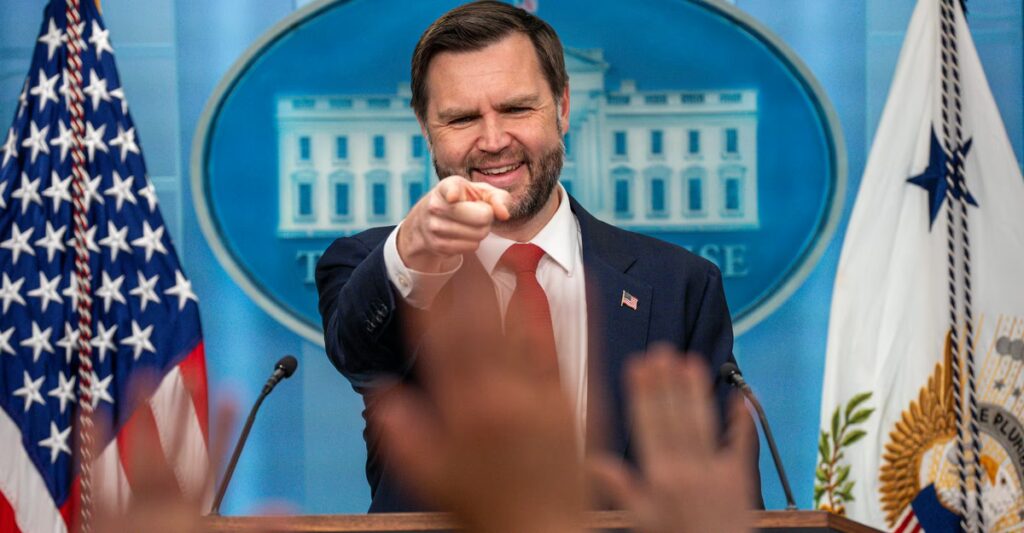
In June, Vance feigned ignorance about the fact that Democrats are more likely than Republicans to vote by mail, a tendency that produces the familiar pattern known as the “blue shift” in election tallies. In May, during a White House briefing, he argued that congressional Democrats’ applause for King Charles III during a joint meeting of Congress proved that “No Kings” rallies critical of Trump were hypocritical. “Maybe they don’t care so much about kings as they pretend that they do,” he said. (Yes, he said this with a very straight face. See for yourself.) “Maybe they just don’t like the agenda that we’re implementing that’s actually making American workers and American families safe and prosperous again.”
He’s been at this for some time. In 2025, on the comedian Theo Von’s podcast, Vance said, “I feel like something happened, like, 10 years ago, where every—it’s like you have to think that every single person who fought for the Confederate side was an evil person. I just think that’s so stupid.” That would be stupid, if anyone were arguing it. In reality, the big debate has been about questions such as whether military bases should be named for traitors and whether governments should host monuments to a rebellion to defend slavery. In 2024, Vance told what he quickly acknowledged were falsehoods about Haitian immigrants in Springfield, Ohio, to bring attention to administration talking points about immigration.
Separately, Vance has developed a conspiratorial mode of thinking—a plague on many otherwise smart people. Despite having access to some of the best information in the world, he reportedly became convinced that a broad plot was behind Charlie Kirk’s assassination, alarming his wife; Vance suggested on Rogan’s show that Jeffrey Epstein had shadowy government connections in Israel or the United States. (Perhaps Vance was thinking of Epstein’s ties to Donald Trump or Howard Lutnick?)
Why is a smart man spending so much time saying stupid things? The simplest explanation is that Vance believes his voters are stupid. Or as Vance himself told Rogan last week: “There’s a real populism that I’m very much a fan of because I think you should be responsive to people, but there’s, like, a faux populism of: The way that I’m going to appeal to people is by assuming that they’re idiots and acting like they’re idiots.”
This is admission by analysis. All politicians pander, but the best of them do it with some finesse. Vance, who struggles through the most basic photo ops, is not one of the best; his two successful elections are both testaments to Trump’s political muscle. In 2022, when he was a U.S. Senate candidate, I included Vance in a round-up of very intelligent Republicans who were clumsily pretending to be fools for electoral purposes. Vance seems to have doubled down on the strategy since then, but each new incident just offers more evidence of his dripping disdain for voters’ intelligence.
This may not be the wisest political strategy, H. L. Mencken notwithstanding. Vance’s approval ratings have been underwater for more than a year, and the Never Trump pollster Sarah Longwell recently conducted a focus group with Trump voters and found that Vance has left them cold. Either way, Vance’s performance plays as tragicomedy: comic because he’s so bad at it, but tragic because of who Vance was not that long ago. Much has been made of his critique of Trump in his 2016 Atlantic essay, and although his flip-flop on the president is astonishing, he has also reversed himself on a more fundamental view of politics.
In that essay, he criticized the demagogic tendency to condescend to people in so-called flyover country, where he grew up—to view them as yokels who could be easily manipulated with simplistic talking points and grievance plays. The harms that Trump identified, Vance wrote, “demand serious thought and measured action—from governments, yes, but also from community leaders and individuals.” Trump, he argued, was cynically co-opting those harms for his own gain and doing Americans a disservice. That Vance was right; this Vance doesn’t seem to care.
Related:
Here are four new stories from The Atlantic:
- Where did all the computer-science professors go?
- Iraq’s man in the middle
- Pete Hegseth’s reckless message to helicopter pilots
- The secretary of homeland
Today’s News
- The United States and Iran continued exchanging strikes for the tenth night in a row as fears grew that the conflict could further disrupt global oil supplies. Yemen’s Iran-backed Houthis threatened shipping in the Red Sea yesterday, sending oil prices above $90 a barrel, the highest price in more than a month.
- New Jersey Governor Mikie Sherrill said that from June 2023 to June 2024, a software error at the state’s motor-vehicle agency had improperly registered about 6,600 noncitizens to vote, and roughly 400 later cast ballots in unspecified elections. Sherill said that these voters had correctly identified themselves as a noncitizen when they registered at the agency, and that they will be removed from the voter rolls.
- President Trump imposed 50 percent tariffs on most Canadian goods yesterday, including products previously protected under the expired U.S.-Mexico-Canada trade agreement, arguing that Canada unfairly discriminates against American autos, alcohol, and dairy products.
Evening Read
Does Your Credit Card Even Plunk?
By Alexandra Tremayne-Pengelly
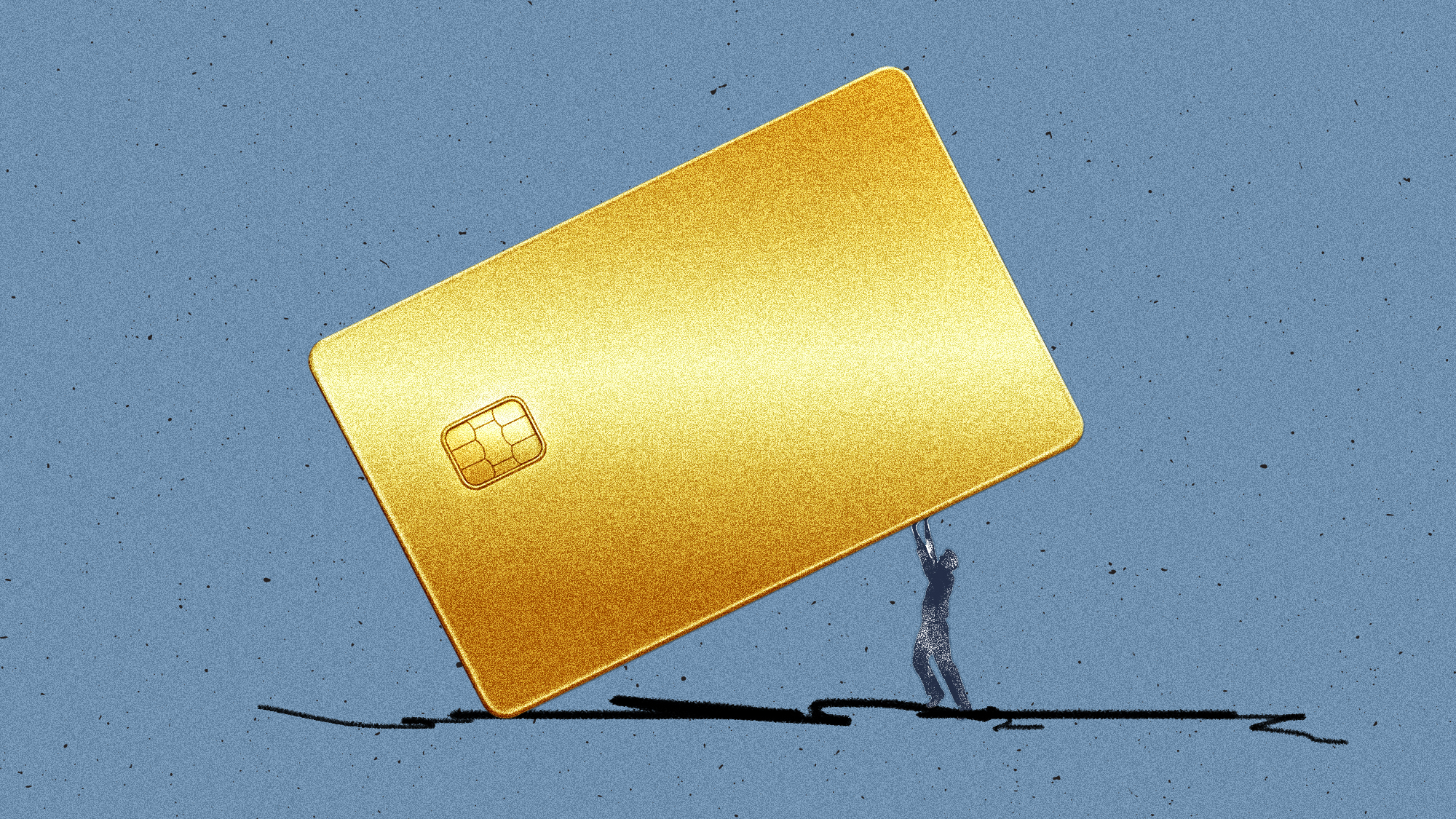
Physical credit cards should be a thing of the past. Over the past few years, touchless services such as Apple Pay have driven a boom in the digital-payment industry: Digital wallets now account for about half of global online purchases and one-third of point-of-sale payments. You would think that credit-card companies might abandon investing in cards that weigh down your wallet—but you’d be wrong.
More From The Atlantic
- The AI bubble is no ordinary bubble.
- The lines the Supreme Court won’t cross
- The DSA is a parasite, James Kirchick argues.
- Few know about this law, but everyone is paying for it.
- Fighter jets are passé.
Culture Break

Read. Amitav Ghosh believes that climate change requires rethinking the novel. His new work of fiction, Ghost-Eye, fails that standard, Robert Rubsam argues.
Explore. Dua Lipa’s latest literary cause is good PR—and a complicated topic, Sophia Nguyen writes.
Rafaela Jinich contributed to this newsletter.
When you buy a book using a link in this newsletter, we receive a commission. Thank you for supporting The Atlantic.
The post J. D. Vance Isn’t a Fool. Why Does He Act Like One? appeared first on The Atlantic.